in pictures and a few words
What it is and why
Pridinol (Myopridin, Lyseen) is a tablet that relaxes tense muscles. Adults use it for muscle pain and spasms.
- Low back pain, wry neck, muscle spasms
- The plan is set by a doctor
Where the pain comes from
A back or neck muscle tightens and will not let go. The spasm itself hurts and limits movement.
- The drug helps the muscle relax
- The earlier you start, the easier
How it works
According to the label, pridinol acts like atropine on skeletal and smooth muscle. Blood levels peak in an hour; within a day it mostly leaves in the urine.
- Eases tension in back, neck and leg muscles
- Strengthens other atropine-like drugs
3 in 4 responded
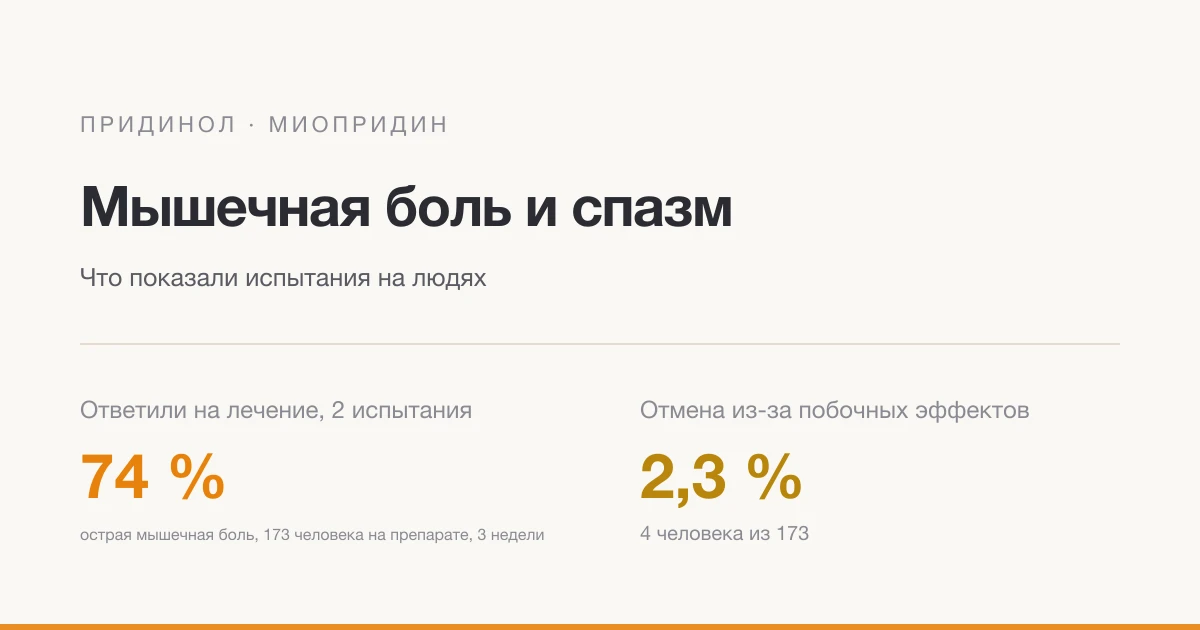
In 2 studies of 342 people with acute muscle pain, over 3 weeks doctors saw a treatment response in 74% on the drug versus 50% on a dummy pill.
- 173 people on the drug, 169 on a dummy pill
- For every 4 people treated, 1 extra response
Less stiffness
On the drug, pain at rest and on movement, stiffness, muscle tenderness and freedom of movement were all better.
- Tablets and injections worked the same
- Side effects like on a dummy pill
How to take it
Usually ½–1 tablet of 3 mg 3 times a day. For night-time leg cramps, 1–2 tablets at bedtime.
- Works faster before meals
- A doctor decides how long to take it
What can happen
Uncommon: dry mouth, dizziness, headache, fast pulse, low blood pressure, nausea, tiredness.
- Usually goes away with a lower dose
- Take care driving: vision may blur
Important. Important: with swelling, shortness of breath or a pounding heart — see a doctor at once.
Who should see a doctor first
Do not take pridinol without a doctor if you have:
- glaucoma; enlarged prostate, urinary retention
- heart rhythm problems; bowel obstruction
- pregnancy, breastfeeding; 65+, kidney or liver disease
Important. Important: pain after an injury, a weak or numb leg, fever — get checked first.
In one sentence
The tablet relaxes a tense muscle, so there is less pain and stiffness.
- ½–1 tablet of 3 mg 3 times a day
- Best started early
- Decision made with a doctor
The main points
One extra response for every 4 people treated. NNT 4.1 is how many people need the drug for one of them to respond in a way placebo did not achieve (PMID 35502575[1]).
| Substance | How much | What it does | What studies showed |
|---|---|---|---|
| Pridinol (Myopridin 3 mg, Lyseen) | 1.5–3 mg (½–1 tablet) 3 times a day; for night-time leg cramps 3–6 mg at bedtime | relieves painful tension in skeletal muscles: low back pain, torticollis, muscle spasms | 2 trials, 342 people, 3 weeks: treatment response in 74.0% of 173 people on the drug versus 49.7% of 169 on placebo, NNT 4.1 |
How it works
In a muscle spasm, the muscle contracts and does not let go. The spasm itself hurts, presses on the tissues around it and limits movement, and the pain in turn keeps the spasm going.
Pridinol is a centrally acting muscle relaxant. According to the SmPC, it acts through an atropine-like mechanism on both smooth and skeletal (striated) muscle. This property is used to relieve skeletal muscle tension of central and peripheral origin (Myopridin Fachinformation, section 5.1).
The earlier treatment starts, the more easily pridinol relieves the tension. In long-standing spasms, where the muscle fibres, ligaments and joint capsules have already changed, the effect may be partial (section 5.1).
After an oral dose, the peak blood level is reached in about 1 hour. Within 24 hours the drug is mostly excreted by the kidneys, partly unchanged (section 5.2).
What the studies showed
| Study | Who took part | Comparison | Result |
|---|---|---|---|
| Meta-analysis, Überall 2022, 2 double-blind placebo-controlled trials, 3 weeks (PMID 35502575[1]) | 342 adults with mild to moderate acute muscle pain (173 and 169), mean age 50.6 years, 55.3% women | pridinol as tablets or injections, without other painkillers, versus placebo | physician-rated treatment response 74.0% versus 49.7%, NNT 4.1; more responders also for pain at rest and on movement, stiffness, tenderness and restricted movement; adverse events comparable to placebo |
The meta-analysis of two trials
The authors searched for every placebo-controlled trial of pridinol in adults with muscle pain. Of 38 records found, 2 randomised trials were included. In them, 342 people with mild to moderate acute muscle pain received either pridinol alone (173 people) or placebo alone (169) for 3 weeks, as tablets or as injections (Überall MA Curr Med Res Opin 2022. PMID 35502575[1]).
- The main goal was the overall treatment response as judged by the physician. It was seen in 74.0% on pridinol versus 49.7% on placebo, NNT 4.1.
- The result did not depend on whether the drug was given as tablets or injections.
- More people responded on every secondary goal as well: pain at rest, pain on movement, stiffness, muscle tenderness, restricted movement.
- Drug-related adverse events were reported in one of the two trials: in 13 people on pridinol and 10 on placebo. Treatment was stopped because of them by 4 people (2.3%) versus 1 (0.6%), a non-significant difference.
Indications
According to the Myopridin SmPC (section 4.1), the drug is used in adults for:
- muscle spasms of central and peripheral origin;
- low back pain (lumbago);
- torticollis (wry neck);
- general muscle pain.
How it is used
- Dose: 1.5–3 mg of pridinol (½–1 Myopridin 3 mg tablet) 3 times a day. The tablet can be split in half.
- Night-time leg cramps: 3–6 mg (1–2 tablets) at bedtime.
- How to take it: whole, without chewing, with plenty of liquid such as a glass of water. It can be taken with or without food, but it starts working faster before meals. If you are prone to low blood pressure, take it after meals and be especially careful on the first day.
- How long: a doctor decides the length of the course (Myopridin Fachinformation, section 4.2).
Safety
- Uncommon: restlessness, dizziness, headache, speech disturbance, fast heartbeat, low blood pressure, nausea, abdominal pain, dry mouth, tiredness, weakness. These usually go away after the dose is lowered or the drug is stopped (Myopridin Fachinformation, section 4.8).
- Rare: allergy (itching, skin redness, swelling, shortness of breath), blurred vision, problems with attention, coordination or taste.
- Pridinol strengthens the effect of other atropine-like (anticholinergic) drugs, such as atropine (section 4.5).
- Because it may affect vision, take care when driving or operating machinery (section 4.7).
Important
See a doctor first, rather than reaching for a muscle relaxant, if the pain started after an injury, a leg becomes weak or numb, urination or bowel habits change, or you have a fever: these need to be checked.
According to the Myopridin SmPC (section 4.3), pridinol is not used in:
- allergy to the drug;
- glaucoma;
- enlarged prostate and urinary retention;
- obstruction of the digestive tract;
- heart rhythm disorders;
- the first trimester of pregnancy.
Discuss it with a doctor in these cases too:
- pregnancy after the first trimester — only when strictly necessary and under medical supervision; avoid it while breastfeeding (section 4.6);
- age 65 or over, severe kidney or liver disease: blood levels may be higher and last longer (section 4.4);
- a tendency to low blood pressure;
- hereditary galactose intolerance, lactase deficiency or glucose-galactose malabsorption: the tablet contains lactose;
- children and teenagers: no data.
Summary
Pridinol relieves painful tension in skeletal muscles. In 2 placebo-controlled trials of 342 people with acute muscle pain, 74.0% of the 173 people on the drug versus 49.7% of the 169 on placebo responded over 3 weeks, with tolerability like placebo. 1.5–3 mg 3 times a day, best started early, and a decision made with a doctor, especially with glaucoma, an enlarged prostate or heart disease.
References
- Überall MA Curr Med Res Opin 2022. PMID 35502575
Key facts
- Pridinol is a centrally acting muscle relaxant. One Myopridin 3 mg tablet contains 3.02 mg of pridinol (as 4 mg pridinol mesilate).
- According to the SmPC, it acts through an atropine-like mechanism on both smooth and skeletal muscle and relieves muscle tension of central and peripheral origin (Myopridin Fachinformation, section 5.1).
- In a meta-analysis of 2 placebo-controlled trials (342 people with acute muscle pain, 3 weeks), physicians rated a treatment response in 74.0% of the 173 people on the drug versus 49.7% of the 169 on placebo, NNT 4.1 (Überall MA Curr Med Res Opin 2022. PMID 35502575).
- In these trials, adverse events on pridinol were comparable to placebo (PMID 35502575).
- The usual dose is 1.5–3 mg (½–1 tablet) 3 times a day; for night-time leg cramps, 3–6 mg (1–2 tablets) at bedtime.