In plain words: what helps a plaque shrink
A plaque in a vessel
A bump on the artery wall, with a soft part and a hard part.
- a vessel is a flexible tube, not a stone
- early plaques are small and can change
Good news
Early plaques can disappear.
- in some people they got smaller or vanished over the years
- this is an association from observation, not a promise for everyone
Step 1. Do not smoke
In non-smokers a plaque disappeared more often.
- the best step is never starting or quitting
- the benefit needs no special preparation, only a decision
Step 2. Training
Short intense intervals under supervision.
- twice a week
- in people after a stent the share of plaque in the heart vessels was smaller after half a year
- start after your doctor agrees
Important. Important: with heart disease, intense training only after your doctor allows it.
Step 3. The plate
Vegetables, fruit and whole grains together with a dietitian.
- the soft part of the plaque shrank more
- vegetables fill half the plate
- fruit and whole grains
Step 4. Nuts
A handful of nuts a day with a Mediterranean diet.
- the wall of the carotid artery became thinner
- nuts as a snack instead of cookies
- vegetables, legumes and fish alongside
Putting it together
The four steps fit into an ordinary day.
- a walk and a workout on a schedule
- vegetables at every meal
- a handful of nuts in the afternoon
- no cigarettes
When to see a doctor
Doctor first if:
- you already have heart disease or a stent
- high cholesterol or blood pressure on treatment
- chest pain or breathlessness on exertion
Important. Important: prescribed treatment continues, and these steps add to it.
Key points
A plaque in a vessel sounds like a verdict, but human studies speak more gently: early plaques can get smaller and even disappear. Over 6 years this happened in 8 of 100 people who already had plaques. Four steps are linked to a better picture of the vessels: not smoking, supervised high-intensity interval training, a diet with vegetables, fruit and whole grains, and a handful of nuts with a Mediterranean diet. All of them are within reach of an ordinary person, and you can begin with one.
| What | How much | Why it helps | What studies showed |
|---|---|---|---|
| Early plaques (observation) | 6 years | Can disappear | 123 of 1,529 people with plaques: 8 in 100 |
| Not smoking (observation) | Every day | Plaque disappears more often | About twice the chance of disappearance in non-smokers (1,529 people) |
| Supervised high-intensity interval training | 2 times a week, 6 months | Smaller plaque share in the heart vessels | 60 people after a stent: −1.2 versus +0.2 percentage points |
| Diet with vegetables, fruit and whole grains with a dietitian | About 67 weeks | Smaller soft part of the plaque | 92 people: −51 mm³ versus −21 mm³; total volume no different |
| Mediterranean diet and nuts | 30 g a day, 2.4 years | Thinner carotid artery wall | 164 people in 3 groups: −0.08 mm versus +0.05 mm |
Early plaques can disappear
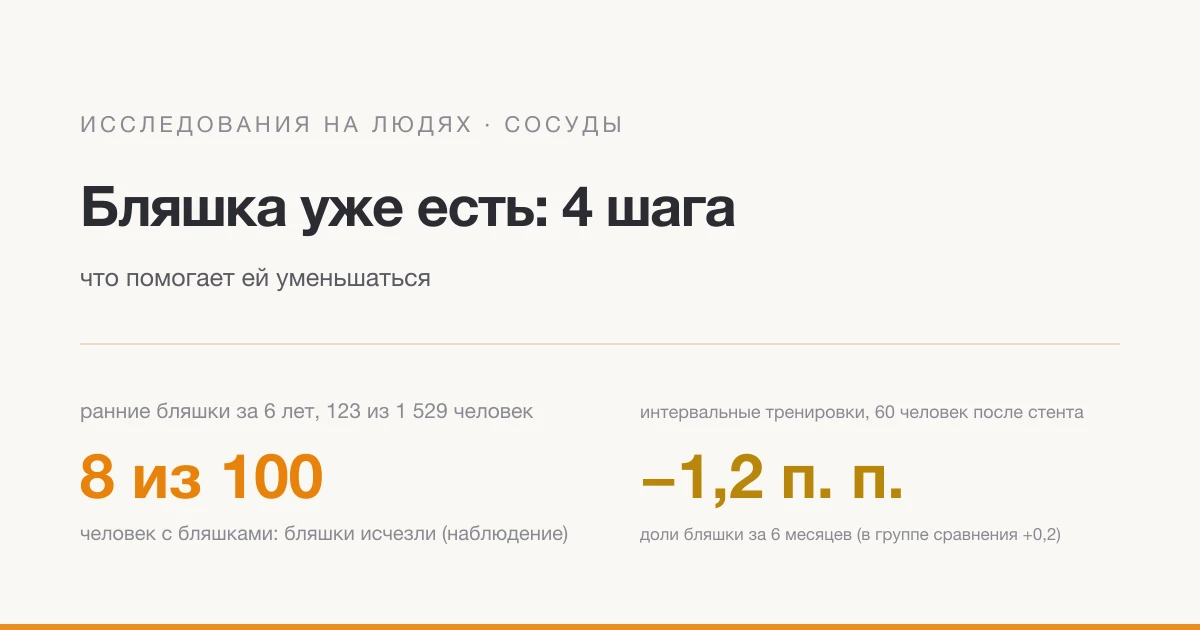
The most encouraging news: a plaque is not necessarily forever. In a large observation, participants had 3D ultrasound of the carotid and femoral arteries and small plaques were followed. Over 6 years plaques disappeared in 123 of the 1,529 people who had them, that is 8 in 100 (Mendieta G J Am Coll Cardiol 2023. PMID 37993199[1]).
What this means in practice. Vessels are not a petrified pipe, they are alive and they change. An early plaque is still a small change of the wall, and in some people it went away over time. That is a reason not to put off caring for the vessels and to begin with the steps linked to a better picture. Remember: this is an observation, it shows an association and does not guarantee a result for everyone.
Step 1. Do not smoke
The same observation compared who lost plaques more often. In non-smokers the chance that a plaque disappeared was about twice as high: in smokers the odds ratio of disappearance was 0.43 (95% CI 0.26–0.72) (Mendieta G J Am Coll Cardiol 2023. PMID 37993199[1]). Smoking was assessed at the start of follow-up, so this is an association: in non-smokers plaques disappeared more often.
The good news is that this step is the simplest to start: no gym and no special foods, only a decision. If you do not smoke, that is already a contribution to your vessels. If you do, help from a doctor and a habit of replacing the cigarette with a walk or a glass of water at the usual moments make quitting more realistic. It helps to know your difficult moments in advance: the morning coffee, a work break, the evening after dinner. It is better to plan a replacement for them before they come.
Step 2. Supervised high-intensity interval training
This was a randomized trial: 60 people after a stent were split into two groups. One group did supervised high-intensity interval training twice a week for 6 months, the other, the comparison group, followed usual prevention guidelines. Both groups received usual treatment. Intravascular ultrasound showed that the plaque share of vessel volume in the heart vessels in the trained group fell by 1.2 percentage points, and in the comparison group rose by 0.2. The difference was −1.4 (95% CI −2.7 to −0.1; p = 0.036) (Vesterbekkmo EK Eur J Prev Cardiol 2023. PMID 36562212[2]).
An interval workout is simple: short stretches of intense effort alternate with rest. For example, a brisk climb on an exercise bike or fast uphill walking for a few minutes, then an easy pace. The key words here are "under supervision": with heart disease such training starts after a doctor allows it, together with a trainer who watches how you feel. Twice a week is realistic to fit into a schedule.
Step 3. A diet with vegetables, fruit and whole grains
In the trial, 92 people for about 67 weeks followed the DASH diet together with a dietitian: plenty of vegetables, fruit and whole grains. On images of the heart vessels, the non-calcified, that is soft, part of the plaque shrank by 51 mm³ versus 21 mm³ in those without such help (p = 0.045). Total plaque volume did not differ. Both groups continued their prescribed treatment (Henzel J JACC Cardiovasc Imaging 2021. PMID 33341413[3]).
What it looks like in an ordinary day. Breakfast: whole-grain porridge with berries or an apple. Lunch: vegetable soup or stew, a salad, a slice of whole-grain bread. Dinner: baked vegetables with fish or chicken. Herbs, lemon, garlic and spices give the dishes their flavour. A dietitian helps build such a menu for you; in the trial the diet was followed together with a dietitian.
Step 4. A Mediterranean diet and a handful of nuts
The trial included 164 people in 3 groups, with 2.4 years of follow-up. In the Mediterranean diet group with 30 g of nuts a day the wall of the internal carotid artery became 0.08 mm thinner, while in the comparison group it became 0.05 mm thicker (p = 0.024) (Sala-Vila A Arterioscler Thromb Vasc Biol 2014. PMID 24285581[4]).
Nuts are convenient because they need no cooking: a handful of almonds, walnuts or hazelnuts in the afternoon instead of a cookie or a bun. Vegetables, legumes, fish and herbs go well with them, which is the familiar Mediterranean table. Keep the portion at about a handful: that is the 30 g. It is handy to portion nuts into small jars for the week ahead so the serving does not quietly grow. Choose nuts without salt, sugar or glaze.
How to apply
- Start with the one step that is easiest: for many it is a handful of nuts in the afternoon or vegetables with every lunch.
- Do not smoke: if you do, discuss help with a doctor and set a date.
- Supervised high-intensity interval training twice a week; with heart disease only after a doctor allows it.
- Vegetables on half the plate, fruit and whole grains; a dietitian can help build the menu.
- A handful of nuts (30 g) a day with a Mediterranean diet.
Who should see a doctor first
Discuss the steps with your doctor first if you already have heart disease, a stent, high cholesterol or blood pressure. Training with heart disease starts only after a doctor allows it. In the training and dietitian trials participants continued their prescribed treatment and the steps added to it: treatment decisions are made with a doctor. Chest pain, breathlessness on exertion or sudden weakness are reasons to see a doctor straight away.
Summary
A plaque in a vessel is not always forever. Early plaques can disappear, and four steps (not smoking, supervised interval training, vegetables with whole grains and a dietitian, a handful of nuts) are linked in human studies to a smaller plaque or a thinner artery wall. Pick one step this week, add a second in a month and discuss the plan with your doctor.
References
- Mendieta G J Am Coll Cardiol 2023. PMID 37993199
- Vesterbekkmo EK Eur J Prev Cardiol 2023. PMID 36562212
- Henzel J JACC Cardiovasc Imaging 2021. PMID 33341413
- Sala-Vila A Arterioscler Thromb Vasc Biol 2014. PMID 24285581
Key facts
- Early plaques can disappear: over 6 years they vanished in 8 of 100 people who had them (123 of 1,529; observational, small plaques only, 3D ultrasound of the carotid and femoral arteries) (Mendieta G J Am Coll Cardiol 2023. PMID 37993199).
- In non-smokers the chance that a plaque disappeared was about twice as high (odds ratio of disappearance in smokers 0.43; 95% CI 0.26–0.72; 1,529 people; observational) (Mendieta G J Am Coll Cardiol 2023. PMID 37993199).
- Supervised high-intensity interval training twice a week in 60 people after a stent: plaque share of vessel volume in the heart vessels fell by 1.2 percentage points in 6 months, versus a rise of 0.2 in the comparison group; difference −1.4 (95% CI −2.7 to −0.1; p = 0.036); both groups continued usual treatment (Vesterbekkmo EK Eur J Prev Cardiol 2023. PMID 36562212).
- A diet with vegetables, fruit and whole grains together with a dietitian (92 people, about 67 weeks): the non-calcified, soft part of the plaque shrank by 51 mm³ versus 21 mm³ without such help (p = 0.045); total plaque volume did not differ (Henzel J JACC Cardiovasc Imaging 2021. PMID 33341413).
- A Mediterranean diet with 30 g of nuts a day (164 people in 3 groups, 2.4 years): the wall of the internal carotid artery became 0.08 mm thinner, versus 0.05 mm thicker in the comparison group (p = 0.024) (Sala-Vila A Arterioscler Thromb Vasc Biol 2014. PMID 24285581).