in pictures and a few words
What it is and why
Otilonium bromide (Spasmomen 40 mg) is a tablet for colon spasms. Adults use it for irritable bowel syndrome.
- Eases spasm, pain and bloating
- The plan is set by a doctor
Where the pain comes from
In irritable bowel syndrome the colon muscle squeezes too hard. That causes spasms, pain and bloating.
- The drug relaxes this muscle
- And makes pain from the gut quieter
Works in the gut
Only about 3% of the dose reaches the blood. The drug stays in the muscle of the colon and rectum and leaves with the stool.
- Does not affect stomach juices
- No typical atropine effects
Fewer pain attacks
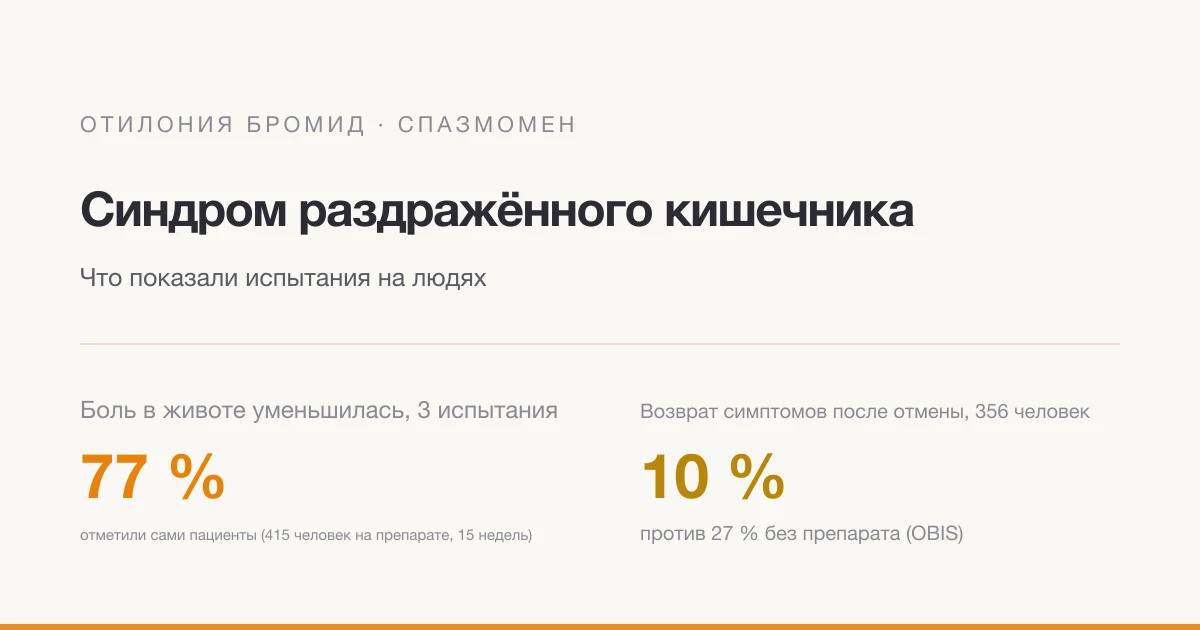
In a study of 356 people over 15 weeks, there were fewer pain attacks and less bloating than on a dummy pill.
- After stopping, symptoms came back less often
- Dropped out due to relapse: 10% vs 27%
3 in 4 felt better
In three studies, 77% of people on the drug versus 66% on a dummy pill improved on the overall pain score.
- 415 people on the drug, 424 on a dummy pill
- The effect builds up by weeks 10–15
How to take it
Usually 1 tablet of 40 mg 2–3 times a day. The studies used 40 mg 3 times a day.
- No more than 3 tablets a day
- A doctor decides how long to take it
What can happen
Side effects are uncommon: dry mouth, nausea, headache, dizziness, itching.
- Hardly affects driving
- The tablet contains lactose
Important. Important: with a rash, hives or facial swelling — see a doctor at once.
Who should see a doctor first
Do not start with an antispasmodic; get checked first if you have:
- first symptoms after 50; blood in the stool
- unexplained weight loss; pain at night; anaemia
- glaucoma, enlarged prostate; pregnancy
Important. Important: these signs need tests, not a spasm tablet.
In one sentence
The tablet relieves colon spasm while barely reaching the blood, so there is less pain and bloating.
- 40 mg 2–3 times a day before meals
- Rule out red flags first
- Decision made with a doctor
Key points
| Substance | How much | What it does | What studies showed |
|---|---|---|---|
| Otilonium bromide (Spasmomen 40 mg) | 1 tablet of 40 mg 2–3 times a day, preferably before meals | relieves spasm of the colon and rectum; about 3% is absorbed into the blood | 3 trials, 415 versus 424 people: 77.2% versus 65.8% on placebo improved on the global pain assessment at week 15 |
| Otilonium bromide in the OBIS trial | 40 mg 3 times a day for 15 weeks, then 10 weeks of follow-up | fewer pain episodes, less bloating | 179 versus 177 people: pain frequency −0.90 versus −0.65; after stopping, 10% versus 27% dropped out due to relapse |
How it works
In irritable bowel syndrome the colon muscle contracts too strongly, which causes spasms, pain and bloating.
Otilonium bromide acts on the smooth muscle of the colon and rectum. According to the SmPC, it reduces calcium entry into muscle cells, most likely through L-type and T-type calcium channels in the muscle cells and the sensory nerves of the gut. Contractions become weaker and pain from the gut quieter. It also interacts with the tachykinin receptors NK1 and NK2 (Spasmomen SmPC, section 5.1).
It works at doses that do not affect gastric secretion and do not cause typical atropine-like effects (Spasmomen SmPC, section 5.1).
About 3% of the dose reaches the blood. The drug probably reaches the muscle directly through the gut wall and builds up in the muscle of the colon and rectum, then leaves with the stool mostly unchanged. Taking it shortly before a meal, the SmPC says, helps it work where and when symptoms are expected to be strongest (Spasmomen SmPC, section 5.2).
What the studies showed
| Study | Who took part | Comparison | Result |
|---|---|---|---|
| OBIS, Clavé 2011, double-blind, 15 weeks + 10 weeks of follow-up (PMID 21679214[1]) | 356 people with irritable bowel syndrome (179 and 177), mean age 46, 71% women | otilonium bromide 40 mg 3 times a day versus placebo | pain episode frequency −0.90 versus −0.65; bloating −1.2 versus −0.9; after stopping, 10% versus 27% dropped out due to relapse |
| Pooled analysis of 3 trials, Clavé and Tack 2017, 15 weeks (PMID 28246548[2]) | 883 people (442 and 441), of whom 415 and 424 in the efficacy analysis | otilonium bromide 40 mg 3 times a day versus placebo | 77.2% versus 65.8% improved on the global pain assessment at week 15; 71.8% versus 62.4% at week 10 |
The OBIS trial
356 adults with irritable bowel syndrome took otilonium bromide 40 mg 3 times a day (179 people) or placebo (177) for 15 weeks. They were then followed for another 10 weeks without treatment (Clavé P Aliment Pharmacol Ther 2011. PMID 21679214[1]).
- The weekly frequency of pain episodes fell more: −0.90 versus −0.65. This was the main goal of the trial.
- Bloating eased more: −1.2 versus −0.9.
- Patients rated the overall benefit of treatment higher: 1.3 versus 1.0.
- After treatment stopped, 10% of those on the drug versus 27% on placebo dropped out because symptoms came back, and the time without relapse was longer.
Safety and quality of life were comparable in the two groups.
The pooled analysis of three trials
The authors pooled 3 trials with the same design, OBIS among them. Everyone first took placebo for 2 weeks, then otilonium bromide 40 mg 3 times a day or placebo for 15 weeks. In total 883 people, 70% women, mean age 46 (Clavé P, Tack J Ther Adv Gastroenterol 2017. PMID 28246548[2]).
- On the global pain assessment (strength and frequency together), 77.2% of 415 people on the drug versus 65.8% of 424 on placebo improved at week 15. Put simply, about 3 in 4 versus 2 in 3.
- The difference from placebo became significant by week 10 and was largest by week 15.
- Bloating also eased more on the drug.
- Stool frequency and consistency did not change significantly: the drug works on spasm and pain, not on the stool.
The course was completed equally often: 16.1% dropped out in both groups.
Indications
According to the Spasmomen SmPC (section 4.1), the drug is used in adults aged 18 and over for:
- irritable bowel syndrome;
- painful spasms of the lower intestine, above all the colon.
How it is used
- Dose: 1 tablet of 40 mg 2–3 times a day, depending on how strong the symptoms are. The maximum recommended dose is 40 mg 3 times a day.
- How to take it: swallow the tablet whole with a glass of water, preferably before meals.
- How long: the length of the course is set by a doctor. The Belgian SmPC gives a usual course of 4 weeks, after which the doctor decides whether to continue. In the trials the drug was given for 15 weeks.
- Antispasmodics are not taken continuously without a doctor's advice (Spasmomen SmPC, sections 4.2 and 4.4).
Safety
- Uncommon: dry mouth, nausea, vomiting, upper abdominal pain, headache, dizziness, itching, skin redness, tiredness. Rarely allergy: hives, angioedema (Spasmomen SmPC, section 4.8).
- The drug has no or negligible effect on driving (section 4.7).
Important
See a doctor first, not reach for an antispasmodic, if there are red flags — they call for tests:
- symptoms first appeared after age 50;
- blood in the stool;
- unexplained weight loss;
- pain that wakes you at night;
- anaemia.
Discuss the drug with a doctor in these cases too:
- bowel obstruction (a contraindication in the Belgian SmPC) or allergy to the drug;
- glaucoma, an enlarged prostate, narrowing of the stomach outlet (pyloric stenosis);
- you take many medicines;
- hereditary lactose or galactose intolerance: the tablet contains lactose;
- pregnancy or breastfeeding: there are no clinical data, the drug is used only when absolutely necessary;
- age under 18: the drug is not recommended.
Summary
Otilonium bromide relieves colon spasm and barely reaches the blood. In irritable bowel syndrome, across 3 trials 77.2% of 415 people on the drug versus 65.8% of 424 on placebo improved on the global pain assessment, and in OBIS there were fewer pain episodes, less bloating and fewer relapses after stopping. 40 mg 2–3 times a day before meals, and the decision made with a doctor, especially with red flags.
References
- Clavé P Aliment Pharmacol Ther 2011. PMID 21679214
- Tack J Ther Adv Gastroenterol 2017. PMID 28246548
Key facts
- Otilonium bromide is an antispasmodic for the colon and rectum. One Spasmomen tablet contains 40 mg.
- About 3% of the dose is absorbed into the blood: the drug works in the gut wall and leaves with the stool mostly unchanged (Spasmomen SmPC, section 5.2).
- In a pooled analysis of 3 trials (415 people on the drug, 424 on placebo), 77.2% versus 65.8% improved on the patients' global pain assessment at week 15 (Clavé P, Tack J Ther Adv Gastroenterol 2017. PMID 28246548).
- In the OBIS trial of 356 people, after treatment stopped, 10% of those on the drug versus 27% on placebo dropped out because symptoms came back (Clavé P Aliment Pharmacol Ther 2011. PMID 21679214).
- The usual dose is 1 tablet of 40 mg 2–3 times a day, preferably before meals; the trials used 40 mg 3 times a day.