A simple experiment for blood pressure: what to do and what to expect
A trial week
Try a week with less salt.
- take the salt shaker off the table
- do not add salt
- watch your home monitor
Where salt comes from
Most salt does not come from the shaker.
- bread, cheese, sausages
- sauces and ready meals
- read the labels
What to use instead
You can make flavour brighter without salt.
- herbs and lemon
- garlic and spices
- fresh vegetables
Vegetables and fruit
With vegetables and fruit the effect is stronger.
- add them to every meal
- less salt plus vegetables
- pressure falls even more
Blood pressure
In most people pressure goes down.
- within a week
- at ages 50 to 75 and at different pressures
- measure morning and evening
Taste adapts
The first days are the hardest.
- after a few months
- less salty food tastes better
- taste adjusts
Step by step
The strict week was an experiment. In life, go step by step.
- a little less each week
- cook at home
- no rush
When to see a doctor
Talk to your doctor before cutting salt sharply.
- you are treated for blood pressure
- heart or kidney failure
- dizziness, weakness or cramps
- you sweat a lot
Important. Important: prescribed treatment is not changed on your own.
The main point
A week of low-salt food is a quick, clear way to see how salt affects your blood pressure. In large controlled trials less salt lowered pressure in most people, and together with vegetables and fruit the effect was even stronger. The good news is that after a few months, less salty food starts to taste better.
| what | how much | why it helps | what studies showed |
|---|---|---|---|
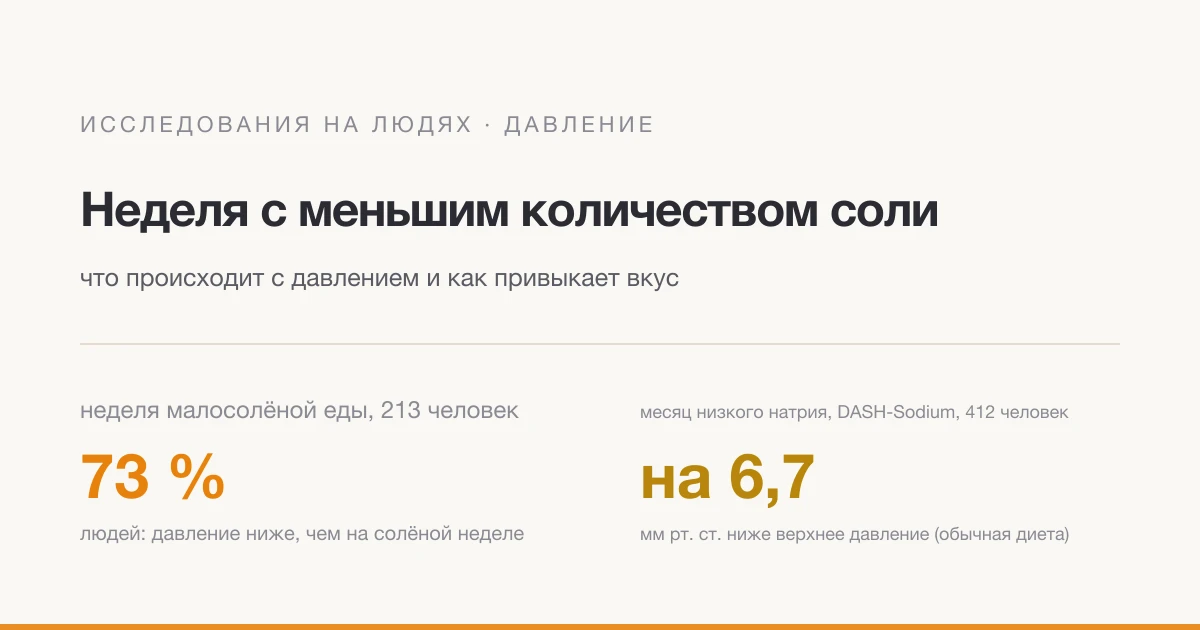
| A week of low-salt food | about 500 mg sodium a day, 1 week | Lower blood pressure | 213 people aged 50-75: pressure lower than on the salty week in 73%; versus usual food systolic 6 mm Hg lower |
| A month of low-salt food | a month of low sodium versus a month of high | Lower systolic pressure | DASH-Sodium, 412 participants: 6.7 mm Hg lower in the usual-diet group |
| Low salt plus vegetables and fruit | DASH diet with low sodium | Pressure lower still | people with hypertension: systolic 11.5 mm Hg lower than usual salty food |
| Taste adapting | several months | Less salty food tastes better | young adults on a low-salt diet for 5 months: preferred saltiness fell |
A week of low-salt food: the Gupta study
The Gupta trial included 213 people aged 50-75: with normal pressure and with controlled, uncontrolled and untreated hypertension. First they ate their usual food, then a week each of salty food (about 2200 mg sodium added to usual food) and low-salt food (about 500 mg sodium a day from all food). Pressure was measured by 24-hour monitor (Gupta D K JAMA 2023. PMID 37950918[1]).
Median systolic pressure was 125 mm Hg on usual food, 126 on salty and 119 on low-salt. In 73.4% of participants mean pressure was lower in the low-salt week than in the salty week. At the end of the first week the systolic difference between people allocated to salty and low-salt food was 8 mm Hg (95% CI 4-11). The effect was similar across subgroups, including people treated for blood pressure, and adverse events were mild and no more frequent in the low-salt week.
A month of low-salt food: DASH-Sodium
In the DASH-Sodium trial 412 participants received a typical American diet or the DASH diet (vegetables, fruit, low-fat dairy). Within their diet they ate food with high, intermediate and low sodium for 30 days each. In the usual-diet group, going from high to intermediate sodium lowered systolic pressure by 2.1 mm Hg, and from intermediate to low by a further 4.6 mm Hg, 6.7 mm Hg in all. The effect was seen in people with and without hypertension, and in women and men (Sacks F M N Engl J Med 2001. PMID 11136953[2]).
Salt and vegetables: stronger together
The DASH diet by itself gave lower pressure at each salt level. DASH with low sodium, compared with usual salty food, lowered systolic pressure by 7.1 mm Hg in people without hypertension and by 11.5 mm Hg in people with hypertension (Sacks F M N Engl J Med 2001. PMID 11136953[2]). That is why a week without adding salt works well alongside more vegetables and fruit on the plate.
Taste adapts
Over several months on a low-salt diet, people began to find less salty food more pleasant: their preferred saltiness of soup and crackers fell, while in the control group it did not change (Bertino M Am J Clin Nutr 1982. PMID 7148734[3]). That is good news: the first days are the hardest.
How to use it
Start with a week. Take the salt shaker off the table and do not add salt. Read labels on bread, cheese, sausages, sauces and ready meals: most salt comes from there. Cook at home and add flavour with herbs, lemon, garlic and spices. Add vegetables and fruit to every meal. Measure pressure at home in the morning and evening before and after the week.
The strict scheme of about 500 mg sodium a day was a scientific experiment for one week; in everyday life it is sensible to move step by step.
Who should see a doctor first
See a doctor if you are treated for blood pressure, have heart or kidney failure, are pregnant, sweat a lot (training, heat), or if low-salt food brings dizziness, weakness or cramps. Do not stop or change prescribed treatment on your own. If home pressure is repeatedly 140/90 mm Hg or higher, that is also a reason to talk to a doctor.
A real-life example
Many people think food without salt is bland. But you can begin differently. On Monday, do not add salt to the soup. On Tuesday swap the sausage sandwich for an egg and vegetables. On Wednesday dress the salad with lemon and herbs. Write down your pressure: by Friday you have your own pressure numbers, and your taste will adjust within a few months.
Summary
A week without adding salt and without ready-made salty foods is a simple experiment on your blood pressure. Add vegetables and fruit, and in a couple of months your taste will adjust.
References
- Gupta D K JAMA 2023. PMID 37950918
- Sacks F M N Engl J Med 2001. PMID 11136953
- Bertino M Am J Clin Nutr 1982. PMID 7148734
Key facts
- A week of very low-salt food (about 500 mg sodium a day) versus a week of added salt: in 213 people aged 50-75 mean arterial pressure was lower in 73.4%, and the systolic difference between groups was 8 mm Hg (Gupta D K JAMA 2023. PMID 37950918).
- In the same study median systolic pressure was 125 mm Hg on usual food and 119 on low-salt food, about 6 mm Hg lower (Gupta D K JAMA 2023. PMID 37950918).
- A month of low sodium versus a month of high: in the usual-diet group of the DASH-Sodium trial (412 participants) systolic pressure was 6.7 mm Hg lower (Sacks F M N Engl J Med 2001. PMID 11136953).
- Low-salt food with DASH (vegetables, fruit, low-fat dairy): in people with hypertension systolic pressure was 11.5 mm Hg lower than on usual salty food (Sacks F M N Engl J Med 2001. PMID 11136953).
- Taste adapts: after several months on low-salt food people prefer less salty food (Bertino M Am J Clin Nutr 1982. PMID 7148734). See a doctor if you have heart or kidney failure, are treated for blood pressure, or feel dizzy.