Key points
What EPA and DHA are
Omega-3s are a family of polyunsaturated fatty acids. Oily sea fish and fish oil contain eicosapentaenoic acid (EPA) and docosahexaenoic acid (DHA). Alpha-linolenic acid (ALA) comes from plants, for example from flaxseed oil and walnuts. The body cannot make ALA and uses it as raw material for EPA and DHA (Burgerstein, Handbuch Nährstoffe 2015, pp. 155–156).
The conversion works poorly: according to the handbook, the enzyme it needs is slowed by a shortage of vitamin B6, zinc or magnesium, by insulin resistance, alcohol and age (Burgerstein, Handbuch Nährstoffe 2015, p. 156). If you eat more ALA for a long time, the share of EPA in the blood rises, but not that of DHA; in women the conversion is more active (Burdge GC Reprod Nutr Dev 2005. PMID 16188209[4]). That is why flaxseed oil does not replace fish as a source of DHA.
What the handbook says
According to Burgerstein’s handbook, EPA and DHA give rise to signaling substances that reduce platelet clumping, blood fats, blood pressure and inflammation (Burgerstein, Handbuch Nährstoffe 2015, pp. 156, 161). The norm is 2–3% of daily calories as ALA and its derivatives (Burgerstein, Handbuch Nährstoffe 2015, p. 162), with an omega-6 to omega-3 ratio of about 5:1 (Burgerstein, Handbuch Nährstoffe 2015, p. 156).
For capsules, the handbook gives the author’s doses — 1–5 g of fish oil a day (Burgerstein, Handbuch Nährstoffe 2015, p. 163). This is not a recommendation: current guidelines are more cautious and prescribe high doses only to lower triglycerides. The point about blood pressure also disagrees with newer data: in a Cochrane review of 86 studies, omega-3 had almost no effect on blood pressure and on blood fats other than triglycerides — those it lowered by about 15% (Abdelhamid AS Cochrane Database Syst Rev 2020. PMID 32114706[6]).
Triglycerides: where the benefit is best proven
The American Heart Association (AHA) considers triglycerides raised from 2.26 mmol/L (200 mg/dL); back in 2002 it recommended 2–4 g of EPA and DHA a day to lower them. In a 2019 review, the AHA calls prescription medicines at 4 g a day an effective and safe way to lower triglycerides — alone or together with other drugs that lower blood fats. With very high triglycerides, a mixture of EPA and DHA can raise LDL (low-density lipoprotein, “bad” cholesterol), while pure EPA does not (Skulas-Ray AC Circulation 2019. PMID 31422671[1]). What else lowers blood fats is covered in the article Cholesterol: when statins are not needed and what works instead.
The heart: why the results differed
The medicines and comparators were different, so the result of prescription EPA cannot be carried over to ordinary fish oil. In the Cochrane review, omega-3 had almost no effect on overall mortality (45 studies, 143,693 people), but may have slightly reduced deaths and events from coronary heart disease; the certainty of these data is low (Abdelhamid AS Cochrane Database Syst Rev 2020. PMID 32114706[6]).
Pregnancy and DHA
In a Cochrane review, preterm birth was less common with omega-3: before 37 weeks — 11.9% versus 13.4% (26 studies, 10,304 women); before 34 weeks — 2.7% versus 4.6% (9 studies, 5,204 women). No noticeable difference was found in children’s development and intelligence; the data are mostly of low and very low quality (Middleton P Cochrane Database Syst Rev 2018. PMID 30480773[3]).
How to read the label
“Fish oil 1000 mg” is the weight of all the oil in the capsule, and EPA and DHA are only part of it. Add up the EPA and DHA lines in milligrams and multiply by the number of capsules per serving: this total is what you compare with the doses from studies — 1 g in VITAL and ASCEND, 4 g in medicinal regimens. Read the handbook the same way: its 1–5 g is fish oil, not pure EPA and DHA. “Omega-3” without a breakdown may mean plant ALA.
What the studies showed
| What was tested | Who took part | Result |
|---|---|---|
| REDUCE-IT: 4 g purified EPA, 4.9 years, 2019 | 8,179 people on statins, triglycerides 1.52–5.63 mmol/L (135–499 mg/dL) | Events in 17.2% versus 22.0%; hospitalizations for atrial fibrillation or flutter 3.1% versus 2.1% |
| VITAL: 1 g omega-3, 5.3 years, 2019 | 25,871 people, primary prevention | Events 386 versus 419, difference not significant |
| ASCEND: 1 g omega-3, 7.4 years, 2018 | 15,480 people with diabetes | Events 8.9% versus 9.2% |
| STRENGTH: 4 g EPA and DHA, 2020 | 13,078 high-risk people | Events 12.0% versus 12.2%, stopped early because of a low likelihood of benefit |
| Cochrane review, heart, 2020 | 86 studies, 162,796 people | Overall mortality almost unchanged (45 studies, 143,693 people); triglycerides about 15% lower |
| Atrial fibrillation, review, 2021 | 7 studies, 81,210 people | Risk 25% higher: by 12% at up to 1 g, by 49% above 1 g (association) |
| Cochrane review, pregnancy, 2018 | 26 studies (10,304 women) and 9 studies (5,204 women) | Birth before 37 weeks 11.9% versus 13.4%; before 34 weeks 2.7% versus 4.6% |
In people without heart disease, 1 g a day did not show benefit — this is not the same as “omega-3 is useless for everyone” (Manson JE N Engl J Med 2019. PMID 30415637[7]; ASCEND Study Collaborative Group N Engl J Med 2018. PMID 30146932[8]).
Who should be more careful
- If you take anticoagulants or have a blood clotting disorder: high doses of omega-3 can further reduce clotting (Burgerstein, Handbuch Nährstoffe 2015, p. 163). In REDUCE-IT, serious bleeding occurred in 2.7% versus 2.1%; the difference did not reach statistical significance (Bhatt DL N Engl J Med 2019. PMID 30415628[2]).
- If you have risk factors for atrial fibrillation: the risk of developing it rose by 11% for each gram of omega-3 a day. The review did not study people with already diagnosed arrhythmia (Gencer B Circulation 2021. PMID 34612056[5]). One of the hidden causes of this arrhythmia is covered in the article Sleep apnea and atrial fibrillation.
- With very high triglycerides, from 5.65 mmol/L (500 mg/dL): this is a reason for treatment by a doctor, not for a supplement (Skulas-Ray AC Circulation 2019. PMID 31422671[1]).
- In pregnancy: with omega-3, pregnancies probably went past 42 weeks more often — 2.6% versus 1.6% (Middleton P Cochrane Database Syst Rev 2018. PMID 30480773[3]).
- If you are allergic to fish and seafood: discuss the form of the supplement with an allergist.
Bottom line
Omega-3 EPA and DHA have the strongest evidence for lowering triglycerides, and prescription purified EPA reduced the number of cardiovascular events in people on statins at high risk with raised triglycerides. In pregnant women, omega-3 lowered the risk of early birth. Taking 1 g a day did not show benefit in people without heart disease, and omega-3 supplements were linked to a higher risk of atrial fibrillation, especially at doses above 1 g a day. On the label, count the total of EPA and DHA. Whether you need a supplement and at what dose can be decided at a consultation.
This material is for information only and does not replace a consultation with a doctor. The omega-3 dose, especially if you take anticoagulants or have an arrhythmia or high triglycerides, is chosen by a doctor based on the results of an examination.
References
- Skulas-Ray AC Circulation 2019. PMID 31422671
- Bhatt DL N Engl J Med 2019. PMID 30415628
- Middleton P Cochrane Database Syst Rev 2018. PMID 30480773
- Burdge GC Reprod Nutr Dev 2005. PMID 16188209
- Gencer B Circulation 2021. PMID 34612056
- Abdelhamid AS Cochrane Database Syst Rev 2020. PMID 32114706
- Manson JE N Engl J Med 2019. PMID 30415637
- ASCEND Study Collaborative Group N Engl J Med 2018. PMID 30146932
- Nicholls SJ JAMA 2020. PMID 33190147
Key facts
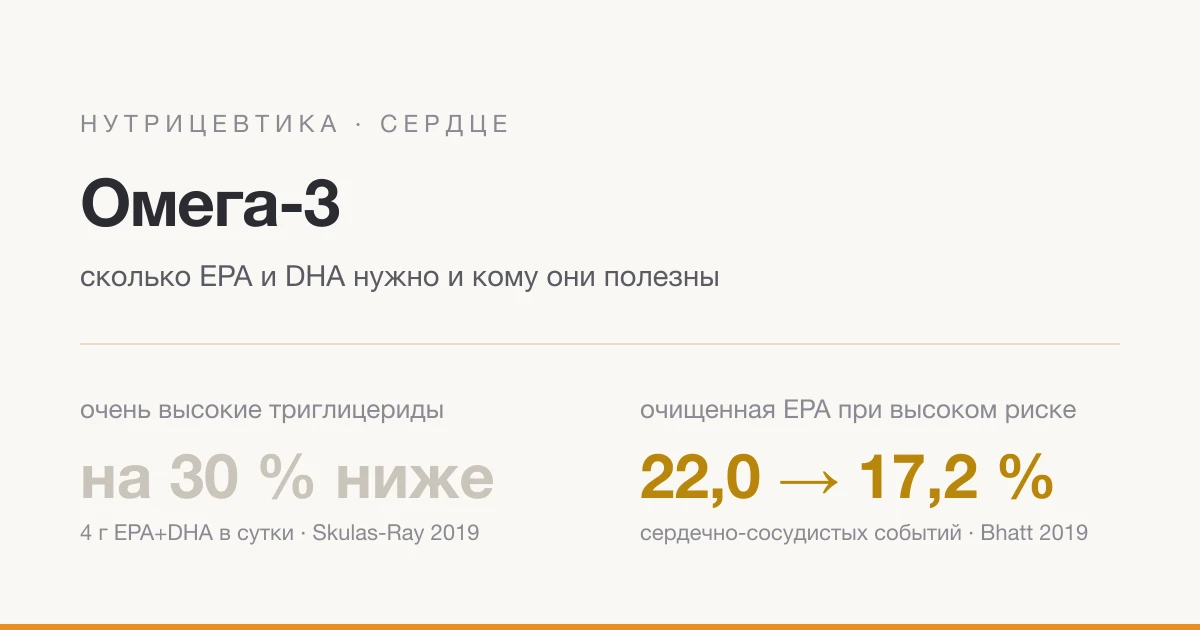
- With very high triglycerides — from 5.65 mmol/L (500 mg/dL) — EPA+DHA medicines at 4 g a day lower them by 30% or more on average (Skulas-Ray AC, Circulation 2019).
- In 8,179 people on statins with heart and blood vessel disease, or with diabetes and other risk factors, and triglycerides of 1.52–5.63 mmol/L (135–499 mg/dL), 4 g of purified EPA a day over 4.9 years lowered the rate of cardiovascular events from 22.0% to 17.2% (Bhatt DL, N Engl J Med 2019).
- In 25,871 people without heart disease, 1 g of omega-3 a day over 5.3 years did not reduce the number of major cardiovascular events: 386 versus 419 on placebo (Manson JE, N Engl J Med 2019).
- In 7 large studies, omega-3 supplements were linked to a 25% higher risk of atrial fibrillation, and at doses above 1 g a day to a 49% higher risk (Gencer B, Circulation 2021).
- In pregnant women who took omega-3, birth before 34 weeks occurred in 2.7% versus 4.6% (9 studies, 5,204 women) (Middleton P, Cochrane Database Syst Rev 2018).