In plain words: why oil helps and what to swap it for
What this oil is
A familiar fat of the Mediterranean table.
- goes well with vegetables, fish, legumes
- extra virgin is best: it has more useful substances
The main rule
Oil goes in place of another fat.
- a spoon of oil is about 120 kcal
- a swap, not an addition on top
Heart and life
In large cohorts, people who ate oil met trouble less often.
- risk of death lower than for those who did not eat oil
- this is an association, not a promise
What to replace
Best instead of solid fats.
- instead of butter in the pan
- instead of mayonnaise in a salad
- instead of margarine in baking
Cholesterol
"Bad" cholesterol is lower when oil replaces butter.
- the benefit is in the swap, not the addition
Sugar in diabetes
Fasting sugar becomes a little steadier.
- seen in trials in type 2 diabetes
- it does not replace treatment
How to eat it
Simple and Mediterranean.
- one or two spoons a day
- dressing: oil, lemon, herbs
- a plate of vegetables, fish, eggs and legumes
When to see a doctor
See a doctor first if you have:
- liver, gallbladder or pancreas disease
- high cholesterol or diabetes on treatment
- glucose repeatedly below 3.0 mmol/L (54 mg/dL) or above 8.9 mmol/L (160 mg/dL)
Important. Important: do not change prescribed treatment on your own. In diabetes targets are individual; below 3.0 mmol/L (54 mg/dL) always means a doctor.
Key points
Olive oil is the familiar fat of the Mediterranean table, and in studies in people it has a good reputation. In large cohorts, people who eat it regularly instead of butter, margarine and mayonnaise have a lower risk of death, and in trials their "bad" cholesterol is lower. In type 2 diabetes, oil as part of the diet helps keep sugar steadier. The rule is simple: a spoon of oil is about 120 kcal, so what works is swapping a fat, not adding oil on top of the usual diet. You can start today: change the fat in the pan and in the salad dressing.
| What | How much | Why it helps | What studies showed |
|---|---|---|---|
| Length of life (association) | More than 7 g a day, over half a tablespoon | Lower risk of death from any cause | 92,383 people, 28 years: 19% lower (HR 0.81) |
| Heart and vessels | Mediterranean diet with extra virgin oil | Fewer heart attacks, strokes and deaths from heart and vessel disease | 7,447 people, 4.8 years: risk of events 31% lower than with advice to eat less fat |
| Brain (association) | More than 7 g a day | Lower risk of dementia-related death | 4,751 such deaths: 28% lower (HR 0.72) |
| Cholesterol | Oil instead of butter | Lower "bad" LDL | Network analysis, 54 trials in total: about minus 0.25 mmol/L (9.7 mg/dL) |
| Type 2 diabetes | Oil as part of the diet | Steadier fasting sugar and HbA1c | 25 trials, 1,724 people: minus 0.44 mmol/L (7.9 mg/dL) against control groups |
| "Good" cholesterol | 25 mL a day, 3 weeks | Higher HDL with high-polyphenol oil | 200 men: plus 0.025-0.045 mmol/L (1.0-1.7 mg/dL) |
Heart and vessels: a diet with olive oil
The best-known trial tested not oil alone but Mediterranean eating as a whole: vegetables, legumes, fish and extra virgin olive oil. It included 7,447 people aged 55-80 at high cardiovascular risk, with a median follow-up of 4.8 years. The diet was compared with advice to eat less fat. Heart attacks, strokes and deaths from heart and vessel disease occurred in 96 people (3.8%) in the oil group against 109 (4.4%) in the comparison group. The risk of such events was 31% lower (HR 0.69; 95% CI 0.53-0.91) (Estruch R N Engl J Med 2018. PMID 29897866[1]).
For an ordinary person the takeaway is this: olive oil works well as part of a plate with plenty of vegetables, legumes and fish. It is pleasant and simple: a salad, stewed vegetables, baked fish, eggs with herbs.
Length of life and memory: large cohorts
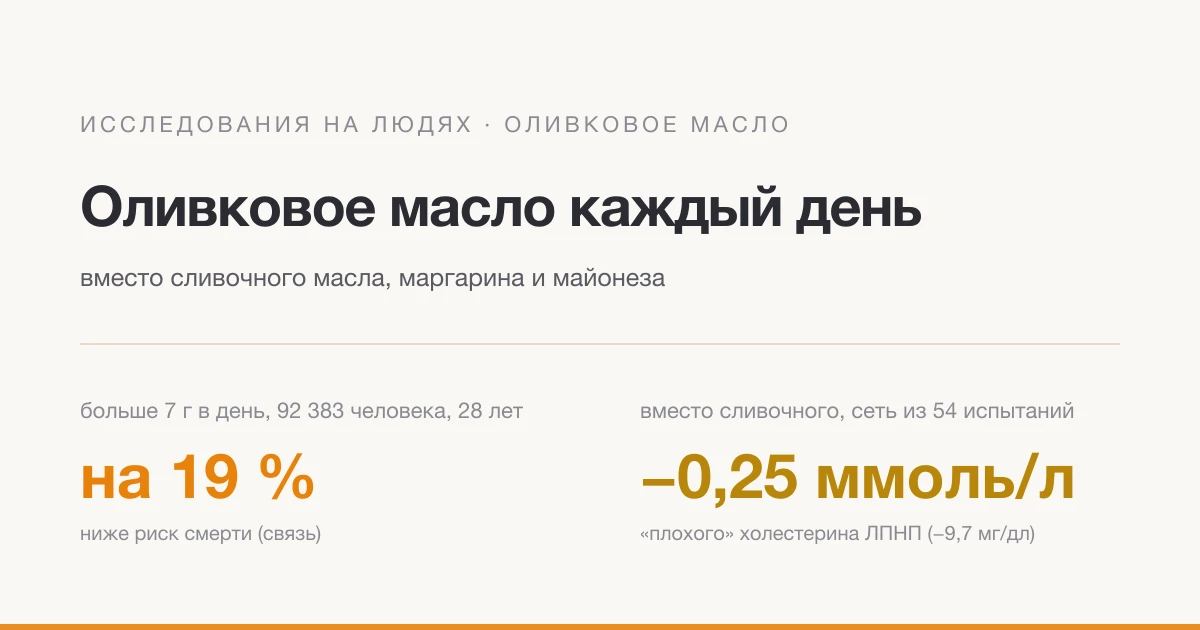
Two large cohorts followed 92,383 people for 28 years, during which 36,856 deaths occurred. Among those who ate more than 7 g of olive oil a day, the risk of death from any cause was associated with a 19% reduction compared with those who did not eat it (HR 0.81; 0.78-0.84). Specific causes of death were also associated with lower risk in the same sample: heart and vessel disease (by 19%), neurodegenerative disease (by 29%) and respiratory disease (by 18%) (Guasch-Ferré M J Am Coll Cardiol 2022. PMID 35027106[2]).
The most interesting part is what to replace. Swapping 10 g a day of butter for olive oil was associated with a 14% lower risk of death, margarine 13%, mayonnaise 19%. Replacing other vegetable oils made no clear difference (Guasch-Ferré M J Am Coll Cardiol 2022. PMID 35027106[2]). The practical takeaway: olive oil pays off most when it takes the place of the fats that come with baking, sandwiches and ready-made sauces.
The same cohorts counted dementia separately: there were 4,751 dementia-related deaths. More than 7 g of olive oil a day was associated with a 28% lower risk of such a death (HR 0.72; 0.64-0.81), regardless of overall diet quality (Tessier AJ JAMA Netw Open 2024. PMID 38709531[3]). This is an observation of association: people who ate oil may have differed in other habits too.
Cholesterol: oil instead of butter
A network analysis that pooled 54 randomised trials in total compared different fats when 10% of calories were swapped. Olive oil instead of butter lowered LDL by about 0.25 mmol/L (9.7 mg/dL) (Schwingshackl L J Lipid Res 2018. PMID 30006369[4]). Sunflower and rapeseed oils lowered LDL a little more. So the honest formula is: olive oil is good where there used to be solid animal fat, margarine or mayonnaise.
An extra benefit of extra virgin is polyphenols. In a crossover trial, 200 healthy men took 25 mL of oil a day for three weeks each. "Good" HDL cholesterol rose more the more polyphenols the oil had: by 0.025, 0.032 and 0.045 mmol/L (by 1.0, 1.2 and 1.7 mg/dL) (Covas MI Ann Intern Med 2006. PMID 16954359[5]).
Type 2 diabetes: fasting sugar and HbA1c
In a review of trials in people with type 2 diabetes, olive oil as part of the diet gave a lower HbA1c, by 0.27 percentage points on average (22 trials, 1,428 people), and lower fasting glucose, by 0.44 mmol/L (7.9 mg/dL) (25 trials, 1,724 people). The comparison was with the control groups of the trials (Schwingshackl L Nutr Diabetes 2017. PMID 28394365[6]).
It is a good illustration of why oil need not be feared in diabetes: a moderate amount of fat from oil in place of part of the fast carbohydrates makes meals more filling and calmer for sugar. But this is about swapping, not adding calories.
How to use it
- Guide from the cohorts: more than half a tablespoon (7 g) a day; 1-2 spoons a day fit an ordinary menu.
- Swap the fat, do not add: in the pan instead of butter, in dressing instead of mayonnaise, in baking instead of margarine.
- For salads and finished dishes choose extra virgin: it has more polyphenols. A simple dressing: oil, lemon juice, herbs.
- Build the plate around vegetables, fish, eggs and legumes: that way oil works as part of Mediterranean eating.
- Remember calories: a spoon of oil is about 120 kcal; with excess weight swap the fat rather than stacking it.
Who should see a doctor first
Olive oil does not replace prescribed treatment for high cholesterol, diabetes or heart disease. With liver, gallbladder or pancreas disease, agree the amount of fat in your diet with a doctor. If you take prescribed treatment, discuss diet at your appointment.
If you monitor sugar: a repeat result below 3.0 mmol/L (54 mg/dL) or above 8.9 mmol/L (160 mg/dL) is a reason to see a doctor. In diabetes targets are individual, and below 3.0 mmol/L (54 mg/dL) always means a doctor. Do not change prescribed treatment on your own.
Bottom line
Olive oil is a simple habit with a clear benefit. In place of butter, margarine and mayonnaise it is associated with a lower risk of death and lower "bad" cholesterol, and in type 2 diabetes with steadier sugar. Choose extra virgin, keep to one or two spoons and put oil in place of another fat: that way the benefit is greatest and calories do not creep up.
References
- Estruch R N Engl J Med 2018. PMID 29897866
- Guasch-Ferré M J Am Coll Cardiol 2022. PMID 35027106
- Tessier AJ JAMA Netw Open 2024. PMID 38709531
- Schwingshackl L J Lipid Res 2018. PMID 30006369
- Covas MI Ann Intern Med 2006. PMID 16954359
- Schwingshackl L Nutr Diabetes 2017. PMID 28394365
Key facts
- More than 7 g of olive oil a day (over half a tablespoon) is associated with a 19% lower risk of death from any cause compared with people who never eat it: 92,383 people, 28 years of follow-up, 36,856 deaths (Guasch-Ferré M J Am Coll Cardiol 2022. PMID 35027106).
- Mediterranean diet with extra virgin olive oil in people aged 55-80 at high cardiovascular risk: risk of heart attacks, strokes and deaths from heart and vessel disease 31% lower than with advice to eat less fat (HR 0.69; 0.53-0.91), 7,447 people, median follow-up 4.8 years (Estruch R N Engl J Med 2018. PMID 29897866).
- Olive oil instead of butter lowers LDL ("bad") cholesterol by about 0.25 mmol/L (9.7 mg/dL): an estimate from a network analysis that included 54 randomised trials of different fats in total (Schwingshackl L J Lipid Res 2018. PMID 30006369).
- In type 2 diabetes, a diet with olive oil lowered fasting glucose in trials by 0.44 mmol/L (7.9 mg/dL) on average: 25 trials, 1,724 people; HbA1c by 0.27 percentage points: 22 trials, 1,428 people; compared with the control groups of the trials (Schwingshackl L Nutr Diabetes 2017. PMID 28394365).