In plain words: short answers from studies
How to read the blitz
Eight questions, eight short answers.
- six "yes", one "with a doctor", one "no"
- almost everything comes from observing large groups
- choose two or three habits to your taste
Coffee
Yes: a few cups a day.
- about three cups a day are linked with lower risk
- better without sugar and cream
- in pregnancy, ask a doctor
Sauna
Yes: the more often, the better the picture for the heart.
- in the study people went four to seven times a week
- men took part
- with heart disease or blood pressure problems, see a doctor first
Important. Important: with heart disease or blood pressure problems, discuss the sauna with a doctor.
Cold shower
Yes: half a minute of cold water at the end.
- people were split into groups, and the cold shower cut sick days
- you can start with thirty seconds
- with heart disease, see a doctor first
Vitamin D
With a doctor: by test.
- in trials vitamin D3 slightly lowered deaths in older people
- most data come from older women
- whether you need a supplement is decided by a test
Nuts and strength
Yes: a handful of nuts and a little strength work.
- a handful of nuts a day is linked with lower risk
- strength work for half an hour twice a week
- both are easy to start at home
Sleep
Weekends help, very long sleep does not.
- if you sleep little on weekdays, longer weekend sleep may make up for it
- steady sleep of about seven to eight hours
- very long sleep is linked with higher risk
When to see a doctor
See a doctor first if:
- heart disease or blood pressure problems: sauna, cold, strength work
- pregnancy: coffee
- you regularly sleep far longer than usual
Important. Important: prescribed treatment continues; habits complement it.
Key points
Eight quick questions about longevity and eight short answers, each with one number and a source. Six answers are "yes": coffee, sauna, cold shower, nuts, strength training and catching up on sleep at weekends. One is "with a doctor": vitamin D. And one is "no": sleeping over nine hours. Almost all numbers come from observation and show an association of a habit with a long life. Choose two or three habits you like and start there.
| Question | Short answer | What it is based on |
|---|---|---|
| Coffee | Yes, 3 cups a day | Risk of death from any cause 17% lower vs no coffee (umbrella review of meta-analyses) |
| Sauna | Yes, 4-7 times a week | Sudden cardiac death 63% lower vs once a week (2,315 men, 20.7 years) |
| Cold shower | Yes, 30-90 seconds at the end | 29% less self-reported sickness absence (randomised trial, 3,018 people) |
| Vitamin D | With a doctor, by test | D3: mortality 6% lower, the authors' conclusion concerns older people (38 trials, 75,927 people) |
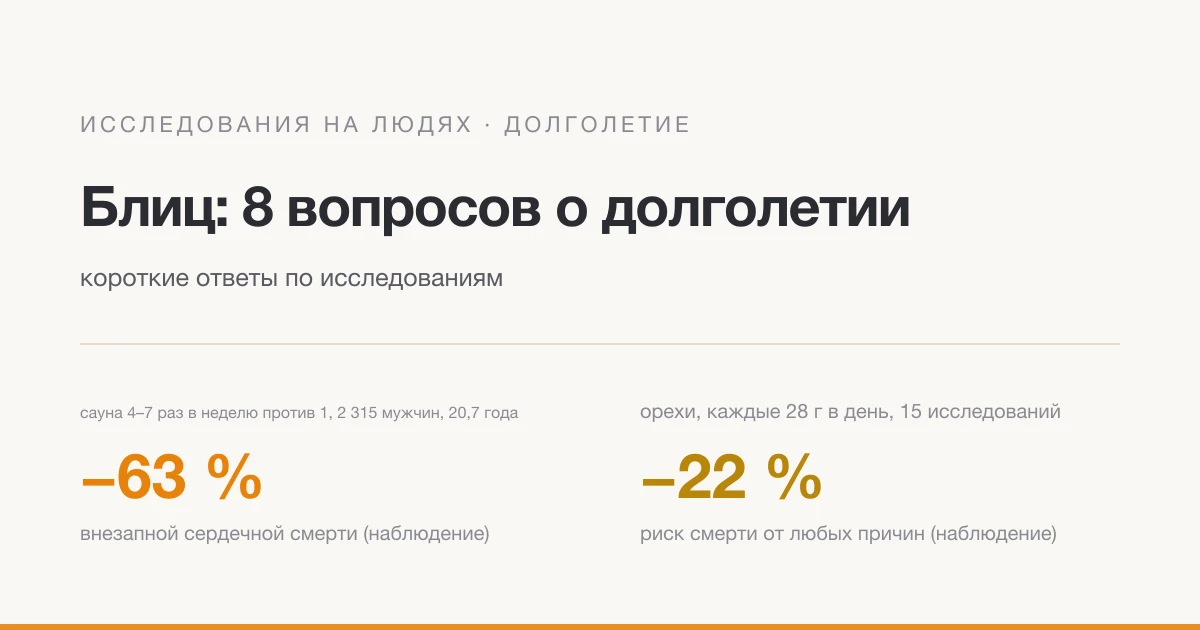
| Nuts | Yes, 28 g a day | Risk of death 22% lower (15 studies) |
| Strength training | Yes, 30-60 minutes a week | Risk of death about 10-20% lower (meta-analysis of cohorts) |
| Catching up on sleep at weekends | Yes, if you sleep little on weekdays | Mortality did not differ from steady 6-7 hours (cohort of 43,880 people; analysis under 65) |
| Sleeping over 9 hours | No | Long sleep: risk of death 30% higher (16 studies, 1,382,999 people) |
Coffee: yes
Three cups of coffee a day are familiar to many, and the good news is that they are associated with benefit. An umbrella review of meta-analyses reported the largest risk reduction at 3 cups a day compared with none: all-cause mortality 17% lower (RR 0.83; 95% CI 0.79-0.88) and cardiovascular mortality 19% lower (Poole R BMJ 2017. PMID 29167102[1]). Coffee without sugar and cream, a cup in the morning and two more before mid-afternoon: that is the whole scheme. This is an association from observation, not a guarantee.
Sauna: yes
The sauna has long been popular in Finland, and that is where it was studied in people. In a study of 2,315 men aged 42-60 over a median of 20.7 years, 190 sudden cardiac deaths occurred. Those who used a sauna 4-7 times a week, compared with once a week, had a 63% lower risk of sudden cardiac death (HR 0.37; 95% CI 0.18-0.75; groups of 201 and 601 men) (Laukkanen T JAMA Intern Med 2015. PMID 25705824[2]). The same direction was seen for deaths from heart disease and from any cause. Only men took part, so this study gives no data for women.
Cold shower: yes
A cold shower sounds harsher than it is. In a randomised trial, 3,018 people aged 18-65 without severe disease were divided into four groups: a warm shower as usual or with 30, 60 or 90 seconds of cold water at the end, for 30 days in a row. Self-reported sickness absence fell by 29% (IRR 0.71; p = 0.003), and no serious adverse events related to the shower were reported (Buijze GA PLoS One 2016. PMID 27631616[3]). Illness days did not differ significantly. Start with thirty seconds at the end of your usual shower and add gradually.
Vitamin D: with a doctor
The most accurate answer here is "by test and together with a doctor". A Cochrane review pooled randomised trials: vitamin D3 lowered mortality by 6% (RR 0.94; 95% CI 0.91-0.98; 38 trials, 75,927 people), while other forms of vitamin D did not significantly affect mortality. Most trials included women over 70, and the authors conclude that D3 seemed to decrease mortality in elderly people living independently or in institutional care (Bjelakovic G Cochrane Database Syst Rev 2014. PMID 24414552[4]). In some trials D3 combined with calcium increased the risk of kidney stones, so the dose and combination are chosen by a doctor. Vitamin D level is found with a blood test, and the need and form are decided by a doctor.
Nuts: yes
A handful of nuts is the simplest item on the list. In a meta-analysis of prospective studies, every additional 28 g of nuts a day was associated with a 22% lower risk of death from any cause (RR 0.78; 95% CI 0.72-0.84; 15 studies) (Aune D BMC Med 2016. PMID 27916000[5]). Results were similar for tree nuts and peanuts. A handful a day is an example in your palm: add it to yogurt or a salad, or take it as a snack instead of biscuits.
Strength training: yes
Strength training is not only for athletes. A systematic review of prospective cohorts (16 studies) showed that muscle-strengthening activities were associated with a 10-17% lower risk of death from any cause and of cardiovascular disease, cancer, diabetes and lung cancer. For death from any cause, cardiovascular disease and cancer the largest risk reduction, about 10-20%, was at 30-60 minutes a week (Momma H Br J Sports Med 2022. PMID 35228201[6]). That is two sessions of half an hour: squats, push-ups, dumbbells or a resistance band. For diabetes the pattern was different: the risk fell markedly up to 60 minutes a week.
Catching up on sleep at weekends: yes
If you do not get enough sleep on weekdays, long weekend sleep may make up for it, as the authors suggest. In a cohort of 43,880 people over 13 years, in people under 65 mortality with short weekday sleep and long weekend sleep did not differ from that of people sleeping a steady 6-7 hours. Steady sleep of five hours or less was associated with a higher risk of death (HR 1.65; 1.22-2.23) (Åkerstedt T J Sleep Res 2019. PMID 29790200[7]). In people aged 65 and over, no association with sleep was found. Constant sleep debt is not a plan, and long weekend sleep was not linked with higher risk in this cohort.
Sleeping over nine hours: no
Sleeping longer does not mean living longer. In a meta-analysis of 16 studies (1,382,999 people) long sleep was associated with a 30% higher risk of death (RR 1.30; 95% CI 1.22-1.38) and short sleep with a 12% higher risk (Cappuccio FP Sleep 2010. PMID 20469800[8]). Each study set its own cut-off for long sleep, so nine hours here is a guide from the question, not a threshold from the review. The practical conclusion: do not chase hours in bed, aim for steady sleep of about seven to eight hours. If you regularly sleep far more than nine hours and still feel wrecked, it is a reason to discuss sleep with a doctor.
Who should see a doctor first
Discuss sauna and cold water with a doctor first if you have heart disease or blood pressure problems. In pregnancy, discuss the amount of caffeine with a doctor. Vitamin D is prescribed by test. Strength training with heart or joint disease, or after a long break, starts after a consultation. If you regularly sleep far longer than usual and do not feel rested, tell your doctor. Prescribed treatment continues; habits complement it.
Bottom line
Eight short answers add up to a simple picture: coffee, sauna, cold shower, nuts, strength training and steady sleep go on the plus side, vitamin D is decided with a doctor, and long sleep does not go on the plus side. All numbers except the cold shower trial and the Cochrane review come from observation and show an association, not a guarantee. Choose two or three habits to your taste and start today. For a plan built around your tests, see a doctor.
References
- Poole R BMJ 2017. PMID 29167102
- Laukkanen T JAMA Intern Med 2015. PMID 25705824
- Buijze GA PLoS One 2016. PMID 27631616
- Bjelakovic G Cochrane Database Syst Rev 2014. PMID 24414552
- Aune D BMC Med 2016. PMID 27916000
- Momma H Br J Sports Med 2022. PMID 35228201
- Åkerstedt T J Sleep Res 2019. PMID 29790200
- Cappuccio FP Sleep 2010. PMID 20469800
Key facts
- Coffee: 3 cups a day compared with none were associated with a 17% lower risk of death from any cause (RR 0.83; 95% CI 0.79-0.88; umbrella review of meta-analyses) (Poole R BMJ 2017. PMID 29167102).
- Sauna: 4-7 times a week compared with once were associated with a 63% lower risk of sudden cardiac death (HR 0.37; 95% CI 0.18-0.75; 2,315 men aged 42-60, median follow-up 20.7 years; observational) (Laukkanen T JAMA Intern Med 2015. PMID 25705824).
- Cold shower: 30, 60 or 90 seconds of cold water at the end of a shower for 30 days cut self-reported sickness absence by 29% (IRR 0.71; p = 0.003; randomised trial, 3,018 people aged 18-65); illness days did not differ significantly (Buijze GA PLoS One 2016. PMID 27631616).
- Vitamin D3: in randomised trials D3 lowered mortality by 6% (RR 0.94; 95% CI 0.91-0.98; 38 trials, 75,927 people); the authors conclude that D3 seemed to decrease mortality in elderly people living independently or in institutional care; other forms of vitamin D did not significantly affect mortality (Bjelakovic G Cochrane Database Syst Rev 2014. PMID 24414552).
- Nuts: for every 28 g a day the risk of death from any cause was 22% lower (RR 0.78; 95% CI 0.72-0.84; 15 studies; observational) (Aune D BMC Med 2016. PMID 27916000).
- Strength training: 30-60 minutes a week was associated with the largest risk reduction, about 10-20%, for three outcomes: death from any cause, cardiovascular disease and cancer (meta-analysis of prospective cohorts; observational) (Momma H Br J Sports Med 2022. PMID 35228201).
- Weekend sleep: in people under 65, short weekday sleep together with long weekend sleep did not differ in mortality from steady 6-7 hours of sleep; the authors suggest long weekend sleep may compensate for short weekday sleep (cohort of 43,880 people, 13 years; observational) (Åkerstedt T J Sleep Res 2019. PMID 29790200).
- Long sleep: associated with a 30% higher risk of death (RR 1.30; 95% CI 1.22-1.38; 16 studies, 1,382,999 people; observational) (Cappuccio FP Sleep 2010. PMID 20469800).