In brief: what this injection is
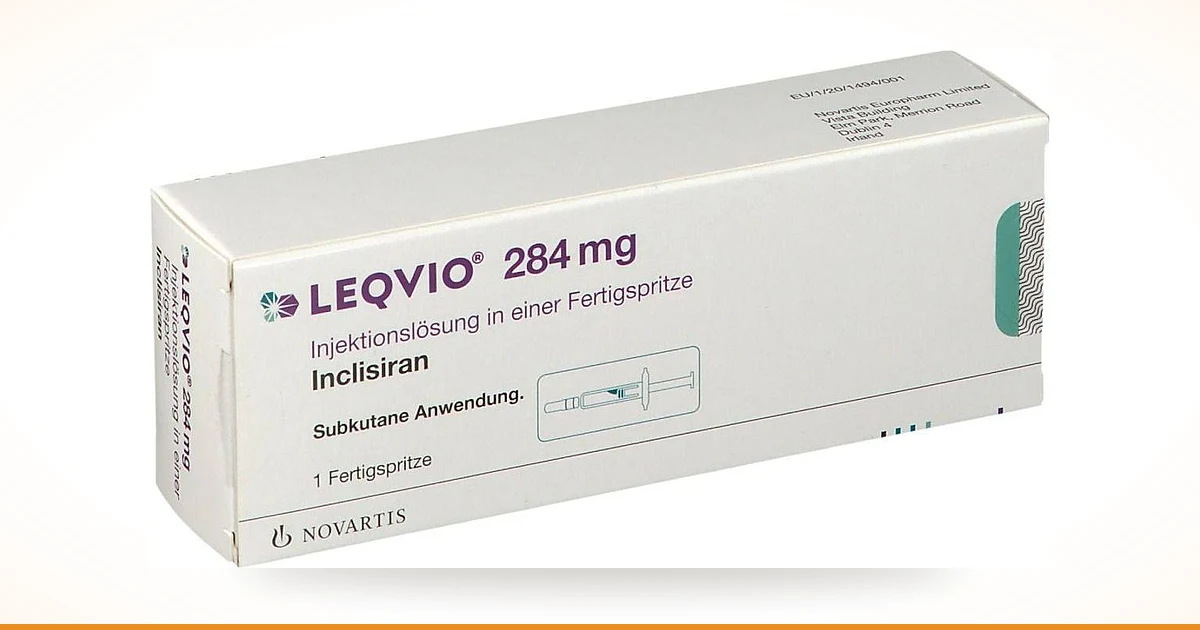
Inclisiran (brand name Leqvio, Novartis) is an injection that lowers "bad" cholesterol by roughly half and is given twice a year. Not a daily tablet, not a fortnightly injection — two appointments across a year.
Behind that frequency lies a different principle of intervention rather than convenient packaging. Every familiar way of lowering cholesterol acts on molecules that already exist: statins inhibit an enzyme, antibodies capture a protein. Inclisiran acts earlier — it stops the liver cell from making the protein at all, intervening at the level of messenger RNA.
What follows: how that works, what the trials showed in numbers, how the drug differs from statins and from evolocumab and alirocumab injections, who it is for, and — as a separate section — what cannot yet be claimed about it.
How cholesterol enters the blood and how it is cleared
One piece of physiology makes the drug intelligible.
The liver removes LDL particles — what people call "bad cholesterol" — from the blood. It does so with LDL receptors on its surface: a receptor grabs a particle, pulls it inside, releases the contents and returns to the surface for the next one. The more working receptors, the lower the blood cholesterol.
This system has a regulator: a protein called PCSK9, also made by the liver. It binds the receptor and sends it for destruction rather than recycling. The receptor dies along with the particle it captured, the population of collectors shrinks and blood cholesterol rises.
The therapeutic idea follows directly: remove PCSK9 and receptors live longer. Three generations of agents work on that idea, and they differ in which step they interrupt.
| Approach | Where it acts | Example | How often |
|---|---|---|---|
| Statins | Inhibit cholesterol synthesis in the liver | atorvastatin, rosuvastatin | daily |
| PCSK9 antibodies | Bind the already-made protein in blood | evolocumab, alirocumab | every 2–4 weeks |
| siRNA (inclisiran) | Prevents the protein being made in the liver cell | Leqvio | every 6 months |
The mechanism: switching off production rather than catching the product
Inclisiran is a small interfering RNA. This short double-stranded molecule loads into a natural cellular machine called RISC and directs it at one target: the messenger RNA of the PCSK9 gene. Messenger RNA is the working copy of a gene, the instruction from which the ribosome assembles a protein. Destroy the instruction and the protein simply never appears.
The engineering that matters most is delivery. The molecule carries an address: a GalNAc conjugate (N-acetylgalactosamine) recognised by a receptor found almost exclusively on liver cells. The liver is precisely where PCSK9 is synthesised, so the drug works where it is needed rather than across the body.
That is fundamentally different from the familiar logic of "take the tablet, get the effect; skip it, lose the effect".
What the trials showed
Patients with atherosclerosis
▸ORION-10 and ORION-11 (New England Journal of Medicine, 2020). Two phase 3 trials in patients with atherosclerotic cardiovascular disease or a risk equivalent, already taking maximally tolerated statins. LDL cholesterol fell by about 50% versus placebo [1].
The critical detail: that reduction is on top of statins, not instead of them — in patients whose cholesterol stays high despite therapy, and there are many of those.
Familial hypercholesterolaemia
▸ORION-9 (New England Journal of Medicine, 2020). In patients with heterozygous familial hypercholesterolaemia — a genetic condition with lifelong high cholesterol — LDL fell by about 40% [2].
Less than in the general group, which is expected: in the familial form the receptors themselves are impaired, so the ceiling is lower. For a population that responds poorly to standard treatment, it is nonetheless substantial.
Does the effect last
▸ORION-8 (Cardiovascular Research, 2024) — extended follow-up of programme participants. LDL reduction was maintained across years of treatment with no sign of the effect escaping [3].
This answers a reasonable suspicion: might the liver adapt and route around the block? On the available data, no.
What cannot yet be claimed
Here begins the most important section, and the one marketing materials tend to lose.
It is proven that inclisiran lowers LDL cholesterol. It is not proven that it reduces heart attacks, strokes or deaths.
The distinction is not pedantic. LDL is a surrogate marker: closely tied to risk, but not an event. Lowering LDL by other means — statins, ezetimibe, PCSK9 antibodies — did reduce events. But every new agent must demonstrate that for itself; medicine has examples where an elegant shift in a laboratory value never translated into patient benefit.
For inclisiran those trials are running now: ORION-4 and VICTORION-2-PREVENT, large cardiovascular outcome studies expected to report in 2027. Until then the honest formulation is: the drug lowers cholesterol reliably and durably, and an effect on events is anticipated but unconfirmed.
The practical consequence: inclisiran is a sensible tool where cholesterol cannot be brought to target, but not a reason to abandon therapy whose effect on outcomes is established.
Who it is for
The label has widened twice, which changes the picture:
▸initially — adults with atherosclerotic cardiovascular disease and with familial hypercholesterolaemia, as an addition to statins; ▸then the FDA allowed use in people with high LDL and increased risk who have not yet had a vascular event — primary prevention; ▸in 2025 the label widened again: the drug may be used without a background statin, as monotherapy.
That last point matters particularly for patients intolerant of statins, a group whose options have always been narrow.
The general rule still holds: the higher the total risk and the further cholesterol sits from target, the stronger the case for adding the drug. The decision belongs to the clinician, based on LDL, comorbidity and what has already been tried.
How it is administered
| Item | Detail |
|---|---|
| Dose | 284 mg in a prefilled syringe |
| Route | Subcutaneous, usually the abdomen |
| Schedule | Day 0 → 3 months → every 6 months thereafter |
| Who administers | Usually a healthcare professional rather than the patient |
| Monitoring | Lipid profile before starting, then per the clinician's plan |
Two appointments a year address a problem that weighs more heavily in cardiology than it appears: adherence. A substantial share of patients abandon daily tablets within the first year, and a drug you cannot forget to take carries value of its own — provided the appointment happens.
Tolerability
The commonest adverse event is a local reaction at the injection site: redness, tenderness, a firm lump. Usually mild, self-resolving, rarely a reason to stop. Pooled safety analyses have not identified systemic problems specific to the drug [4].
Muscles deserve separate mention. Muscle pain is a common complaint on statins and a common reason for stopping them. Inclisiran's mechanism does not touch muscle tissue, and no such effect is expected.
Long-term safety continues to be studied: the drug is relatively new and the intervention operates at the level of gene expression, albeit reversibly and selectively. That is not grounds for alarm, but it is grounds for honesty.
What a patient should understand
▸It is not a "cholesterol vaccine". The effect lasts while injections continue; a missed six-month appointment means cholesterol returns, just slowly. ▸It does not replace lifestyle. Diet, weight, physical activity and smoking influence risk through a dozen mechanisms, not only through LDL. ▸It is not an automatic reason to stop statins. Monotherapy is permitted but chosen deliberately, most often for intolerance. ▸It is a prescription medicine, given under medical supervision with lipid monitoring — not a preventive "course".
Summary
▸Inclisiran switches off PCSK9 production in the liver cell at the messenger RNA level — a fundamentally different level of intervention from statins and antibodies. ▸GalNAc-targeted delivery takes the drug almost exclusively to the liver. ▸Two injections a year after loading doses — the effect persists because the production line is off, not because drug remains in the blood. ▸LDL falls about 50% on top of statins (ORION-10 and ORION-11) and about 40% in familial hypercholesterolaemia (ORION-9), sustained for years (ORION-8). ▸Effects on heart attacks and mortality are unproven — outcome trials report in 2027. That is the key limitation today. ▸The label now covers primary prevention and use without a statin. ▸Tolerability is good, the main complaint being a local injection-site reaction.
It is worth discussing this drug with your clinician if LDL cholesterol will not reach target on maximally tolerated therapy, if statins are not tolerated, or in familial hypercholesterolaemia. The product can be ordered here — it is prescription-only, administered by a healthcare professional, and a prescription is required.
References
1. Ray KK, et al. Two phase 3 trials of inclisiran in patients with elevated LDL cholesterol (ORION-10 and ORION-11). N Engl J Med. 2020;382(16):1507–1519. PMID 32187462
2. Raal FJ, et al. Inclisiran for the treatment of heterozygous familial hypercholesterolemia (ORION-9). N Engl J Med. 2020;382(16):1520–1530. PMID 32197277
3. Wright RS, et al. Inclisiran administration potently and durably lowers LDL-C over an extended-term follow-up: the ORION-8 trial. Cardiovasc Res. 2024;120(12):1400–1410. PMID 38753448
4. Cicero AFG, et al. Efficacy and safety of inclisiran, a newly approved FDA drug: a systematic review and pooled analysis of available clinical studies. Am Heart J Plus. 2022. PMID 38560059
5. Luo M, et al. Efficacy and safety of inclisiran in stroke or cerebrovascular disease prevention: a systematic review and meta-analysis. Front Pharmacol. 2023. PMID 37383716
Key facts
- Inclisiran (brand name Leqvio, Novartis) is neither a tablet nor an antibody but a small interfering RNA: it does not block the finished PCSK9 protein — it switches off its production in the liver cell at the messenger RNA level.
- The molecule carries an address label: a GalNAc conjugate recognised by a receptor found almost exclusively on hepatocytes. The drug therefore acts where PCSK9 is made rather than throughout the body.
- Dosing: 284 mg subcutaneously on day 0, again at 3 months, then once every 6 months. Two appointments a year instead of daily dosing is the entire point of the design.
- Efficacy: in ORION-10 and ORION-11 (NEJM, 2020) LDL cholesterol fell by about 50% versus placebo in patients with atherosclerotic cardiovascular disease already on maximally tolerated statins.
- In heterozygous familial hypercholesterolaemia (ORION-9) the LDL reduction was about 40% — in people whose high cholesterol is genetic and responds poorly to standard therapy.
- The effect lasts: in the extended ORION-8 follow-up (Cardiovascular Research, 2024) LDL reduction was maintained over years of treatment with no sign of waning.
- THE KEY LIMITATION: an effect on heart attacks, strokes and death is NOT yet proven. The cardiovascular outcome trials ORION-4 and VICTORION-2-PREVENT are ongoing, with results expected in 2027. What is proven today is a reduction in cholesterol — a surrogate marker, not the events themselves.
- The difference from PCSK9 antibodies (alirocumab, evolocumab) is frequency: those are given every 2–4 weeks, inclisiran twice a year. The difference from statins is more fundamental: statins reduce cholesterol production, inclisiran increases its clearance by the liver.
- Tolerability: the commonest adverse reaction is local — redness, pain or induration at the injection site — usually mild and self-limiting. The mechanism does not produce the muscle complaints familiar from statins.
- The label has been widened twice: first the FDA allowed use in people with high LDL and increased risk who have not yet had a cardiovascular event, and in 2025 it permitted use without a background statin, that is, as monotherapy.