in pictures and a few words
What it is and why it matters
Glycyron is a Japanese tablet with a substance from licorice root. In Japan it has been made since 1954.
- Each tablet has 25 mg of the licorice-root substance plus two amino acids, glycine and methionine
- In Japan: for eczema, alopecia areata, mouth inflammation, and one type of hives in children
- And to improve liver test results in long-lasting liver disease
Helps together with treatment
Almost everywhere it was added to the main treatment, not given instead of it. That is how the benefit was shown.
- Most studies were done in China on a product with the same formula
- There it is called “compound glycyrrhizin”
- In most studies, people knew what they were getting
Honestly. The authors of the pooled reviews say themselves that the quality of the studies is not high.
Alopecia areata
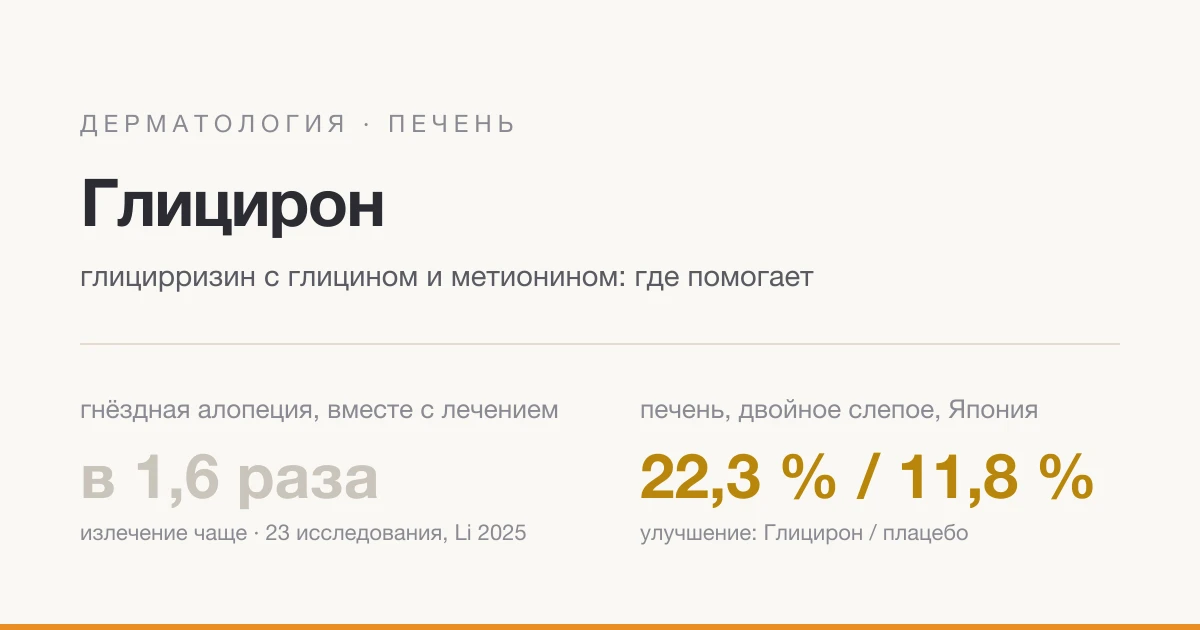
In alopecia areata, hair falls out in patches. A product with the same formula, together with usual treatment, more often led to full hair regrowth.
- Together with minoxidil, hair loss shrank more than with minoxidil alone
- Swelling happened more often with it than without it
Honestly. We did not find comparisons with a dummy pill in alopecia: so the benefit was not shown this way, but that is not the same as “does not help”.
Eczema: a blinded test
Among the skin studies we found, only in eczema were the capsules compared with a dummy pill in a blinded way: neither patients nor doctors knew who got what.
- All adults with long-lasting eczema used the same steroid ointment
- With the capsules, strong skin improvement happened more often, and eczema came back less often
- There was no clear difference in side effects; the most common was leg swelling
Tested in people. Tested in people: capsules of the same formula with the ointment versus a dummy pill with the same ointment.
Hives, psoriasis, vitiligo
Pooled reviews showed a benefit when a product with the same formula was added to the main treatment.
- Hives: with an anti-allergy medicine, they cleared fully more often and came back less often
- Psoriasis: skin cleared noticeably more often, with the same amount of side effects
- Vitiligo (white patches on the skin): the overall treatment result was better
Honestly. It is unknown what was studied, tablets or injections: the short summaries of these reviews do not say.
Liver
In a Japanese study of long-lasting liver inflammation, Glycyron itself was compared with a dummy pill in a blinded way. With it, liver test results clearly improved more often.
- Improvement was judged by broad categories, not by exact test numbers
- The study is old and is not in the database of scientific papers; the data come from the package insert
- In a summary of different licorice products, including injections, liver test results also went down
Tested in people. Tested in people: Glycyron itself versus a dummy pill, blinded.
How it is taken
According to the Japanese package insert, after meals. The doctor chooses the dose based on age and symptoms.
- Adults: 2–3 tablets 3 times a day after meals
- Children: 1 tablet 3 times a day
- While you take it, your doctor checks your blood pressure and blood potassium
Honestly. According to the insert, glycine and methionine reduce fluid retention, but this has only been studied in animals. Blood pressure and potassium are checked anyway.
Who should see a doctor first
It is taken only when a doctor prescribes it. According to the insert, it must not be used with low potassium, muscle diseases, too much of the hormone that makes the body hold sodium, or end-stage liver cirrhosis.
- The medicine itself can cause swelling and higher blood pressure; if you already have these, tell your doctor
- Loop and thiazide diuretics (potassium drops more), moxifloxacin (heart rhythm problems)
- Older age (low potassium is more common), pregnancy, breastfeeding
Important. Do not combine it with other products that contain licorice: the substance adds up. In pregnancy, only if the doctor decides the benefit outweighs the risk.
When to see a doctor right away
The main risk is that the body may start holding on to sodium and water. Muscle breakdown is also possible. How often either happens is unknown.
- Swelling, higher blood pressure, weight gain, less urine, weakness: see a doctor right away
- Weakness, muscle pain, cramps: also see a doctor right away
Important. If you have swelling, weakness or muscle pain, see a doctor right away.
In one sentence
Together with the main treatment, a product with the same formula helped in alopecia, eczema, hives, psoriasis and vitiligo, and Glycyron improved liver test results. It is taken as prescribed by a doctor, with blood pressure and potassium checks.
Honestly. The quality of most studies is not high, and for some it is unknown whether tablets or injections were used.
Key points
What is in the tablet
In Japan, Glycyron is approved for eczema and dermatitis, papular urticaria in children (strophulus), alopecia areata, stomatitis and for improving liver test results in chronic liver disease. It is also sold in China, Mongolia, Uzbekistan and Armenia (PMDA 2026).
According to the label, glycine and methionine reduce the sodium and fluid retention caused by glycyrrhizin, but this has been studied only in animals: such an effect has not been shown in humans (PMDA package insert 2026).
In China, the same formula is produced as “compound glycyrrhizin”: 25 mg of glycyrrhizin, 25 mg of glycine and 25 mg of methionine in a tablet or capsule (Li M Ann Med 2025. PMID 40265259[1]). Most studies were done with it.
Skin and hair
The abstracts of the pooled analyses in urticaria, psoriasis and vitiligo do not say whether tablets or injections were used.
Liver
In a Japanese double-blind study, 224 people with chronic hepatitis at 19 centers took 9 Glycyron tablets a day or placebo for 12 weeks. A clear improvement in liver test results occurred in 22.3% versus 11.8%. The 1989 study is not indexed in PubMed, and the figures come from the label; improvement was assessed by categories, not by enzyme values (PMDA package insert 2026).
In a pooled analysis of 15 studies (1,367 people with liver disease), licorice preparations lowered alanine aminotransferase (ALT) by an average of 15.6 U/L and aspartate aminotransferase (AST) by 7.4 U/L, especially purified glycyrrhizic acid; the analysis included various licorice preparations, including injections (Giangrandi I Phytother Res 2024. PMID 39079711[7]).
How it is taken
According to the Japanese label, adults are prescribed 2–3 tablets 3 times a day after meals, children 1 tablet 3 times a day (PMDA package insert 2026).
The adult dose is 150–225 mg of glycyrrhizic acid a day, while for food the EU scientific committee considers regular intake of up to 100 mg a day from all sources, including licorice confectionery, safe for most people (EU Scientific Committee on Food 2003). The limit is set for food, not for a medicine taken under a doctor’s supervision, but it explains why blood pressure and potassium are monitored on Glycyron.
Japanese Glycyron (100 tablets) is available in the shop — ordered on request via chat, taken as prescribed by a doctor.
What the studies showed
| What was studied | Who took part | Result |
|---|---|---|
| Alopecia areata, 23 studies, 2025 | 2,219 people | Complete hair regrowth 1.6 times more often; swelling more common |
| Alopecia + minoxidil, 11 studies, 2024 | 1,189 people | SALT score a further 10 points lower |
| Chronic eczema, double-blind with placebo, 2020 | 199 adults | Improvement of at least 75%: 47.9% vs 21.2%; relapses 3.19% vs 12.12% |
| Chronic urticaria, 24 studies, 2024 | 2,649 people | Cure 1.54 times more often, relapses three times less often (data on 446 people) |
| Psoriasis, 11 studies, 2017 | Not stated | PASI 60 30% more often |
| Vitiligo, 17 studies, 2023 | 1,492 people | Overall efficacy 1.54 times higher |
| Chronic hepatitis, double-blind with placebo, 1989 | 224 people, Japan | Clear improvement in 22.3% vs 11.8% |
| Liver, licorice preparations, 15 studies, 2024 | 1,367 people | ALT and AST lower than in controls |
A caveat: most studies are Chinese and open-label, the drug was added to standard treatment, and the authors of the pooled analyses themselves note low quality (Guo C J Dermatolog Treat 2024. PMID 39230160[6]; Yu JJ Curr Med Res Opin 2017. PMID 27786567[4]). We found no placebo-controlled studies in alopecia: in that design an effect has not been shown, which is not the same as “no effect”.
Who should be more careful
- Contraindicated according to the label: end-stage liver cirrhosis with raised blood ammonia (a methionine metabolite may interfere with its clearance), aldosteronism, myopathy (muscle disease) and low potassium (PMDA package insert 2026).
- The main risk is pseudoaldosteronism, and its frequency is unknown. Licorice interferes with the kidney’s conversion of cortisol into inactive cortisone, and cortisol starts retaining sodium like the hormone aldosterone (Stewart PM Lancet 1987. PMID 2889032[8]). Swelling, rising blood pressure, weight gain, less urine and weakness are a reason to see a doctor right away; potassium and blood pressure are monitored during treatment.
- Rhabdomyolysis (muscle breakdown), its frequency also unknown: with weakness, muscle pain or cramps, see a doctor right away; if creatine kinase (CK) and myoglobin rise, the drug is stopped.
- Do not combine it with other products that contain licorice: the glycyrrhizin adds up. On the risks of licorice in supplements, see the article on adaptogens.
- Use caution with diuretics (loop and thiazide), as potassium falls further, and with the antibiotic moxifloxacin: with low potassium, dangerous heart rhythm disturbances with QT prolongation on the ECG are possible.
- In older people, low potassium is more common.
- In pregnancy, only if the doctor decides that the benefit outweighs the risk; during breastfeeding, the decision is made individually.
Bottom line
Compound glycyrrhizin of the same formula taken by mouth together with standard treatment improved outcomes in alopecia areata and eczema, and compound glycyrrhizin (tablets or injections — not specified) together with standard treatment did so in urticaria, psoriasis and vitiligo. In a Japanese double-blind study, Glycyron improved liver test results in chronic hepatitis. The quality of most studies is low, and the main risk is pseudoaldosteronism, so it is taken as prescribed by a doctor, with blood pressure and potassium monitoring. You can discuss whether it suits you at a consultation.
This material is for information only and does not replace a doctor’s consultation. The decision to take Glycyron, the dose and the monitoring of potassium and blood pressure are determined by the treating doctor.
References
- Li M Ann Med 2025. PMID 40265259
- Xu W Evid Based Complement Alternat Med 2020. PMID 32308712
- Chen S J Dermatolog Treat 2024. PMID 38166511
- Yu JJ Curr Med Res Opin 2017. PMID 27786567
- Li M Expert Rev Clin Pharmacol 2023. PMID 37218470
- Guo C J Dermatolog Treat 2024. PMID 39230160
- Giangrandi I Phytother Res 2024. PMID 39079711
- Stewart PM Lancet 1987. PMID 2889032
Key facts
- A Glycyron tablet contains 25 mg of glycyrrhizic acid, 25 mg of glycine and 25 mg of DL-methionine; in Japan the tablets have been produced since 1954, and the current formula was approved in 1991 (PMDA 2026).
- In alopecia areata, adding compound glycyrrhizin to standard treatment raised the chance of complete hair regrowth 1.6 times: 23 studies, 2,219 people (Li M, Ann Med 2025).
- In a double-blind study in 199 adults with chronic eczema, compound glycyrrhizin capsules with an ointment gave an improvement of at least 75% in 47.9% versus 21.2% on placebo with the same ointment (Xu W, Evid Based Complement Alternat Med 2020).
- In a Japanese double-blind study in chronic hepatitis, liver test results clearly improved in 22.3% versus 11.8% on placebo (PMDA package insert 2026).
- The main risk is pseudoaldosteronism: swelling, rising blood pressure, low potassium; its frequency is unknown, so potassium and blood pressure are monitored during treatment (PMDA package insert 2026).