Amoxicillin, doxycycline, ciprofloxacin, nitrofurantoin, metronidazole and clarithromycin
Six antibiotics, six "addresses"
Each substance has its own address: ear and throat, bladder, stomach. An antibiotic acts only on bacteria.
- all six are prescription-only
- the doctor chooses
- only against bacteria
Amoxicillin: ears, throat, airways
Stops bacteria building their wall, like stopping a wall being built up. For a cough with no suspected pneumonia the benefit is small.
- ears, throat, urinary tract, skin
- with severe penicillin allergy it is stopped
- severe diarrhoea: see a doctor
Doxycycline: ticks and chlamydia
Stops the bacterial "protein factory", so it stops growing. Prescribed for tick-borne fevers and chlamydial infections.
- drink plenty of water with it
- sunburn is possible in sunlight
- can stain teeth in children under 8 and late pregnancy
Ciprofloxacin: with strict limits
Stops bacteria copying DNA (deoxyribonucleic acid). For cystitis, sinusitis and bronchitis it is kept for cases with no other treatment.
- infections of gut, bones, airways
- boxed warning: tendons, nerves
- avoided in myasthenia gravis
Important. Important: tendon pain, numbness or tingling, or confusion mean stop the drug and contact a doctor straight away.
Nitrofurantoin: for the urinary tract
Works in the urinary tract, with little in the blood. It is not meant for kidney infection.
- cystitis in adults and children from 1 month
- take it with food
- not for weak kidney function
Metronidazole: against bacteria without oxygen
Activated inside the microbe, it damages its DNA. Prescribed for trichomoniasis, amoebiasis and serious infections.
- no alcohol during the course and for 3 days after
- boxed warning: avoid unnecessary use
- prescribed for set conditions
Clarithromycin: airways and stomach
Stops bacteria building proteins. For the stomach it works only in combination with other drugs.
- mild to moderate infections of airways and skin
- can affect heart rhythm
- not compatible with a number of drugs
An antibiotic does not treat a cold
Colds and flu are caused by viruses, and an antibiotic acts only on bacteria. The course is taken to the end as directed, even if you feel better.
- do not skip doses
- do not stop early
- an extra course gives bacteria a chance to adapt
When to see a doctor
All six are prescribed by a doctor. They choose the substance by the site of infection and the duration.
- before the first tablet
- in pregnancy and breastfeeding
- with penicillin allergy
Important. Important: severe diarrhoea, shortness of breath, yellowing of the skin, rash and facial swelling during an antibiotic mean contact a doctor.
Key points
| Substance | What for | How it works | What studies showed |
|---|---|---|---|
| Amoxicillin | infections of the ear, throat, nose, urinary tract, skin and airways; in adults in combination against Helicobacter pylori | stops bacteria from building their wall | cough with no suspected pneumonia: 2,061 adults, 1 trial; versus placebo the duration of symptoms did not differ significantly (hazard ratio 1.06; 95% confidence interval (CI) 0.96-1.18) (Little P Lancet Infect Dis 2013. PMID 23265995[1]) |
| Doxycycline | tick-borne fevers, mycoplasma and chlamydia infections, malaria prevention for travellers | stops the bacterial "protein factory" | men with chlamydia infection: 9 trials, 821 people; microbiological failure was more frequent with azithromycin than with 7-day doxycycline (relative risk 2.45; 95% CI 1.36-4.41) (Páez-Canro C Cochrane Database Syst Rev 2019. PMID 30682211[2]) |
| Ciprofloxacin | infections of skin, bones, gut, urinary and respiratory tract, typhoid fever; for cystitis, sinusitis and bronchitis only with no alternative | stops bacteria from copying DNA (deoxyribonucleic acid) | typhoid fever: fluoroquinolones, 2 small old trials, 90 people; fewer failures than with ampicillin and amoxicillin (relative risk 0.11; 95% CI 0.02-0.57) (Effa EE Cochrane Database Syst Rev 2011. PMID 21975746[3]) |
| Nitrofurantoin | urinary tract infections in adults and children from 1 month; not for kidney infection | works in the urinary tract, blood levels are usually low | cystitis: in individual studies of the review (27 trials, mostly from the 1970s-1990s) clinical cure 79-92% (Huttner A J Antimicrob Chemother 2016. PMID 26066581[4]) |
| Metronidazole | trichomoniasis, amoebiasis, serious infections by bacteria that live without oxygen (anaerobes) | once activated inside the microbe, damages its DNA | trichomoniasis: 623 women, 1 trial; infection 4 weeks after the end of treatment in 11% after a 7-day course vs 19% after a single dose (relative risk 0.55; 95% CI 0.34-0.70) (Kissinger P Lancet Infect Dis 2019. PMID 30297322[5]) |
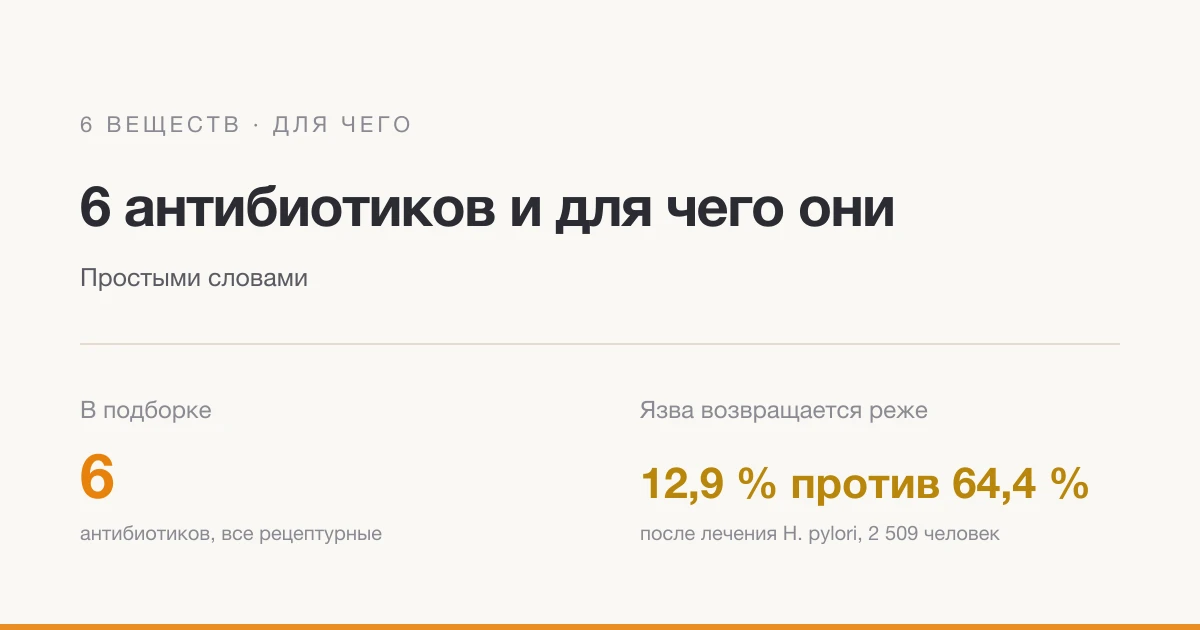
| Clarithromycin | mild to moderate infections of airways and skin; in adults in combination against Helicobacter pylori | as a macrolide, stops bacteria from building proteins | Helicobacter pylori treatment vs no treatment: ulcer returned in 12.9% vs 64.4%, 27 trials, 2,509 people (relative risk 0.20; 95% CI 0.15-0.26) (Ford AC Cochrane Database Syst Rev 2016. PMID 27092708[6]) |
Amoxicillin
Doxycycline
Ciprofloxacin
Nitrofurantoin
Metronidazole
Clarithromycin
Who should see a doctor first
See a doctor before the first tablet in pregnancy and breastfeeding, penicillin allergy, kidney, liver and heart disease (arrhythmia, prolonged QT interval), myasthenia gravis, or when taking other medicines. Contact a doctor right after starting treatment for tendon pain, numbness, confusion, severe diarrhoea, shortness of breath, yellowing of the skin, rash and facial swelling (signs of drug allergy).
Bottom line
The six antibiotics work differently: amoxicillin and clarithromycin for airway infections (clarithromycin also in the regimen against Helicobacter pylori), doxycycline for tick-borne and chlamydial infections, ciprofloxacin with strict safety limits, nitrofurantoin in the urinary tract, metronidazole against bacteria without oxygen and trichomonads. All six are prescription-only: the doctor prescribes and sets the duration, and the course is taken to the end as directed.
References
- Little P Lancet Infect Dis 2013. PMID 23265995
- Páez-Canro C Cochrane Database Syst Rev 2019. PMID 30682211
- Effa EE Cochrane Database Syst Rev 2011. PMID 21975746
- Huttner A J Antimicrob Chemother 2016. PMID 26066581
- Kissinger P Lancet Infect Dis 2019. PMID 30297322
- Ford AC Cochrane Database Syst Rev 2016. PMID 27092708
Key facts
- In a trial of 2,061 adults with a cough and no suspected pneumonia, amoxicillin versus placebo did not shorten the duration of symptoms (hazard ratio 1.06; 95% confidence interval (CI) 0.96-1.18); new or worsening symptoms occurred in 15.9% vs 19.3%. So for an ordinary cough an antibiotic is not always prescribed, only when the doctor suspects a bacterial infection (Little P Lancet Infect Dis 2013. PMID 23265995).
- In men with urogenital chlamydia, the risk of microbiological failure was higher with single-dose azithromycin than with 7-day doxycycline: relative risk 2.45; 95% CI 1.36-4.41 (9 studies, 821 people) (Páez-Canro C Cochrane Database Syst Rev 2019. PMID 30682211).
- Ciprofloxacin carries a boxed warning from the FDA (the US drug agency): tendons, nerves, the central nervous system and worsening of myasthenia gravis; for acute uncomplicated cystitis, acute sinusitis and exacerbation of chronic bronchitis it is kept for patients with no alternative.
- Nitrofurantoin for cystitis: in individual studies of the review (27 trials, mostly from the 1970s-1990s) clinical cure ranged from 79% to 92%; in the most robust studies a 5- or 7-day course was equivalent to trimethoprim/sulfamethoxazole, ciprofloxacin and amoxicillin (Huttner A J Antimicrob Chemother 2016. PMID 26066581).
- Metronidazole for trichomoniasis in women (623 women): 4 weeks after the end of treatment the infection persisted in 11% after a 7-day course vs 19% after a single dose (relative risk 0.55; 95% CI 0.34-0.70) (Kissinger P Lancet Infect Dis 2019. PMID 30297322).
- Treatment that eradicates Helicobacter pylori compared with no treatment: duodenal ulcer returned in 12.9% vs 64.4% (27 trials, 2,509 people; relative risk 0.20; 95% CI 0.15-0.26) (Ford AC Cochrane Database Syst Rev 2016. PMID 27092708).