In plain words: what helps knee pain
What this is about
Knee osteoarthritis: it hurts on walking and on stairs.
- there are five measures with clear benefit
- from the safest to the strongest
Place 5: exercise
Leg exercises and sessions in water.
- thigh muscles take over the load
- in water the joints have it easier
- the safest first step
Place 4: injection
An injection into the joint is given by a doctor.
- helps in the first weeks
- by half a year no effect is seen
- a measure for a flare-up
Place 3: chondroitin
A substance from cartilage in capsules.
- courses of up to half a year
- pain a little lower
- discussed with a doctor
Place 2: gel
A gel on the knee for 6-12 weeks.
- less gets into the blood than from tablets
- benefit beyond a gel without medicine in some people
Place 1: tablets
Anti-inflammatory tablets.
- strong pain relief
- not for everyone and not for long
- only a doctor prescribes them
Important. Important: with stomach, heart and kidney disease such tablets are not suitable for everyone.
How to build a plan
Start simple and move up.
- exercise 2-3 times a week
- gel in a flare-up
- the rest together with a doctor
When to see a doctor
See a doctor first if:
- knee pain does not go away
- the knee is swollen, red or hot
- you cannot put weight on the leg
Important. Important: choose the plan for your knees together with a doctor.
Key points
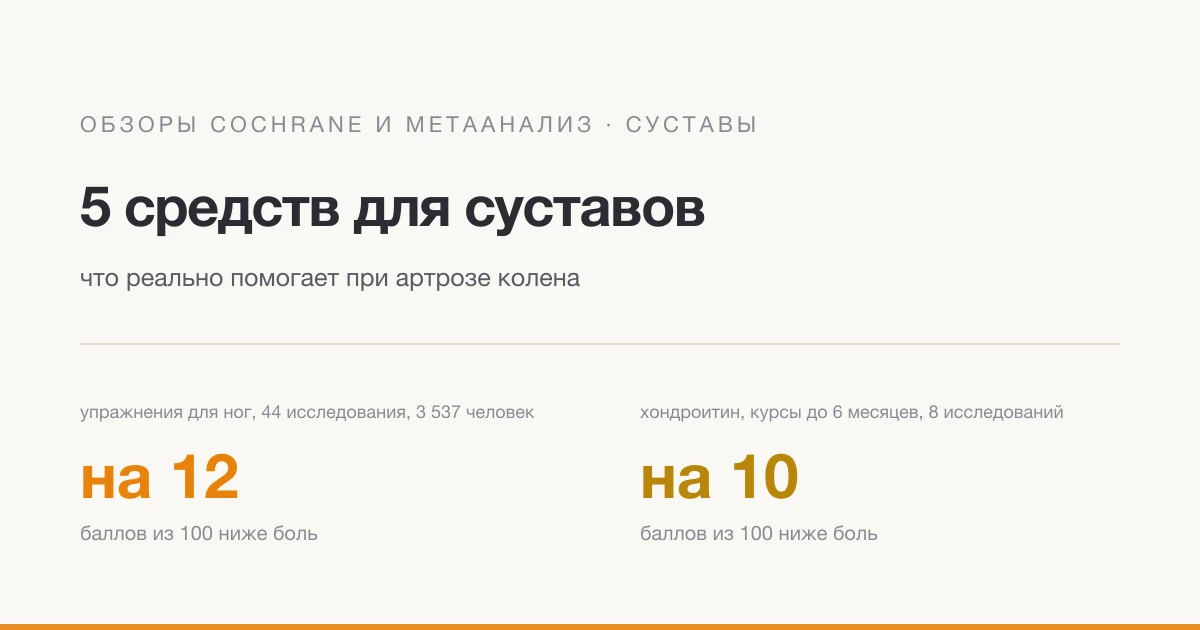
In knee osteoarthritis pain can be reduced in several ways. When the results of Cochrane reviews and one network meta-analysis are put side by side, the five, from the safest to the strongest, are: leg exercises and water exercise, an injection into the joint by a doctor, chondroitin, a pain-relieving gel on the knee and, in first place, anti-inflammatory tablets prescribed by a doctor. You start with the safest: exercise lowers pain by 12 points out of 100 (44 trials, 3,537 people, high-quality evidence) and improves mobility by 10 points out of 100 (3,913 people). A gel on the knee for 6-12 weeks gives noticeable relief in about 60% of people (about half in the group with gel without the active substance). Choose the plan for your knees together with a doctor.
| What | How much | Why it helps | What studies showed |
|---|---|---|---|
| 5. Leg exercises (strength, mobility) | a course of sessions; 2-6 months after the course the effect is smaller but remains | Less pain, better mobility | Cochrane: pain lower by 12 points out of 100 (44 trials, 3,537 people); mobility better by 10 points out of 100 (44 trials, 3,913 people) |
| 5. Water exercise | on average 12 weeks | Less pain, better quality of life | Cochrane: pain lower by 5 points out of 100 (12 trials, 1,076 people), a small short-term effect |
| 4. Corticosteroid injection into the joint by a doctor | at the doctor's decision | Less pain in the first weeks | Cochrane: pain lower by 1.0 cm out of 10, that is 10 points out of 100 (27 trials, 1,767 people); no effect seen at 26 weeks |
| 3. Chondroitin | courses of up to 6 months | Less pain, the joint space narrows more slowly | Cochrane: pain lower by 10 points out of 100 (8 trials); the space narrows more slowly by 4.7% (2 trials) |
| 2. Pain-relieving gel on the knee | a course of 6-12 weeks | Noticeably less pain | Cochrane: 39 trials, 10,631 people; about 60% had noticeably less pain, about half with a gel without medicine |
| 1. Anti-inflammatory tablets prescribed by a doctor | the doctor chooses the dose | The strongest pain reduction among the medicines studied | BMJ network meta-analysis, 192 trials and 102,829 people in total: benefit beyond the noticeable threshold with a probability from 99% |
How to read this list
In studies pain is measured on a scale from 0 to 100, where 0 is no pain. If pain became lower by 12 points out of 100, it was, say, 44 and became 32. The list runs as in the video: from the safest to the strongest. This is mostly about knee osteoarthritis; where a review also included the hip, it is said separately.
Place 5. Leg exercises and water exercise
This is the safest option, and it is where to start. In a Cochrane review exercise (therapeutic exercise on land) lowered pain by 12 points out of 100 (pain in the comparison group was 44) in 44 trials with 3,537 people, and the quality of evidence was rated high. Mobility improved by 10 points out of 100 (44 trials, 3,913 people). 2-6 months after the course ended, pain was still 6 points out of 100 lower (12 trials, 1,468 people). There were no serious adverse events (Fransen M Cochrane Database Syst Rev 2015. PMID 25569281[1]).
Water exercise gives a small short-term effect in people with knee and hip osteoarthritis (moderate-quality evidence): pain lower by 5 points out of 100 (12 trials, 1,076 people), quality of life higher by 7 points out of 100 (10 trials, 971 people). No serious adverse events were reported in these trials (Bartels EM Cochrane Database Syst Rev 2016. PMID 27007113[2]). An example week: two sessions for the thigh muscles (standing up from a chair, heel raises, step-ups) and one in a pool, where water takes the load off the joints.
Place 4. An injection into the joint by a doctor
A corticosteroid injection into the joint is given by a doctor. In a Cochrane review of 27 trials (1,767 people), pain after the injection was lower by 1.0 cm on a ten-centimetre scale (that is, 10 points out of 100). The difference is largest in the first weeks: moderate at 1-2 weeks, small to moderate at 4-6 weeks, small at 13 weeks, and no effect is seen at 26 weeks. The authors rated the evidence as low quality and called it unclear how much the benefit at 1-6 weeks matters to a person (Jüni P Cochrane Database Syst Rev 2015. PMID 26490760[3]).
That is why an injection is a measure for a flare-up, not a permanent treatment.
Place 3. Chondroitin
Chondroitin is a substance from cartilage tissue, sold in capsules. In a Cochrane review, in courses of up to 6 months, pain was lower by 10 points out of 100 in 8 trials; that is about 18 points versus 28 in the placebo group. The NNT is 5: of every 5 people, one gets relief beyond placebo. The authors rated the evidence as low quality, and the trials differed from one another (Singh JA Cochrane Database Syst Rev 2015. PMID 25629804[4]).
There are other pluses: in two trials (high-quality evidence) the joint space, that is, the distance between the bones, narrowed 4.7% more slowly than with placebo, and serious adverse events were fewer on chondroitin than on placebo (OR 0.40; 95% CI 0.19-0.82; 6 trials) (Singh JA Cochrane Database Syst Rev 2015. PMID 25629804[4]).
Place 2. A pain-relieving gel on the knee
A gel with an anti-inflammatory substance is rubbed into the skin over the knee. In a Cochrane review of 39 trials (10,631 people), over a course of 6-12 weeks about 60% of people noted noticeably less pain. But in the group with gel without the active substance, about half also had success. So the extra benefit goes to a minority: the NNT for one of the two substances studied is 9.8 (6 trials, 2,343 people), for the other 6.9 (4 trials, 2,573 people) (Derry S Cochrane Database Syst Rev 2016. PMID 27103611[5]).
The main merit of the gel is safety: much less of the substance gets into the blood than with tablets. With one of the two substances mild skin reactions were more common than with placebo gel, with the other they were not; general and serious adverse events did not differ from placebo, though they were poorly reported (very low-quality evidence) (Derry S Cochrane Database Syst Rev 2016. PMID 27103611[5]). The authors of the BMJ meta-analysis advise considering one of the gels at the studied dose as first-line drug treatment for knee osteoarthritis (da Costa BR BMJ 2021. PMID 34642179[6]).
Place 1. Anti-inflammatory tablets prescribed by a doctor
In the BMJ network meta-analysis (192 trials and 102,829 people with knee and hip osteoarthritis in total) five anti-inflammatory tablet options (NSAIDs) reduced pain beyond the minimal threshold a person notices with a probability of 99% or more; the authors called two of them the most effective. Opioids did not show such a result, and in the authors' words their benefit does not outweigh the harm (da Costa BR BMJ 2021. PMID 34642179[6]).
But the authors stress that such tablets are probably not suitable with other illnesses or for long-term use because of a small rise in adverse events (da Costa BR BMJ 2021. PMID 34642179[6]). Only a doctor prescribes them, choosing the type, dose and length and checking the stomach, heart and kidneys.
What did not make the five
Acupuncture: in a Cochrane review from 2010, compared with sham, the difference in pain was 0.9 points out of 20, below the predefined threshold of clinical relevance (9 trials, 1,835 people) (Manheimer E Cochrane Database Syst Rev 2010. PMID 20091527[7]), so it did not make the five. Glucosamine did not make the five either.
How to build a plan with your doctor
- The basis: exercises for the thigh muscles 2-3 times a week and sessions in water if there is a pool.
- In a flare-up the doctor may suggest a gel on the knee for 6-12 weeks or, if needed, an injection into the joint.
- Discuss chondroitin with the doctor: the benefit in studies is small to moderate, courses up to 6 months.
- Tablets prescribed by a doctor are for strong pain: a short course under control.
Who should see a doctor first
See a doctor for knee pain that does not go away, for swelling, redness and heat in the joint, or when you cannot put weight on the leg. Choose the plan for your knees together with a doctor, and do not change prescribed treatment on your own.
Bottom line
Five measures in knee osteoarthritis, from the safest to the strongest: leg exercises and water exercise, an injection into the joint by a doctor, chondroitin, a gel on the knee and anti-inflammatory tablets prescribed by a doctor. You start with the safest, exercise and gel, and move up the list together with a doctor.
References
- Fransen M Cochrane Database Syst Rev 2015. PMID 25569281
- Bartels EM Cochrane Database Syst Rev 2016. PMID 27007113
- Jüni P Cochrane Database Syst Rev 2015. PMID 26490760
- Singh JA Cochrane Database Syst Rev 2015. PMID 25629804
- Derry S Cochrane Database Syst Rev 2016. PMID 27103611
- da Costa BR BMJ 2021. PMID 34642179
- Manheimer E Cochrane Database Syst Rev 2010. PMID 20091527
Key facts
- Leg exercises in knee osteoarthritis: pain lower by 12 points out of 100 (95% CI 10-15; 44 trials, 3,537 people, high-quality evidence), mobility better by 10 points out of 100 (44 trials, 3,913 people); 2-6 months after the course pain is still 6 points out of 100 lower (12 trials, 1,468 people) (Fransen M Cochrane Database Syst Rev 2015. PMID 25569281).
- Water exercise: pain lower by 5 points out of 100 (12 trials, 1,076 people), quality of life higher by 7 points out of 100 (10 trials, 971 people), no serious adverse events (Bartels EM Cochrane Database Syst Rev 2016. PMID 27007113).
- A gel on the knee for 6-12 weeks: about 60% had noticeably less pain (39 trials, 10,631 people); in the group with gel without the active substance about half had success (Derry S Cochrane Database Syst Rev 2016. PMID 27103611).
- Chondroitin in courses of up to 6 months: pain lower by 10 points out of 100 (95% CI 6-15; 8 trials, low-quality evidence), joint space narrows 4.7% more slowly (2 trials) (Singh JA Cochrane Database Syst Rev 2015. PMID 25629804).
- Anti-inflammatory tablets: the two options the authors called the most effective reduced pain beyond the threshold a person notices with a probability of 99% or more (network meta-analysis, 192 trials and 102,829 people in total); they are probably not suitable with other illnesses or for long-term use; prescribed by a doctor (da Costa BR BMJ 2021. PMID 34642179).
- A corticosteroid injection into the joint: pain lower by 1.0 cm out of 10 (27 trials, 1,767 people, low-quality evidence); the difference is largest in the first 1-6 weeks and shrinks over time, with no effect seen at 26 weeks (Jüni P Cochrane Database Syst Rev 2015. PMID 26490760).