In plain words: what these tests are and why
Why these tests
They show heart risk in advance.
- the heart and vessels give no signals for a long time
- a test shows it earlier than how you feel
1. ApoB
Counts the particles that carry cholesterol.
- not only the load matters, but also the number of particles
- more precise than ordinary cholesterol
2. Lp(a)
An inherited marker.
- set almost entirely by heredity
- usually one test is enough
- an association, not a verdict
3. hs-CRP
Shows quiet inflammation in the body.
- taken together with other tests
- helps to see the whole picture
4. HbA1c
Average sugar over three months.
- one test instead of many measurements
- helps to notice rising sugar earlier
5. Non-HDL
Total cholesterol minus the good one.
- already in an ordinary lipid panel
- a single subtraction
How to use this
Save the list and compare it with your results.
- take your latest tests
- mark what is missing
- discuss the results with a doctor
When to see a doctor
Results are discussed with a doctor.
- a value outside the reference point
- early heart disease in the family
- chest pain or breathlessness on exertion
Important. Important: the reference points show risk, they do not make a diagnosis.
Key points
The heart and vessels work silently for a long time, and tests notice changes before you feel them. Five tests after 25 give a good picture of risk: apoB, lipoprotein(a), high-sensitivity C-reactive protein, glycated hemoglobin and non-HDL cholesterol. One of them is already in an ordinary lipid panel, and another usually needs to be taken only once. The thresholds below come from guidelines and large observations: they show risk, they do not make a diagnosis, and results are discussed with a doctor.
| Test | Threshold from guidelines | Why it helps | What studies showed |
|---|---|---|---|
| ApoB | 1.3 g/L (130 mg/dL) and above adds risk | Counts the particles that carry cholesterol | 389,529 people: heart attack risk linked to a 1.27-fold rise per standard deviation |
| Lp(a) | Above 125 nmol/L (50 mg/dL): show a doctor; below 75 nmol/L (30 mg/dL): risk excluded | Inherited, usually one test is enough | 2022 guidelines: measure at least once in adults |
| hs-CRP | 2 mg/L (0.2 mg/dL) and above adds risk | Quiet inflammation in the body | 27,939 women, 30 years: top fifth linked to a 1.70-fold rise in composite risk versus the bottom fifth |
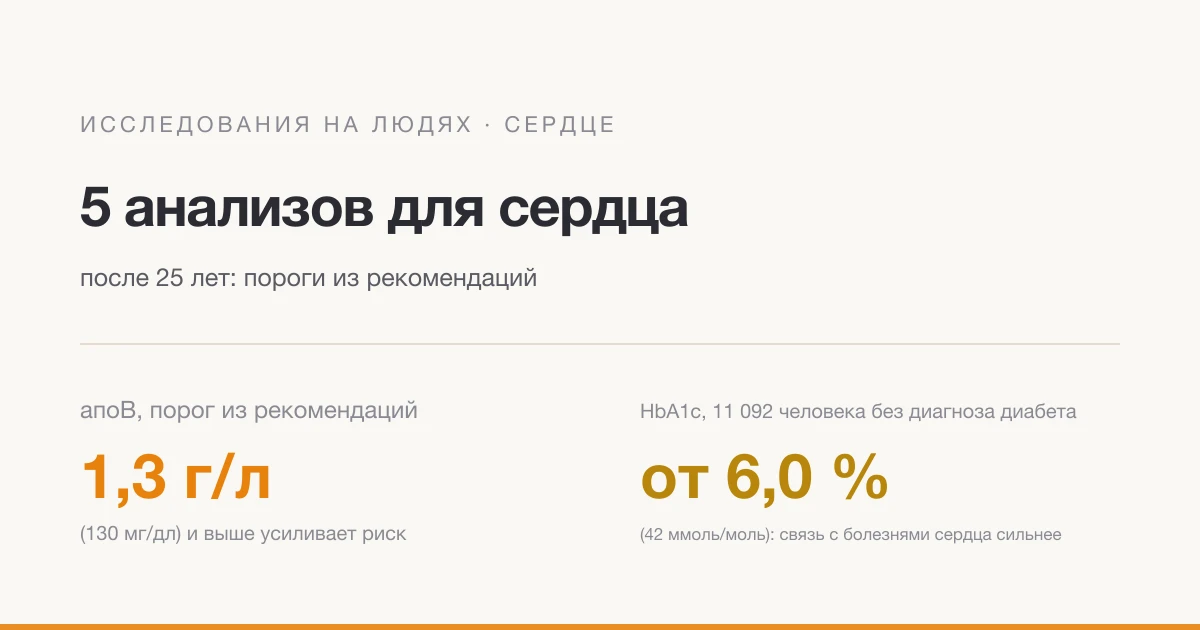
| HbA1c | From 6.0% (42 mmol/mol) | Average sugar over 3 months | 11,092 people without diagnosed diabetes: at 6.0–<6.5% coronary heart disease risk 1.78 times higher than at 5.0–<5.5% |
| Non-HDL | Below 2.6 mmol/L (100 mg/dL): lowest risk | Already in the lipid panel | In women over 30 years: 7.7% events below 2.6 mmol/L (100 mg/dL) versus 33.7% from 5.7 mmol/L (220 mg/dL); 398,846 people in the whole cohort |
1. ApoB: counting particles
Cholesterol travels in the blood inside particles, and each particle carries one apoB protein on its surface. So the apoB test counts the particles themselves: one apoB molecule per particle. What matters is not only how much cargo they carry but how many of them there are. In a large observation of 389,529 people, per standard deviation of apoB the risk of heart attack was linked to a 1.27-fold rise (Marston NA JAMA Cardiol 2022. PMID 34773460[1]).
The reference point from the guidelines: apoB of 1.3 g/L (130 mg/dL) and above adds risk (Grundy SM Circulation 2019. PMID 30586774[2]). In practice this gives a more precise picture than total cholesterol alone: two people with the same cholesterol can differ in the number of particles. The good news is that you can learn this from a single blood test.
2. Lp(a): usually one test is enough
Lipoprotein(a), Lp(a) for short, is almost entirely set by heredity. So you usually do not need to track it for years: it is measured at least once in adult life. In the guidelines, below 75 nmol/L (30 mg/dL) the risk from Lp(a) is considered excluded, and above 125 nmol/L (50 mg/dL) confirmed (Kronenberg F Eur Heart J 2022. PMID 36036785[3]). Between them lies a grey zone of 75–125 nmol/L.
The practical meaning is simple. If the value is below 75 nmol/L (30 mg/dL), the test usually does not need repeating. If it is above 125 nmol/L (50 mg/dL), the result is worth showing to a doctor, who will look at it together with your other values and family history. The units nmol/L and mg/dL are not converted into each other, so compare with the units printed on your own result.
3. hs-CRP: quiet inflammation
High-sensitivity C-reactive protein, hs-CRP, shows quiet inflammation in the body, the kind that neither hurts nor causes a fever. In the guidelines 2 mg/L (0.2 mg/dL) and above is among the risk-enhancing factors (Grundy SM Circulation 2019. PMID 30586774[2]). In a large observation of 27,939 women over 30 years, the top fifth of hs-CRP values was linked to a 1.70-fold rise in composite cardiovascular risk compared with the bottom fifth (Ridker PM N Engl J Med 2024. PMID 39216091[4]).
The test is useful as an extra touch to the picture. It pairs well with apoB: apoB counts the particles, hs-CRP shows the background. Take it when you are well, not during a cold: an acute infection raises the protein and distorts the picture. If the value is raised, the doctor will suggest repeating the test.
4. HbA1c: average sugar over three months
Glycated hemoglobin, HbA1c, shows the average blood sugar over three months. It is one test instead of many measurements, and it can be taken at any time of day. In an observation of 11,092 people without diagnosed diabetes, at HbA1c of 6.0–<6.5% the risk of coronary heart disease was 1.78 times higher (95% CI 1.48–2.15) than at 5.0–<5.5% (Selvin E N Engl J Med 2010. PMID 20200384[5]). That is why from 6.0% (42 mmol/mol) the link with heart disease is stronger.
This is a signal for a talk with a doctor, not a reason to panic. The good side is that sugar can be managed: movement, sleep, meals with vegetables and legumes, fewer sugary drinks. For a self-check there is an insulin resistance test: /en/tools/insulin-resistance-test, which helps you understand what to talk about at the appointment.
5. Non-HDL: already in the lipid panel
Non-HDL cholesterol is total cholesterol minus the "good" HDL cholesterol. Nothing extra needs to be taken: it is worked out from an ordinary lipid panel. It adds together all the cholesterol in the particles that are linked to risk. In a large observation (398,846 people in the whole cohort), the 30-year cardiovascular event rate in women was 7.7% at non-HDL below 2.6 mmol/L (100 mg/dL) versus 33.7% at 5.7 mmol/L (220 mg/dL) and above (Brunner FJ Lancet 2019. PMID 31810609[6]). Below 2.6 mmol/L (100 mg/dL) is linked to the lowest risk.
It is easy to work out: take your lipid panel and subtract HDL from total cholesterol. Or enter the numbers in the calculator: /en/tools/non-hdl-cholesterol-calculator. It is the most accessible of the five tests: you most likely have it already.
How to apply
- Take your latest results and mark which of the five tests are missing.
- Work out non-HDL yourself: total cholesterol minus HDL, reference point below 2.6 mmol/L (100 mg/dL).
- Measure Lp(a) once; take apoB, hs-CRP and HbA1c together with your usual tests.
- Save the table and compare it with each new result in the same units.
- Bring the results to the appointment: decisions about follow-up and treatment are made by a doctor.
Who should see a doctor first
Discuss the result of any of the five tests with a doctor. Thresholds from guidelines and observations show risk, they do not make a diagnosis. See a doctor first if there was early heart disease in the family, if you have diabetes, raised blood pressure or smoke, and for chest pain, breathlessness on exertion and sudden weakness.
Summary
Five tests give a clear picture: apoB counts particles, Lp(a) shows heredity, hs-CRP quiet inflammation, HbA1c average sugar, non-HDL all the "bad" cholesterol together. Save the list, compare it with your own results and bring them to a doctor: that way heart risk becomes clear in advance, not at the moment of trouble.
References
- Marston NA JAMA Cardiol 2022. PMID 34773460
- Grundy SM Circulation 2019. PMID 30586774
- Kronenberg F Eur Heart J 2022. PMID 36036785
- Ridker PM N Engl J Med 2024. PMID 39216091
- Selvin E N Engl J Med 2010. PMID 20200384
- Brunner FJ Lancet 2019. PMID 31810609
Key facts
- ApoB counts cholesterol-carrying particles: per standard deviation of apoB, the risk of heart attack was linked to a 1.27-fold rise (389,529 people; observational); 1.3 g/L (130 mg/dL) and above adds risk in the guidelines (Marston NA JAMA Cardiol 2022. PMID 34773460; Grundy SM Circulation 2019. PMID 30586774).
- Lp(a) is almost entirely inherited and adults are tested at least once; below 75 nmol/L (30 mg/dL) the risk from it is excluded, above 125 nmol/L (50 mg/dL) it is confirmed and the result is worth showing to a doctor (Kronenberg F Eur Heart J 2022. PMID 36036785).
- hs-CRP shows quiet inflammation: 2 mg/L (0.2 mg/dL) and above adds risk (Grundy SM Circulation 2019. PMID 30586774); in 27,939 women over 30 years the top fifth of values was linked to a 1.70-fold rise in a composite risk compared with the bottom fifth (Ridker PM N Engl J Med 2024. PMID 39216091).
- HbA1c from 6.0% (42 mmol/mol): in 11,092 people without diagnosed diabetes, at 6.0–<6.5% the risk of coronary heart disease was 1.78 times higher (95% CI 1.48–2.15) than at 5.0–<5.5%; observational (Selvin E N Engl J Med 2010. PMID 20200384).
- Non-HDL below 2.6 mmol/L (100 mg/dL) is linked to the lowest risk: in women the 30-year cardiovascular event rate was 7.7% below 2.6 mmol/L (100 mg/dL) versus 33.7% at 5.7 mmol/L (220 mg/dL) and above (398,846 people in the whole cohort; observational) (Brunner FJ Lancet 2019. PMID 31810609).