Key points
Why excess happens
Burgerstein's handbook says that for most micronutrients the gap between a beneficial and a harmful dose is very wide, with the possible exception of vitamin A (Burgerstein, Handbuch Nährstoffe 2015, p. 20, 22). But for some substances the threshold is close: EFSA's upper limit for selenium in adults is 255 µg a day, while hair loss was already noted at 330 µg a day in a large cancer-prevention trial of selenium and vitamin E (SELECT) (Turck D EFSA J 2023. PMID 36698500[3]). Excess can build up from several supplements with the same substance or from mistakes: the handbook warns about mixing up micrograms and milligrams, which is a 1,000-fold difference (Burgerstein, Handbuch Nährstoffe 2015, p. 135).
Vitamin D
Vitamin D poisoning is rare but dangerous. The main feature is high blood calcium (hypercalcemia); the most commonly described symptoms are confusion, apathy, repeated vomiting, abdominal pain, passing a lot of urine, thirst and dehydration. A sign of poisoning from overdose is a 25-hydroxyvitamin D (25(OH)D) level above 150 ng/mL (375 nmol/L) (Marcinowska-Suchowierska E Front Endocrinol 2018. PMID 30294301[6]).
In the described cases in children, the doses were enormous: 240,000–4,500,000 IU in total (6–112.5 mg), because of manufacturing, formulation or prescribing errors. Rarely, calcium also rises on usual doses: in infants with rickets and in cases of increased sensitivity to vitamin D (Vogiatzi MG J Clin Endocrinol Metab 2014. PMID 24456284[7]; Marcinowska-Suchowierska E Front Endocrinol 2018. PMID 30294301[6]).
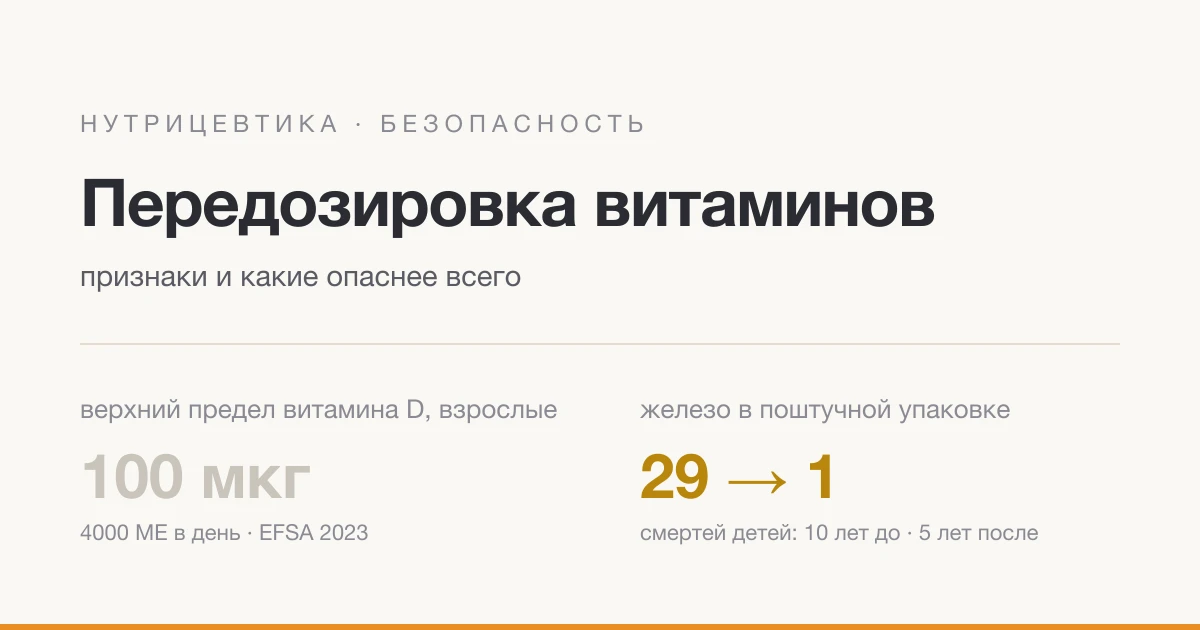
EFSA's upper limit is 100 µg (4,000 IU) a day for adults, pregnant women and adolescents aged 11–17, and 50 µg (2,000 IU) for children aged 1–10 (Turck D EFSA J 2023. PMID 37560437[1]). The handbook called long-term intake above 100 µg (4,000 IU) dangerous for children (Burgerstein, Handbuch Nährstoffe 2015, p. 69); the current limit for children aged 1–10 is half that. How much to take in winter is covered in a separate article.
Vitamin A and pregnancy
Preformed vitamin A (retinol) is found in liver and in supplements. The handbook describes poisoning with long-term intake above 50,000–100,000 IU (15,000–30,000 µg) a day: hair loss, headache, bone pain, dry skin, an enlarged liver (Burgerstein, Handbuch Nährstoffe 2015, p. 62–63).
The main risk is pregnancy. Among 22,748 pregnant women, birth defects of a certain type (in tissues derived from the cranial neural crest) were 4.8 times more common with more than 10,000 IU (3,000 µg) of vitamin A a day from supplements than with 5,000 IU (1,500 µg) or less; by the authors' estimate, in about 1 in 57 such babies the defect was linked to the supplement. The risk was linked to intake before the 7th week of pregnancy (Rothman KJ N Engl J Med 1995. PMID 7477116[8]).
That is why EFSA based the limit on harm to the fetus: 3,000 µg (about 10,000 IU) a day for adults, including pregnant women (Turck D EFSA J 2024. PMID 38846679[9]). The handbook is stricter: in pregnancy, no more than 8,000 IU (2,400 µg) in total (Burgerstein, Handbuch Nährstoffe 2015, p. 61).
B6 and niacin
EFSA considers the link between excess B6 and damage to the peripheral nerves (neuropathy: numbness and tingling) to be firmly established. The limit is 12 mg a day for adults and 3.2–4.5 mg for children aged 1–6; the reference point was 50 mg a day (Turck D EFSA J 2023. PMID 37207271[2]).
Niacin (vitamin B3) at doses of 500–3,000 mg a day used to be prescribed for high cholesterol. In a study of 46 adults (23 on each form): on the regular form, 39% stopped taking it before reaching the maximum dose, most often because of flushing; on the sustained-release form, the liver was damaged in 12 of 23 (52%), on the regular form in no one (McKenney JM JAMA 1994. PMID 8309029[5]).
Iron
Before 1997, iron poisoning was one of the leading causes of death from accidental poisoning in young children; after unit-dose packaging was introduced in the US, there was 1 death in 5 years (Tenenbein M Arch Pediatr Adolesc Med 2005. PMID 15939855[4]).
For adults, the handbook advises starting high doses of iron only after a blood test; in hemochromatosis (inherited iron build-up) they are contraindicated (Burgerstein, Handbuch Nährstoffe 2015, p. 114–115). More in Ferritin and the liver.
Selenium and zinc
In 2008, a liquid supplement in the US contained 200 times more selenium than labeled. A total of 201 people were affected; the typical dose was 41,749 µg a day. The most common symptoms were diarrhea (78%), fatigue (75%) and hair loss (72%); nail changes in 52% lasted 90 days or longer (MacFarquhar JK Arch Intern Med 2010. PMID 20142570[10]).
The selenium limit can be exceeded with regular use of high-dose supplements or Brazil nuts (Turck D EFSA J 2023. PMID 36698500[3]). The 2015 handbook considered up to 400 µg a day safe (Burgerstein, Handbuch Nährstoffe 2015, p. 135); this is above the current limit.
At high doses, zinc displaces copper and with long-term use causes copper deficiency; with intake above 25 mg a day for longer than 6 weeks, the handbook advises monitoring copper (Burgerstein, Handbuch Nährstoffe 2015, p. 112, 136). More about zinc.
What the studies showed
| What was studied | Who took part | Result |
|---|---|---|
| Vitamin A in pregnancy, 1995 | 22,748 pregnant women | More than 10,000 IU (3,000 µg) from supplements vs 5,000 IU (1,500 µg) or less: defects of a certain type 4.8 times more common |
| Niacin, 1994 | 46 adults | Sustained-release form: liver damage in 12 of 23 (52%); regular form: 0% |
| Iron packaging, 2005 | Children under 6, US | Deaths: 1 in 5 years vs 29 in 10 years |
| Selenium in a supplement, 2010 | 201 people | Diarrhea in 78%, hair loss in 72% |
Not everything has been measured precisely: for beta-carotene, EFSA could not set an upper limit because of insufficient data, and for B6 the dose at which harm begins could not be determined in humans (Turck D EFSA J 2024. PMID 38846679[9]; Turck D EFSA J 2023. PMID 37207271[2]).
Who should be more careful
- Pregnant women and those planning pregnancy: preformed vitamin A no higher than the limit; liver is best avoided (Turck D EFSA J 2024. PMID 38846679[9]).
- Smokers: EFSA advises against taking beta-carotene supplements (Turck D EFSA J 2024. PMID 38846679[9]).
- People with granulomatous diseases (for example, sarcoidosis) and some lymphomas: the body itself makes excess active vitamin D (Marcinowska-Suchowierska E Front Endocrinol 2018. PMID 30294301[6]).
- See a doctor without delay: with vomiting, thirst and confusion while taking vitamin D, numbness in the hands and feet while taking B6, hair loss while taking selenium; if a child has swallowed iron, call an ambulance straight away.
Bottom line
In usual doses, vitamins and minerals are safe for most people; excess comes from high doses, stacking supplements and mistakes with units. You can have your supplement regimen chosen for you at a consultation.
This material is for information only and does not replace a consultation with a doctor. Supplement doses, especially in pregnancy, in children and in chronic diseases, are chosen by a doctor.
References
- Turck D EFSA J 2023. PMID 37560437
- Turck D EFSA J 2023. PMID 37207271
- Turck D EFSA J 2023. PMID 36698500
- Tenenbein M Arch Pediatr Adolesc Med 2005. PMID 15939855
- McKenney JM JAMA 1994. PMID 8309029
- Marcinowska-Suchowierska E Front Endocrinol 2018. PMID 30294301
- Vogiatzi MG J Clin Endocrinol Metab 2014. PMID 24456284
- Rothman KJ N Engl J Med 1995. PMID 7477116
- Turck D EFSA J 2024. PMID 38846679
- MacFarquhar JK Arch Intern Med 2010. PMID 20142570
Key facts
- According to the European Food Safety Authority (EFSA), people in Europe are unlikely to exceed the upper limit for vitamin D, B6 and selenium from ordinary food; it may be exceeded by those who regularly take high-dose supplements (for selenium, also by Brazil nut lovers) (Turck D, EFSA J 2023).
- The upper limit for vitamin D is 100 µg (4,000 international units, IU) a day for adults and 50 µg (2,000 IU) for children aged 1–10 (Turck D, EFSA J 2023).
- A sign of vitamin D poisoning from overdose is a 25-hydroxyvitamin D (25(OH)D) level above 150 ng/mL (375 nmol/L) (Marcinowska-Suchowierska E, Front Endocrinol 2018).
- After iron in the US switched to unit-dose packaging, there was 1 death of a child under 6 from iron poisoning in 5 years, versus 29 in the 10 years before it (Tenenbein M, Arch Pediatr Adolesc Med 2005).
- In 2008, a liquid supplement that contained 200 times more selenium than labeled poisoned 201 people in 10 US states (MacFarquhar JK, Arch Intern Med 2010).