in pictures and a few words
What it is and why
Gliquidone (Glurenorm) is a tablet for type 2 diabetes. It helps the pancreas release insulin, and blood sugar falls.
- 30 mg tablet, can be halved
- Treatment is prescribed by a doctor
How it works
Gliquidone nudges beta cells to release insulin in response to glucose. Your own insulin is needed: it does not work in type 1 diabetes.
- It also raises insulin sensitivity
Barely burdens the kidneys
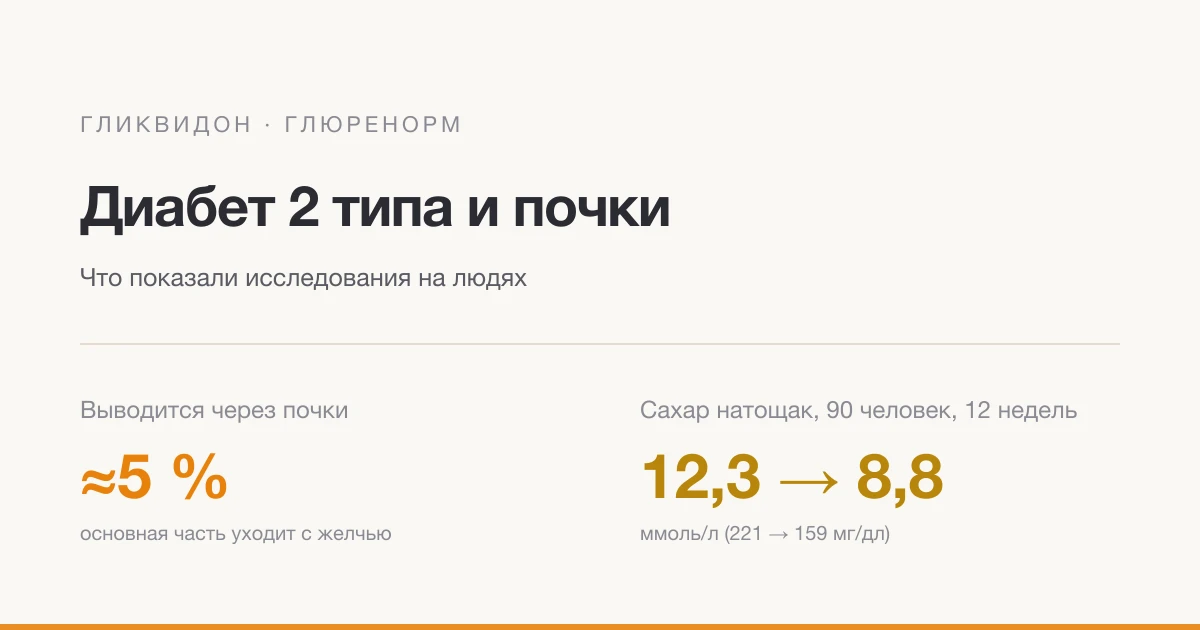
Only about 5% of a dose leaves in urine. The liver clears the rest into bile.
- No build-up in kidney disease
- Severe kidney disease — under a doctor's control
Short action
Sugar starts to fall after 60–90 minutes, most of all at 2–3 hours. The effect lasts 8–10 hours.
- Easy to match to meals
Lower sugar
In 90 people over 12 weeks, fasting glucose fell from 12.3 to 8.8 mmol/L (from 220.8 to 159.1 mg/dL).
- Glycated haemoglobin HbA1: 11.3 → 9.2%
- Fewer lows than with glibenclamide
How to take it
At the start of a meal, not before it. People usually start with 15 mg at breakfast.
- Up to 60 mg a day — once at breakfast
- More — in 2–3 doses, at most 120 mg
Low sugar
Below 3.9 mmol/L (70 mg/dL): shaking, sweating, hunger, palpitations. Eat something sweet straight away.
- Higher risk if you skip a meal
- Exercise and alcohol change the effect
Important. Important: below 3.0 mmol/L (54 mg/dL) — always see a doctor; if confused — call an ambulance.
Who should see a doctor first
Do not start the tablet without a doctor if you have:
- type 1 diabetes, severe liver disease
- severe kidney disease, older age
- other diabetes medicines, beta blockers
Important. Important: gliquidone is not used in pregnancy or while breastfeeding.
In one sentence
Gliquidone lowers sugar in type 2 diabetes and is barely cleared by the kidneys.
- Take it at the start of a meal
- Do not skip meals
- The doctor sets the dose
Key points
| Substance | How much | Benefit | What studies showed |
|---|---|---|---|
| Gliquidone (Glurenorm), 30 mg tablets | 15–120 mg a day at the start of a meal; up to 60 mg — once at breakfast, more — in 2–3 doses | lowers blood sugar in type 2 diabetes, only about 5% cleared by the kidneys | 90 people: fasting glucose 12.3 → 8.8 mmol/L (220.8 → 159.1 mg/dL) over 12 weeks; 20 people: control like glibenclamide, fewer lows |
How it works
Gliquidone is a second-generation sulfonylurea. It helps the beta cells of the pancreas release insulin in response to glucose, and in the liver and fat tissue it raises insulin sensitivity. It works only while the body still makes its own insulin (Glurenorm SmPC, section 5.1).
The drug is almost completely absorbed and fully broken down by the liver. Its breakdown products in the blood are inactive and do not lower sugar (section 5.2).
Kidneys and liver: the key difference
In 10 healthy volunteers, labelled gliquidone taken by mouth or given into a vein was cleared mainly in the faeces, while about 5% of the dose appeared in urine (Kopitar Z Arzneimittelforschung 1975. PMID 1103897[1]).
In people with diabetes, pharmacokinetics did not differ between those with and without kidney failure; even at 60 mg three times a day, blood levels did not rise (Kopitar Z Arzneimittelforschung 1975. PMID 1243665[4]).
The Glurenorm SmPC states: in patients with diabetes and kidney failure, elimination does not change, and neither the drug nor its breakdown products accumulate (section 5.2). People with impaired kidney function or diabetic neuropathy can use it; severe kidney impairment needs close medical supervision (sections 4.4 and 5.1).
Gliquidone is not used in severe liver failure (section 4.3).
What studies showed
| Study | Who took part | Comparison | Result |
|---|---|---|---|
| von Nicolai 1997, single-blind crossover (PMID 9105542[5]) | 32 people with type 2 diabetes, single 30 mg dose | placebo | daytime glucose up to 15% lower, effect 8–10 hours |
| Nikkilä 1982, open randomised crossover, 24 weeks (PMID 6803519[6]) | 11 people with type 2 diabetes | glibenclamide | both lowered fasting glucose and HbA1; glibenclamide lowered fasting glucose more, HbA1 did not differ |
| Borthwick 1984, crossover (PMID 6428917[3]) | 20 people with type 2 diabetes | glibenclamide | similar glucose control, more lows on glibenclamide |
| Nitiyanant 1997, open, 12 weeks (PMID 9470330[2]) | 90 people with type 2 diabetes | before and after | fasting glucose 12.3 → 8.8 mmol/L (220.8 → 159.1 mg/dL), HbA1 11.3 → 9.2% |
| Tuerk 2008, retrospective, 6 months or more (PMID 18793545[7]) | 47 people with diabetes after a kidney transplant | rosiglitazone, 28 people | target reached in 62% vs 71% (difference not significant); fasting glucose 8.5 → 6.7 mmol/L (154 → 120 mg/dL) |
HbA1c is glycated haemoglobin: the share of haemoglobin that has bound glucose, in per cent. It reflects average blood sugar over 2–3 months. Older studies measured HbA1, total glycated haemoglobin, whose values run higher than HbA1c.
After kidney transplant, the target counted as reached if fasting glucose clearly fell, HbA1c went below 7%, there was no glucose in urine and no other glucose-lowering drugs were needed. Four patients had their dose lowered because of signs of low sugar (Tuerk TR Clin Nephrol 2008. PMID 18793545[7]).
Indications
According to the Glurenorm SmPC (section 4.1), gliquidone is used for type 2 diabetes in middle-aged and older people when diet is not enough to control blood sugar. If gliquidone alone is not enough, only metformin may be added (section 4.2).
How it is used
- Start: usually half a tablet (15 mg) at breakfast. The dose is raised gradually as the doctor prescribes (Glurenorm SmPC, section 4.2).
- With food: take the tablet at the start of a meal, not before it. Do not skip the meal after taking it.
- Up to 60 mg a day — once at breakfast. More than 60 mg is split into 2–3 doses, with the largest at breakfast.
- Maximum — 120 mg a day: higher doses usually do not improve glucose control.
- Children and teenagers: not used.
- Pregnancy: if it occurs or is planned, gliquidone is stopped and insulin is started (section 4.6).
Safety
- The most common side effect is hypoglycaemia, meaning blood glucose below 3.9 mmol/L (70 mg/dL) (section 4.8). The risk rises with skipped meals, taking the tablet before rather than at the start of a meal, and exercise; alcohol can either strengthen or weaken the effect. At signs of low sugar, eat something sugary straight away (section 4.4).
- Slight weight gain is possible: in 19 people over 3 months, from 65.7 to 67.2 kg (Chou SC Chang Gung Med J 2000. PMID 11039250[8]).
- The effect is strengthened by ACE inhibitors, painkillers and NSAIDs, fluoroquinolones, clarithromycin, insulin and other glucose-lowering drugs; beta blockers can mask signs of hypoglycaemia. It is weakened by corticosteroids, thiazide and loop diuretics, thyroid hormones and oral contraceptives (section 4.5).
Who should see a doctor first
In diabetes, blood sugar targets are individual and follow the doctor's plan. Below 3.0 mmol/L (54 mg/dL) — always see a doctor; with confusion or loss of consciousness — call an ambulance.
According to the Glurenorm SmPC (sections 4.3 and 4.6), gliquidone is not used:
- in type 1 diabetes, diabetic coma and precoma, ketoacidosis, or after removal of the pancreas;
- during severe infections, before surgery, in severe liver failure or acute intermittent porphyria;
- with allergy to gliquidone or sulfonamides, or hereditary galactose and lactose intolerance;
- in pregnancy or while breastfeeding.
Talk to a doctor first in these cases too (sections 4.4, 4.5 and 4.7):
- severe kidney disease, older age, irregular meals;
- other glucose-lowering drugs, beta blockers or many medicines at once, regular alcohol;
- glucose-6-phosphate dehydrogenase deficiency — haemolytic anaemia is possible;
- driving and operating machinery: avoid them when sugar is low.
Bottom line
Gliquidone is a short-acting sulfonylurea for type 2 diabetes that is barely cleared by the kidneys: about 5% of a dose leaves in urine. It lowers glucose and glycated haemoglobin, and compared with glibenclamide it caused fewer lows. The tablet is taken at the start of a meal, and the doctor sets the dose.
References
- Kopitar Z Arzneimittelforschung 1975. PMID 1103897
- Nitiyanant W J Med Assoc Thai 1997. PMID 9470330
- Borthwick LJ Eur J Clin Pharmacol 1984. PMID 6428917
- Kopitar Z Arzneimittelforschung 1975. PMID 1243665
- PMID 9105542
- PMID 6803519
- Tuerk TR Clin Nephrol 2008. PMID 18793545
- Chou SC Chang Gung Med J 2000. PMID 11039250
Key facts
- Gliquidone (Glurenorm) is a second-generation sulfonylurea: it helps the beta cells of the pancreas release insulin in response to glucose (Glurenorm SmPC, section 5.1).
- Only about 5% of a dose leaves in urine; most is cleared through the liver into bile and the gut (Kopitar Z Arzneimittelforschung 1975. PMID 1103897).
- The effect starts after 60–90 minutes, peaks at 2–3 hours and lasts 8–10 hours (section 5.1).
- The SmPC indication is type 2 diabetes in middle-aged and older people when diet alone is not enough (section 4.1).
- Dosing: from 15 mg at breakfast up to 120 mg a day, always at the start of a meal; more than 60 mg a day is split into 2–3 doses (section 4.2).