the eye capsule in pictures and a few words
What it is and why
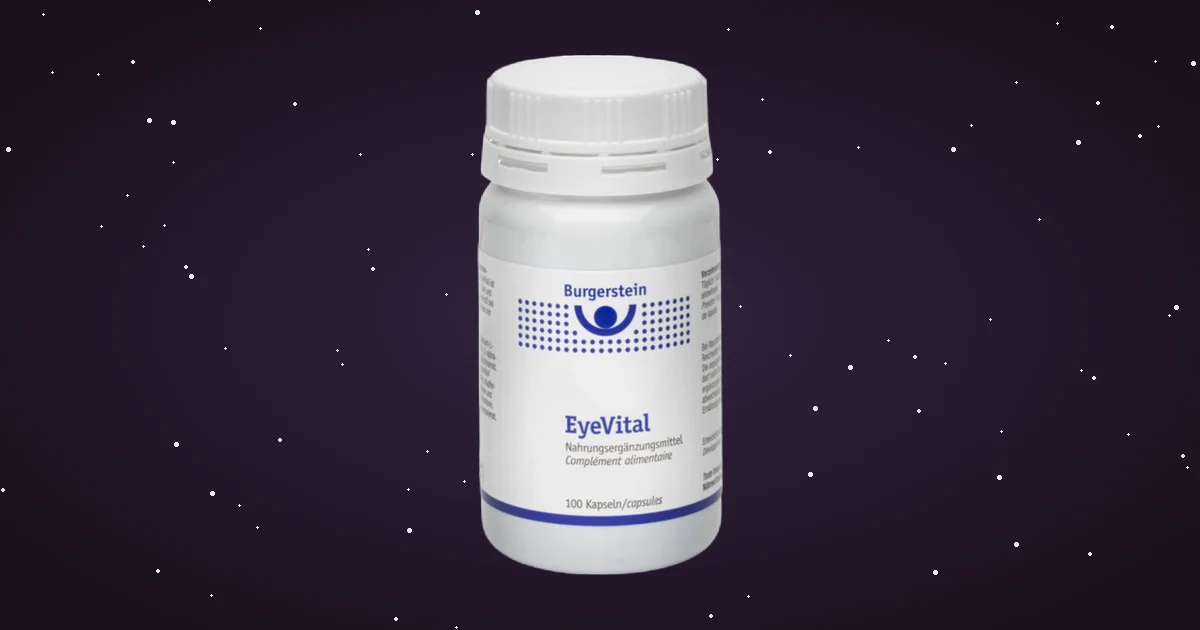
A Swiss capsule for the eyes. One a day: it has pigments that protect the center of your vision, plus vitamins and minerals for the eyes.
- One capsule a day
- For people who look at a screen a lot
- A food supplement, not a medicine
The yellow spot — the center of vision
In the middle of the eye there is a small yellow spot. We use it to read, to recognize faces and to see small details.
- Two yellow pigments give it its color
- The pigment works like sunglasses from the inside
- The body does not make it — only food gives it
What is inside
The main ingredients are lutein and zeaxanthin, the yellow pigments of the eye. Zinc, copper, selenium and vitamins are added to them.
- Pigments — protect the center of vision
- Zinc and vitamins — for normal vision
- Antioxidants — look after the cells of the eye
How it helps
The pigment absorbs blue light from screens and the sun. The more of it there is, the better the center of the eye is protected.
- More pigment in the center of the eye
- The eyes tire less
- Small details look sharper
Who it is especially for
For people whose eyes work all day: screen, reading, driving. And for people over 45, when the center of the eye weakens with the years.
- Many hours at a screen
- Lots of reading and driving
- Age over 45
How to take it
One capsule a day with a meal. The pigments dissolve in fat, so they are absorbed better with food.
- 1 capsule a day
- During a meal or right after
- One jar lasts more than three months
Who should see a doctor first
Sometimes it is better to ask a doctor first.
- If you smoke or quit recently
- During pregnancy and breastfeeding
- If you already take other vitamins
Important. If straight lines look wavy or a spot appears in the center of your vision — see an eye doctor right away.
In one sentence
EyeVital is one capsule a day to support the center of your vision: especially for people who look at a screen a lot, and after 45.
The short version
EyeVital is one capsule a day with 18 mg of lutein and 14 other ingredients. Lutein and zeaxanthin are the yellow pigments of the center of the retina, which we use to read and recognize faces. Vitamin A (from beta-carotene), vitamin B2 and zinc help maintain normal vision, while vitamins C, E and B2, zinc, copper, manganese and selenium help protect cells from oxidative stress. The table shows the composition and what human studies found.
| Ingredient | Amount per capsule | Why it helps | What studies showed |
|---|---|---|---|
| Lutein | 18 mg | Yellow retinal pigment: absorbs blue light and raises the density of the macular pigment | AREDS2 (Age-Related Eye Disease Study 2), people with intermediate age-related macular degeneration (AMD): lutein 10 mg with zeaxanthin 2 mg in a formula with vitamins C, E and zinc instead of beta-carotene; after 10 years late AMD was 15 % less frequent than with the beta-carotene formula (hazard ratio 0.85; exploratory analysis; Chew EY JAMA Ophthalmol 2022. PMID 35653117[1]); in AMD, slightly better visual acuity and contrast (8 trials, 1176 patients; Liu R Invest Ophthalmol Vis Sci 2014. PMID 25515572[2]) |
| Zeaxanthin | 0.9 mg | The second macular pigment, works as a pair with lutein | In AREDS2, 2 mg together with lutein (AREDS2 Research Group JAMA 2013. PMID 23644932[3]) |
| Zinc + copper | 5 mg + 1 mg | Zinc helps maintain normal vision; zinc and copper help protect cells from oxidative stress | In people with signs of AMD, antioxidants with zinc 80 mg and copper 2 mg (the AREDS formula) over 6.3 years lowered the odds of late AMD: odds ratio 0.72 versus placebo (AREDS Research Group Arch Ophthalmol 2001. PMID 11594942[4]) |
| Vitamins C and E | 60 mg and 30 mg | Antioxidants: help protect cells from oxidative stress | Part of the AREDS formula at 500 mg and 400 IU (international units) (AREDS Research Group Arch Ophthalmol 2001. PMID 11594942[4]) |
| Beta-carotene | 2 mg | A source of vitamin A, needed for normal vision | AREDS used 15 mg; after AREDS2 it was replaced with lutein (AREDS2 Research Group JAMA 2013. PMID 23644932[3]) |
| Selenium, manganese | 50 mcg, 1 mg | Help protect cells from oxidative stress | Nutrient claims in the EU register of health claims (Regulation 432/2012) |
| Vitamin B2 and other B vitamins | B2 1.6 mg; B1 1.4 mg; B6 2 mg; niacin 18 mg; folic acid 200 mcg | B2 helps maintain normal vision; B1, B2, B6 and niacin contribute to normal energy metabolism | Nutrient claims in the EU register of health claims (Regulation 432/2012) |
How it works
The macular pigment
The macula is the center of the retina. Its color comes from lutein and zeaxanthin: the pigment absorbs blue light and works as a built-in light filter. Its amount is measured as macular pigment optical density (Stringham JM Foods 2017. PMID 28661438[5]). The body does not make lutein — it comes only from food or a supplement. It is abundant in leafy greens, and in egg yolk lutein and zeaxanthin make up the largest share of carotenoids; for more on foods, see the article Lutein for the eyes: who it helps and how much you need.
The other ingredients
According to the EU register, zinc, riboflavin (vitamin B2) and vitamin A, whose source here is beta-carotene, help maintain normal vision. Vitamins C and E, riboflavin, zinc, selenium, copper and manganese, according to the EU register, help protect cells from oxidative stress. The retina is constantly exposed to light, and free radicals form in it as light is absorbed (Evans JR Cochrane Database Syst Rev 2023. PMID 37702300[6]). In the AREDS formula copper was added to the high dose of zinc (2 mg of copper per 80 mg of zinc) (AREDS Research Group Arch Ophthalmol 2001. PMID 11594942[4]). The capsule also contains taurine, an amino acid that is abundant in the retina.
What studies showed
How to take it
- Dose. 1 capsule a day with a small amount of water. Do not exceed the daily dose.
- With food. Preferably during or right after a meal: lutein, zeaxanthin, beta-carotene and vitamin E dissolve in fat and are absorbed better with food.
- How long. A jar of 100 capsules lasts 100 days; the manufacturer allows long-term use. In the study, pigment density rose within six months (Stringham JM Foods 2017. PMID 28661438[5]).
- Who for. Adults and teenagers from age 16 with a heavy daily load on the eyes, for example long hours at a screen; the manufacturer especially recommends it from about age 45.
You can order EyeVital in the shop — availability is confirmed by an administrator in the chat.
Who should see a doctor first
- Smokers and people who quit recently. The capsule contains 2 mg of beta-carotene — 7.5 times less than in AREDS (15 mg); the lung cancer risk in former smokers was described for the AREDS dose (AREDS2 Research Group JAMA 2013. PMID 23644932[3]). Smokers are better off discussing any beta-carotene supplement with a doctor.
- During pregnancy and breastfeeding — only after agreeing with a doctor.
- If you already take vitamins. Add up the doses of zinc, vitamin A and selenium from all supplements so you do not exceed safe limits.
- If straight lines look wavy, a spot appears in the center of your vision, or vision is dropping fast — see an ophthalmologist: a supplement does not replace an eye exam.
Bottom line
EyeVital is a convenient daily capsule for the eyes: 18 mg of lutein is within the 20 mg a day up to which the safety data on lutein are reliable (Shao A Regul Toxicol Pharmacol 2006. PMID 16814439[7]), plus zeaxanthin, zinc with copper and antioxidants. The manufacturer recommends it for a heavy load on the eyes, for example at a screen, and especially from about age 45. You can discuss whether the supplement is right for you at a consultation.
References
- Chew EY JAMA Ophthalmol 2022. PMID 35653117
- Liu R Invest Ophthalmol Vis Sci 2014. PMID 25515572
- AREDS2 Research Group JAMA 2013. PMID 23644932
- AREDS Research Group Arch Ophthalmol 2001. PMID 11594942
- Stringham JM Foods 2017. PMID 28661438
- Evans JR Cochrane Database Syst Rev 2023. PMID 37702300
- Shao A Regul Toxicol Pharmacol 2006. PMID 16814439
Key facts
- One EyeVital capsule contains 18 mg of lutein and 0.9 mg of zeaxanthin — the pigments of the macula, the center of the retina — plus zinc 5 mg, copper 1 mg, selenium 50 mcg, vitamin C 60 mg, vitamin E 30 mg, beta-carotene 2 mg and B vitamins (manufacturer Burgerstein, Switzerland).
- The Age-Related Eye Disease Study 2 (AREDS2) enrolled 4203 people aged 50–85 at high risk of late age-related macular degeneration (AMD). In the formula with vitamins C, E and zinc, lutein 10 mg with zeaxanthin 2 mg replaced beta-carotene. After 10 years, among 3882 participants, late AMD developed 15 % less often with the lutein formula than with the beta-carotene formula (hazard ratio 0.85; post-trial follow-up, exploratory analysis) (Chew EY, JAMA Ophthalmol 2022).
- In people with AMD, lutein and zeaxanthin slightly improved visual acuity and contrast sensitivity compared with placebo (8 randomized trials, 1176 patients; Liu R, Invest Ophthalmol Vis Sci 2014).
- In 48 healthy young adults who spent at least 6 hours a day at screens, six months of 24 mg of a lutein, zeaxanthin and meso-zeaxanthin mix, compared with placebo, raised pigment density and improved visual tests and sleep; headaches and eye fatigue became less frequent (Stringham JM, Foods 2017).
- Safety data for lutein are reliable up to 20 mg a day — EyeVital contains 18 mg (Shao A, Regul Toxicol Pharmacol 2006). Take 1 capsule a day with food, from age 16.