in pictures and a few words
What it is and why
Empagliflozin (Jardiance) is a tablet that helps the kidneys remove extra sugar. It is used in type 2 diabetes, a weak heart and kidney disease.
- One tablet a day
- Also suits people without diabetes if the heart is weak
- Prescription medicine: the dose is set by a doctor
How it works
The kidneys filter the blood and take sugar back. The tablet blocks this, so extra sugar leaves with the urine.
- A little salt and water leave with the sugar
- Sugar in a urine test on this tablet is normal
Protecting the heart
In people with diabetes and heart disease, the tablet lowered the risk of dying from heart and blood-vessel disease.
- Fewer hospital stays because of a weak heart
- The protection came on top of usual treatment
A weak heart
When the heart pumps more weakly, the tablet helps people end up in hospital less often.
- Works with and without diabetes
- Helps in different types of weak heart
Looks after the kidneys
In people with a weak heart, the kidneys lost strength more slowly on the tablet.
- Kidney disease is one reason to prescribe it
- Kidneys are checked before starting and once a year
How to take it
Usually 10 mg once a day, with or without food. Swallow the tablet whole with water.
- In diabetes the doctor may raise the dose to 25 mg
- Forgot? Take it when you remember, never two at once
- With insulin, the doctor may lower its dose
What to watch for
Thrush is more common. Fluid loss is possible, especially in older people and on diuretics.
- Vomiting or diarrhoea: discuss a pause with a doctor
- Before surgery the tablet is paused for a while
Important. Important: nausea, vomiting, belly pain, strong thirst, hard breathing or unusual weakness — tell a doctor at once.
Who should see a doctor first
The decision about the tablet is made with a doctor. Especially if you have:
- type 1 diabetes; insulin or tablets that push insulin out
- diuretics; older age
- frequent urinary infections; surgery coming up
Important. Important: the dose and plan are chosen by a doctor; do not start on your own.
In one sentence
One tablet a day helps the kidneys remove extra sugar and protects the heart and kidneys.
- 10 mg a day, with or without food
- Kidney test once a year
- Decision made with a doctor
Key points
| Substance | How much | How it helps | What the studies showed |
|---|---|---|---|
| Empagliflozin in type 2 diabetes | 10 mg once a day; 25 mg if eGFR ≥ 60 and tighter control is needed | excess sugar leaves in the urine, heart and blood vessels are protected | 7,020 people: cardiovascular death 38% lower, death from any cause 32% lower, hospitalisation for heart failure 35% lower |
| Empagliflozin in heart failure, ejection fraction ≤ 40% | 10 mg once a day | fewer hospital stays, kidneys lose function more slowly | 3,730 people: cardiovascular death or hospitalisation 25% lower, with or without diabetes |
| Empagliflozin in heart failure, ejection fraction > 40% | 10 mg once a day | fewer hospital stays | 5,988 people: the same outcome 21% lower, mainly through hospitalisations |
| Empagliflozin in chronic kidney disease | 10 mg once a day | official EMA indication in adults | in the heart failure trial (3,730 people) eGFR declined by 0.55 vs 2.28 mL/min/1.73 m² per year |
How it works
Every day the kidneys filter the blood and then return what is useful. Sugar in the primary urine is taken back by a protein called SGLT2. Empagliflozin blocks this protein, so excess glucose leaves with the urine, together with a little salt and water (EMA, Jardiance product information).
That is why a urine test on treatment will show glucose — an expected result of how the medicine works, not a new disease. For the same reason the body loses a little fluid, and blood pressure may fall slightly.
The heart: the EMPA-REG OUTCOME trial
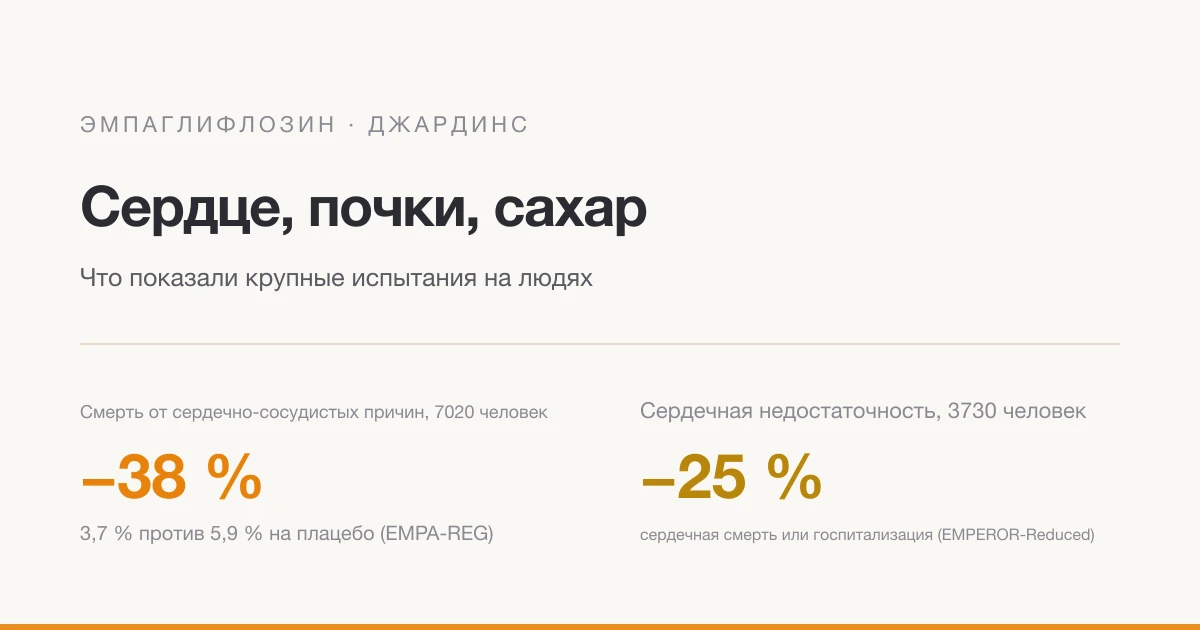
In a double-blind trial, 7,020 people with type 2 diabetes and heart and blood-vessel disease received empagliflozin (4,687 people) or placebo (2,333) on top of usual care. They were followed for a median of 3.1 years (Zinman B N Engl J Med 2015. PMID 26378978[1]).
- Cardiovascular death: 3.7% vs 5.9%. Risk 38% lower (relative); in absolute terms about 2 people in 100 over 3 years.
- Death from any cause: 5.7% vs 8.3%, risk 32% lower.
- Hospitalisation for heart failure: 2.7% vs 4.1%, risk 35% lower.
Heart attacks and strokes on their own did not change significantly: the benefit came mainly through cardiovascular death and heart failure.
Heart failure: EMPEROR-Reduced and EMPEROR-Preserved
The kidneys
Chronic kidney disease in adults is an official indication, at 10 mg once a day. In EMPEROR-Reduced, among 3,730 people, eGFR (estimated glomerular filtration rate, the main measure of kidney function) declined by 0.55 mL/min/1.73 m² per year vs 2.28 on placebo (Packer M N Engl J Med 2020. PMID 32865377[2]).
According to the EMA product information, kidney function is checked before starting and then at least once a year. Starting treatment at an eGFR below 20 mL/min/1.73 m² is not recommended. Below 45, sugar is lowered less, and another medicine may be needed to control diabetes (EMA, Jardiance product information). You can estimate your eGFR with the calculator.
How it is taken
- Start with 10 mg once a day, with or without food; swallow the tablet whole with water.
- In type 2 diabetes the dose can be raised to 25 mg once a day if 10 mg is well tolerated, eGFR is at least 60 mL/min/1.73 m² and tighter sugar control is needed. No more than 25 mg a day.
- In heart failure and chronic kidney disease the dose is 10 mg. With eGFR below 60, also 10 mg.
- Missed a dose? Take it as soon as you remember, but never a double dose on the same day.
- Together with insulin or sulphonylureas, the doctor may lower their dose so that sugar does not drop too low (EMA, Jardiance product information).
Safety
- Genital fungal infections are more common (EMA, Jardiance product information). If symptoms appear, see a doctor.
- Dehydration and a drop in blood pressure are possible, especially at 75 and older and together with diuretics. With vomiting or diarrhoea, the tablet is paused after agreeing it with a doctor.
- Ketoacidosis is rare and can occur with near-normal sugar: with nausea, vomiting, abdominal pain, severe thirst, difficulty breathing or unusual fatigue, see a doctor at once; before major surgery and during an acute serious illness the medicine is paused (EMA, Jardiance product information).
Important
Empagliflozin is a prescription medicine; the dose and plan are chosen by a doctor. Talk to a doctor first if you have:
- type 1 diabetes;
- treatment with insulin or sulphonylureas (risk of sugar dropping too low);
- diuretics;
- older age;
- frequent urinary or genital infections;
- upcoming surgery.
Bottom line
Empagliflozin helps the kidneys remove excess sugar, and in large trials it lowered the risk of cardiovascular death and hospitalisation for heart failure: by 38% in 7,020 people with diabetes and heart disease, and by 25% and 21% in heart failure in 3,730 and 5,988 people. One 10 mg tablet a day, a kidney check at least once a year and a decision made together with a doctor.
References
- Zinman B N Engl J Med 2015. PMID 26378978
- Packer M N Engl J Med 2020. PMID 32865377
- Anker SD N Engl J Med 2021. PMID 34449189
Key facts
- Empagliflozin (Jardiance) blocks SGLT2, a kidney protein that returns sugar from the urine to the blood: excess glucose leaves with the urine.
- In 7,020 people with type 2 diabetes and heart and blood-vessel disease, the risk of dying from cardiovascular causes was 38% lower (relative): 3.7% vs 5.9% over a median of 3.1 years (Zinman B N Engl J Med 2015. PMID 26378978).
- In heart failure with reduced ejection fraction (3,730 people), the risk of cardiovascular death or hospitalisation was 25% lower (Packer M N Engl J Med 2020. PMID 32865377).
- In heart failure with preserved ejection fraction (5,988 people), the same risk was 21% lower, mainly because of fewer hospitalisations (Anker SD N Engl J Med 2021. PMID 34449189).
- The usual dose is 10 mg once a day, with or without food. In diabetes it can be raised to 25 mg if eGFR is at least 60 mL/min/1.73 m² (EMA, Jardiance product information).