What people did to keep prediabetes from turning into diabetes
Prediabetes is not diabetes yet
Blood sugar is already above normal, but there is no diabetes yet. This is the time when everything can be turned around.
- sugar a little above normal
- no diabetes yet
- habits decide a lot
A big test in people
Thousands of adults with prediabetes tried one program. It was compared with ordinary life.
- adults with excess weight
- sugar above normal
- some changed habits, others did not
Goal one: a little less weight
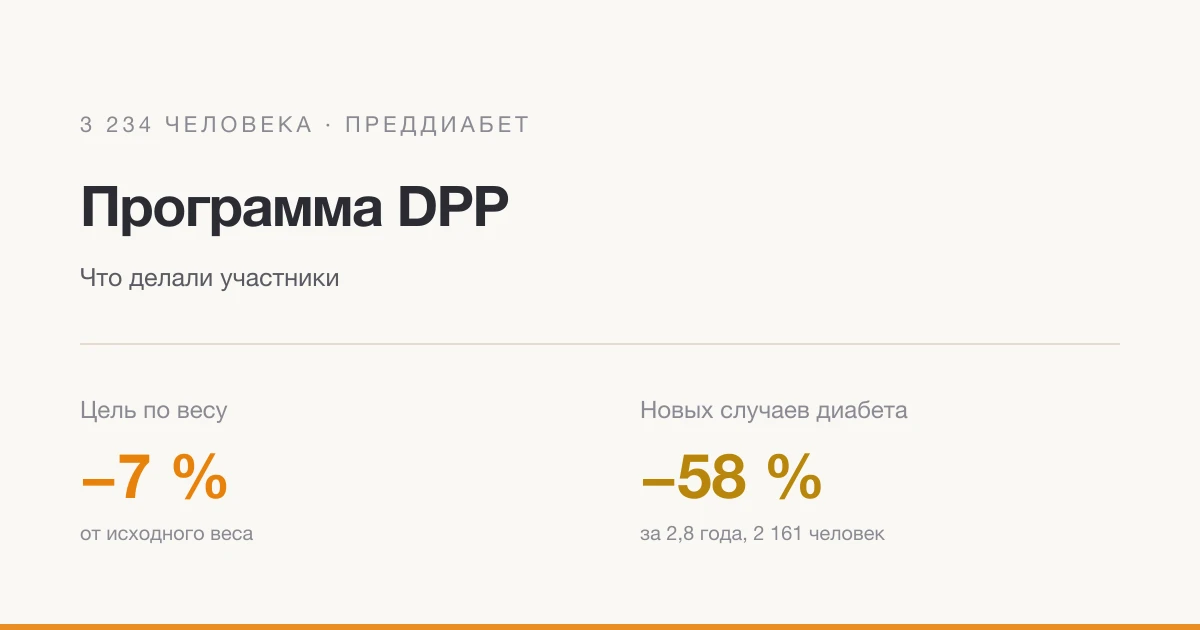
They aimed to lose 7 of every 100 kilograms of their weight. At 80 kg that is about 5–6 kg.
- small but noticeable
- no starving
- the weight was kept off
How they ate
Fewer calories and less fat on the plate. The plan was made with a coach around the person's habits.
- smaller portions
- less fat
- a plan that fits you
Goal two: walk
Brisk walking for 30 minutes 5 days a week. Or about 22 minutes every day.
- at a brisk pace
- 150 minutes a week
- at a time that suits you
A coach was there
For the first six months the person met a coach one on one. They learned to eat, move and change habits.
- one-on-one meetings
- about food and movement
- then monthly and in a group
Notes helped
People wrote down how much they moved and saw what was working.
- write down your weight
- write down steps and walks
- see what is working
What came of it
Diabetes appeared much less often in those who went through the program. After 60 the program helped just as well as in younger people.
- much less diabetes
- in men and in women
- after 60 too
Benefit for years
People were followed for another 10 and 15 years. The risk of diabetes stayed lower in those who went through the program.
- the effect lasts for years
- the habits stay
- still lower after 15 years
When to see a doctor
If your sugar is repeatedly below 3.0 mmol/L (54 mg/dL) or above 8.9 mmol/L (160 mg/dL), see a doctor. A doctor is also a good partner for making your own plan.
- a blood sugar test
- a weight and walking plan
- a doctor's support
Key points
Prediabetes does not have to become diabetes. In the Diabetes Prevention Program (DPP), adults with prediabetes changed how they ate and walked more, and they had 58% fewer new cases of type 2 diabetes. In people aged 60 and older it was 71% fewer. The program rested on two goals and regular support from a coach.
| What they did | How much | What they got |
|---|---|---|
| Lost weight | at least 7% of starting weight | 5.6 kg (12.3 lb) on average |
| Moved | at least 150 minutes a week, for example brisk walking | 74% met the goal at 24 weeks |
| Ate fewer calories and less fat | a plan made with the coach | 450 kcal a day less after one year |
| Worked with a coach | 16 sessions in 24 weeks, then monthly | whole program: 58% fewer new cases of diabetes |
Who took part
The trial in 27 US centers enrolled 3,234 adults aged 25 and over with excess weight and raised blood sugar. Fasting glucose was 5.3–6.9 mmol/L (95–125 mg/dL), and 2 hours after a sugar drink 7.8–11.0 mmol/L (140–199 mg/dL). The average age was 51, average weight 94 kg (207 lb), and 68% of participants were women. People were randomly assigned to three groups: the lifestyle program (1,079 people), metformin tablets (1,073) and a comparison group taking a dummy pill (1,082) (Knowler WC N Engl J Med 2002. PMID 11832527[1]).
Goal 1: minus 7% of body weight
Each participant aimed to lose at least 7% of starting weight and keep it off. At 94 kg (207 lb) that is about 6.6 kg (14.5 lb). The tool was a “healthy low-calorie, low-fat diet”, as the authors describe it: the plan was built with the coach around the person's habits. After one year participants were eating on average 450 kcal a day less than at the start.
At 24 weeks 50% of participants had reached the 7% goal, and 38% at the last visit. On average the group lost 5.6 kg (12.3 lb).
Goal 2: 150 minutes of movement a week
The second goal was at least 150 minutes a week of moderate activity; the authors give brisk walking as the example. That is 30 minutes 5 days a week, or about 22 minutes every day. Participants logged their own activity. At 24 weeks 74% were meeting the goal, and 58% at the last visit.
How the support worked
Another part of the program was the coach. The coach ran 16 one-on-one sessions in the first 24 weeks: on food, on movement and on how to change habits. The program was adapted to the person, their culture and way of life. After that meetings were usually monthly, with group sessions added so that the new habits would stick.
What they got
Over 2.8 years of follow-up, per 100 people per year diabetes developed in 4.8 program participants and in 11.0 in the comparison group. There were 58% fewer new cases of diabetes (2,161 people in the two groups). Over 3 years 14.4% of program participants developed diabetes versus 28.9% in the comparison group: half the risk. For one person to avoid diabetes over 3 years, 7 people need to go through the program.
The program worked equally well in men and women and in people of different backgrounds. In older people it was no weaker than in younger ones: at 60 and older there were 71% fewer new cases of diabetes (648 people across all three groups), at 45–59 years 59% fewer, at 25–44 years 48% fewer. Metformin reduced new cases by 31%; the lifestyle program worked better.
After 10 and 15 years
After the trial ended, 2,766 participants were followed further. Ten years after the start, the risk of diabetes in those who went through the program remained 34% lower (Diabetes Prevention Program Research Group Lancet 2009. PMID 19878986[2]). After 15 years it was 27% lower, 2,776 people (Diabetes Prevention Program Research Group Lancet Diabetes Endocrinol 2015. PMID 26377054[3]). People who never developed diabetes had 28% fewer complications in the small vessels of the eyes, kidneys and nerves than those who did; across the three trial groups the overall number of such complications did not differ.
How to apply it
- Work out your goal: starting weight × 0.07. At 80 kg (176 lb) that is 5.6 kg (12.3 lb).
- Brisk walking for 30 minutes 5 days a week gives the same 150 minutes as in the program.
- Fewer calories and less fat on the plate: that is how eating was set up in the program.
- Log your weight and steps: in the program participants recorded their own activity.
- Find support: a doctor, a coach, a group. In the DPP it was part of the program.
- Check your glucose metabolism: high insulin with normal blood sugar can also be an early sign.
Important
If you do not have diabetes and your glucose is repeatedly below 3.0 mmol/L (54 mg/dL) or above 8.9 mmol/L (160 mg/dL), see a doctor. If diabetes is already diagnosed, targets are individual and follow your doctor's plan. It is best to build your own weight and activity plan together with a doctor.
What the studies showed
| What was compared | How many people | Result | Source |
|---|---|---|---|
| Lifestyle program vs comparison group, 2.8 years | 2,161 people | 58% fewer new cases of diabetes | Knowler WC N Engl J Med 2002. PMID 11832527[1] |
| The same in people aged 60 and older | 648 people across all three groups | 71% fewer | Knowler WC N Engl J Med 2002. PMID 11832527[1] |
| 10-year follow-up | 2,766 people | diabetes risk 34% lower | DPP Research Group Lancet 2009. PMID 19878986[2] |
| 15-year follow-up | 2,776 people | diabetes risk 27% lower | DPP Research Group Lancet Diabetes Endocrinol 2015. PMID 26377054[3] |
Bottom line
The DPP program comes down to two clear goals, minus 7% of body weight and 150 minutes of walking a week, plus support from a coach. Over 3 years it halved the risk of type 2 diabetes in people with prediabetes, and the effect held at 10 and 15 years. You can start by working out your 7% and taking your first week of brisk walks.
References
- Knowler WC N Engl J Med 2002. PMID 11832527
- Diabetes Prevention Program Research Group Lancet 2009. PMID 19878986
- Diabetes Prevention Program Research Group Lancet Diabetes Endocrinol 2015. PMID 26377054
Key facts
- Two program goals: lose at least 7% of body weight and do at least 150 minutes a week of moderate activity, such as brisk walking (Knowler WC N Engl J Med 2002. PMID 11832527).
- During the first 24 weeks each participant had 16 one-on-one sessions with a coach about food, movement and habits, then meetings usually once a month plus group sessions.
- There were 58% fewer new cases of type 2 diabetes than in the comparison group: 2,161 people, 2.8 years of follow-up on average.
- In participants aged 60 and older there were 71% fewer new cases of diabetes (648 people across all three study groups).
- Ten years after the start, the risk of diabetes in program participants was still 34% lower (Diabetes Prevention Program Research Group Lancet 2009. PMID 19878986).