Key points
What hinders absorption
Only 25–35% of the calcium in dairy products and tablets is absorbed. Oxalic acid (oxalates, plentiful in spinach, rhubarb and cocoa), phytates, coffee and alcohol hinder absorption; excess salt and protein above 20% of dietary calories upset the calcium balance (Burgerstein, Handbuch Nährstoffe 2015, p. 94).
How much calcium you need
Count all the calcium for the day — from food and tablets together. The safe upper limit set by the European Food Safety Authority (EFSA) for adults, including pregnant and breastfeeding women, is 2500 mg a day: this much calcium from food and supplements was tolerated without adverse effects in long-term studies (EFSA NDA Panel EFSA J 2012. PMID 42016128[5]). The US limit for adults is 2000–2500 mg a day (Chung M Ann Intern Med 2016. PMID 27776363[6]). The handbook also calls 2.5 g a day safe for people with unimpaired calcium metabolism (Burgerstein, Handbuch Nährstoffe 2015, p. 96).
Food comes first
The easiest way to reach the norm is with dairy products: milk, kefir, yogurt, cheese. If you eat little dairy, count the calcium using the labels.
It is possible without dairy too: calcium from kale, which is low in oxalates, was absorbed even better than from milk (41% vs 32%), while from spinach, according to earlier data, it is absorbed poorly (Heaney RP Am J Clin Nutr 1990. PMID 2321572[2]).
Calcium works together with vitamin D (Ross AC J Am Diet Assoc 2011. PMID 21443983[1]); how much vitamin D you need in winter is covered in the article Vitamin D in winter: how much you need and how to take it.
Tablets and fractures
The heart: a debated question
In a 2010 meta-analysis, calcium without vitamin D (from 500 mg a day) was linked to heart attacks: in data from 8151 participants, 143 heart attacks in the calcium group versus 111 on placebo, 1.31 times more often (Bolland MJ BMJ 2010. PMID 20671013[8]). These are data from randomised trials, but heart attacks were not a prespecified outcome in them.
An updated 2016 review (4 randomised and 27 observational studies) showed that total calcium intake (food + supplements) up to 2000–2500 mg/day, with or without vitamin D, was not associated with the risk of heart disease in generally healthy adults. The authors’ caveat: heart disease was a secondary outcome in all of the studies (Chung M Ann Intern Med 2016. PMID 27776363[6]).
Until the debate is settled, it makes sense to get calcium primarily from food, and to take tablets only in the dose that is missing to reach the norm.
Kidney stones
In WHI, the risk of kidney stones on calcium with vitamin D was 1.17 times higher than on placebo (Jackson RD N Engl J Med 2006. PMID 16481635[7]), and in the Cochrane review kidney disease was slightly more common (relative risk 1.16) (Avenell A Cochrane Database Syst Rev 2014. PMID 24729336[3]). The handbook notes that this link was not confirmed in observational studies in the US (Burgerstein, Handbuch Nährstoffe 2015, p. 96), and EFSA does not consider it established (EFSA NDA Panel EFSA J 2012. PMID 42016128[5]).
How to take tablets if you need them
What the studies showed
| What was tested | Who took part | Result |
|---|---|---|
| Vitamin D + calcium and hip fracture, Cochrane, 2014 | 9 studies, 49,853 people | Relative risk 0.84: 1 fewer fracture per 1000 per year at home, 9 fewer in institutions |
| WHI: calcium 1000 mg + vitamin D 400 IU, 2006 | 36,282 postmenopausal women aged 50–79, 7 years | Hip fracture 0.88 (not significant), kidney stones 1.17 |
| Calcium without vitamin D and heart attack, 2010 | 8151 people (individual participant data) | Heart attack 1.31 times more often (association) |
| Updated review, 2016 | 4 randomised and 27 observational studies | Up to 2000–2500 mg/day (food + supplements): no link with heart disease found |
| Calcium and iron, 1991 | 126 people, single tests with one meal | 300–600 mg calcium: iron absorption 50–60% lower |
Not everything is equally proven: according to high-quality evidence, vitamin D without calcium is unlikely to prevent hip fractures (relative risk 1.12) (Avenell A Cochrane Database Syst Rev 2014. PMID 24729336[3]), and in WHI the reduction in hip fractures was not significant — that is, an effect was not shown, which is not the same as “no effect” (Jackson RD N Engl J Med 2006. PMID 16481635[7]).
Who should be more careful
- In hyperparathyroidism (overactive parathyroid glands) and in vitamin D poisoning, calcium supplements are contraindicated (Burgerstein, Handbuch Nährstoffe 2015, p. 96).
- If you have had kidney stones or have kidney disease, discuss your calcium dose with a doctor (Jackson RD N Engl J Med 2006. PMID 16481635[7]; Avenell A Cochrane Database Syst Rev 2014. PMID 24729336[3]).
- If you take vitamin D, especially calcitriol, your doctor may check your blood calcium: a mild rise to 2.6–2.8 mmol/L (10.4–11.2 mg/dL) occurred more often than on placebo (Avenell A Cochrane Database Syst Rev 2014. PMID 24729336[3]).
- If you have heart disease, start calcium tablets only after discussing it with a doctor.
Bottom line
Bones need calcium throughout life, and food is the place to start. Tablets with vitamin D slightly lower the risk of hip fracture: with the same relative risk, at home that is about 1 fewer fracture per 1000 people per year, and in care institutions, where fractures are more common, about 9. The heart question is debated, and kidney stones were slightly more common in a large study. You can work out whether your diet provides enough calcium and decide whether you need tablets at a consultation.
This material is for information only and does not replace a doctor’s consultation. The dose and form of calcium are chosen by a doctor, taking into account your diet, test results and the medicines you take.
References
- Ross AC J Am Diet Assoc 2011. PMID 21443983
- Heaney RP Am J Clin Nutr 1990. PMID 2321572
- Avenell A Cochrane Database Syst Rev 2014. PMID 24729336
- Straub DA Nutr Clin Pract 2007. PMID 17507729
- EFSA NDA Panel EFSA J 2012. PMID 42016128
- Chung M Ann Intern Med 2016. PMID 27776363
- Jackson RD N Engl J Med 2006. PMID 16481635
- Bolland MJ BMJ 2010. PMID 20671013
- Hallberg L Am J Clin Nutr 1991. PMID 1984335
- B Aires) 2025. PMID 41109285
Key facts
- The US Institute of Medicine recommends 700 to 1300 mg of calcium a day for people over one year old, depending on age (Ross AC, J Am Diet Assoc 2011).
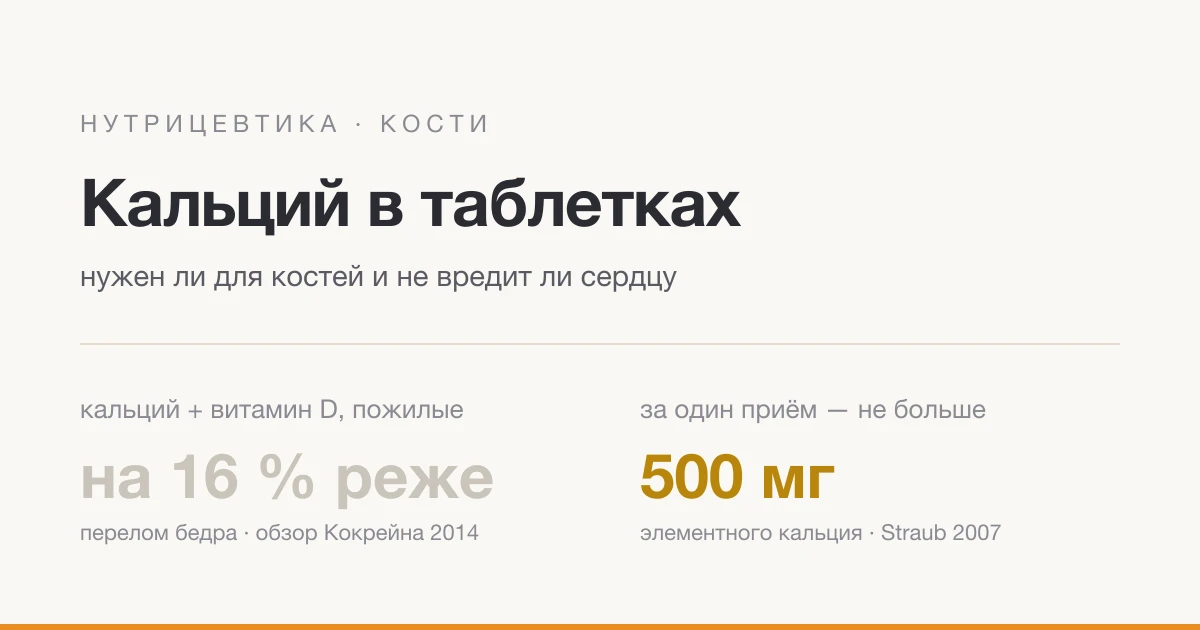
- Vitamin D with calcium slightly lowered the risk of hip fracture (relative risk 0.84): by the authors’ estimate, 1 fewer fracture per 1000 older people per year at home and 9 fewer in care institutions (Avenell A, Cochrane 2014).
- In the WHI study of 36,282 postmenopausal women aged 50–79, calcium with vitamin D raised the risk of kidney stones 1.17-fold (Jackson RD, N Engl J Med 2006).
- Calcium without vitamin D was linked to heart attacks (1.31 times more often), but in an updated review total calcium intake (food + supplements) up to 2000–2500 mg/day, with or without vitamin D, was not associated with the risk of heart disease (Bolland MJ, BMJ 2010; Chung M, Ann Intern Med 2016).
- No more than 500 mg of elemental calcium at a time; calcium carbonate is taken with food, calcium citrate can be taken without food (Straub DA, Nutr Clin Pract 2007).