In Brief
What Happens to the Heart
Transthyretin is an ordinary blood protein carrying thyroid hormone and vitamin A. Normally it is assembled from four identical parts locked firmly together.
With age, or because of an inherited mutation, that lock weakens. The structure falls apart, the loose parts change shape and clump into insoluble fibrils — amyloid.
Those fibrils deposit in the heart muscle. It becomes stiff and stops relaxing properly: the heart cannot fill adequately between beats. Heart failure develops — and its distinguishing feature is that ejection fraction stays normal, which is why the disease slips past diagnosis for years.
The Hint Nature Provided
There is a variant of the transthyretin gene called T119M. In its carriers the protein holds together more firmly than usual. And — the key fact — they do not develop amyloidosis, even when a second, disease-causing mutation is present.
The experiment, in other words, has already been run: nature itself showed that if the tetramer is not allowed to fall apart, the disease does not occur.
Acoramidis is engineered to reproduce that effect chemically: it binds the four parts of the protein and holds them together. This is the rare case of a drug that was not invented from scratch but copied from an existing protection.
What the Trial Showed
▸ATTRibute-CM (NEJM, 2024) — 632 patients followed for 30 months. The primary outcome favoured acoramidis (p<0.001), with a win ratio of 1.8 (95% CI 1.4–2.2): 63.7% of pairwise comparisons favoured the drug against 35.9% favouring placebo [1].
What that result is made of matters: more than half the contribution came from death from any cause and cardiovascular hospitalisation — outcomes that matter in themselves, not laboratory measures.
Tolerability: adverse events occurred equally often in both groups (98.1% versus 97.6%), and serious events were less frequent on the drug: 54.6% versus 64.9%. The explanation is straightforward: in the placebo group the disease progressed faster, and its complications are precisely what counts as serious events.
▸Open-label extension (JAMA Cardiology, 2026) — the effect holds with continued treatment [2].
What a Win Ratio Is and Why It Was Needed
This trial measured its result in an unfamiliar way, and it is worth understanding.
When several outcomes matter and they are not equivalent, they cannot simply be added up: a death and metres walked in six minutes are quantities of different orders. So patients from the two groups are compared in pairs and in a strict order:
| Step | What is compared |
|---|---|
| 1 | Who lived longer |
| 2 | If there is no difference — who had fewer cardiovascular hospitalisations |
| 3 | If still equal — whose NT-proBNP was better |
| 4 | Last — who walked further in six minutes |
Each pair yields a win or a loss. A win ratio of 1.8 means the drug produced 1.8 times as many wins as losses. The point of the construction is to stop small improvements from outweighing deaths, by ranking outcomes in the order of their real importance.
Where It Sits Among Other Drugs
| Tafamidis | Acoramidis | |
|---|---|---|
| Class | Transthyretin stabiliser | Transthyretin stabiliser |
| Pivotal trial | ATTR-ACT (2018) | ATTRibute-CM (2024) |
| Comparator | Placebo | Placebo |
| Head-to-head against each other | *Never done* | *Never done* |
| Form | Capsules | Tablets |
Both drugs act at the same point. Which is stronger is unknown: they have never been compared with each other, and matching up separate trials with different participants is not valid.
When to Suspect the Disease
▸Heart failure in an older person with preserved ejection fraction and unexplained thickened heart walls. ▸Bilateral carpal tunnel syndrome occurring some years before the cardiac symptoms — one of the most characteristic early signs. ▸Spinal canal stenosis, rupture of the biceps tendon. ▸Poor tolerance of standard cardiac drugs, particularly those lowering blood pressure.
The diagnosis today is made without a cardiac biopsy, using scintigraphy with bone-seeking tracers. One condition is mandatory: excluding light-chain amyloidosis, which is treated in an entirely different way.
What Cannot Be Claimed Yet
▸That it is better or worse than tafamidis — no head-to-head data exist. ▸That it dissolves amyloid already deposited: the drug obstructs the formation of new fibrils, it does not remove old ones. ▸That it helps at any stage: the more muscle already affected, the less there is left to protect. ▸That it affects other types of amyloidosis — the indication covers the transthyretin form only.
Who It Is Not For
▸Patients with light-chain amyloidosis: a different disease with different treatment, where delay costs more. ▸Anyone without a confirmed diagnosis: treatment begins after scintigraphy and the exclusion of alternatives, not on suspicion. ▸As a replacement for baseline heart failure therapy — a stabiliser adds to it rather than cancelling it.
Bottom Line
▸Mechanism: holds transthyretin together, copying the naturally protective T119M mutation. ▸Demonstrated in 632 patients: a win ratio of 1.8, with more than half the contribution from deaths and hospitalisations. ▸Tolerability comparable to placebo, with fewer serious events. ▸Early diagnosis decides the outcome: the drug protects intact muscle but does not remove amyloid already laid down. ▸Never compared with tafamidis, so the choice between them is a matter of availability and clinical situation, not proven superiority.
Treatment can be discussed at a consultation; the drug can be ordered here.
References
1. Gillmore JD, et al. Efficacy and Safety of Acoramidis in Transthyretin Amyloid Cardiomyopathy. N Engl J Med. 2024;390(2):132–142. PMID 38197816
2. Soman P, et al. Long-Term Durability of Acoramidis Efficacy in Transthyretin Amyloid Cardiomyopathy: Open-Label Extension of the ATTRibute-CM Trial. JAMA Cardiol. 2026;11(5):446–454. PMID 41911489
3. Maurer MS, et al. Tafamidis Treatment for Patients with Transthyretin Amyloid Cardiomyopathy. N Engl J Med. 2018;379(11):1007–1016. PMID 30145929
4. ATTRUBY (acoramidis) — US Prescribing Information, BridgeBio Pharma.
Key facts
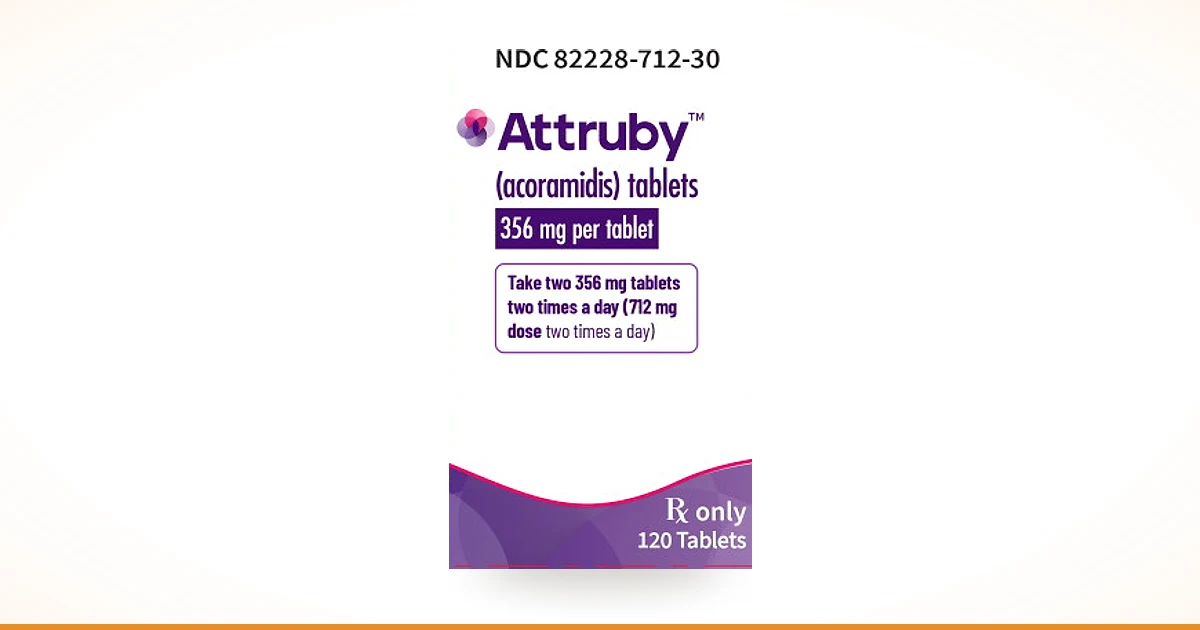
- Acoramidis (brand name Attruby, BridgeBio) is an oral transthyretin stabiliser approved by the FDA in November 2024 for transthyretin amyloid cardiomyopathy in adults.
- Transthyretin is a transport protein that normally exists as a tetramer: four identical subunits locked together.
- In disease the tetramer falls apart into single subunits, which fold into amyloid fibrils and deposit in the heart muscle, making it stiff.
- The molecule was designed after the natural T119M mutation: in its carriers transthyretin is unusually stable and amyloidosis does not develop — nature had already shown the approach works.
- ATTRibute-CM (NEJM, 2024): 632 patients over 30 months; the hierarchical composite outcome favoured the drug (p<0.001) with a win ratio of 1.8 (95% CI 1.4–2.2).
- More than half of that result came from death from any cause and cardiovascular hospitalisation — outcomes that matter in themselves rather than surrogate measures.
- Adverse events occurred at the same rate as on placebo (98.1% versus 97.6%), and serious ones were less frequent: 54.6% versus 64.9%.
- An open-label extension (JAMA Cardiology, 2026) confirmed that the effect holds with long-term treatment.
- The first stabiliser in this class was tafamidis (the ATTR-ACT trial, 2018); acoramidis has never been compared with it head-to-head, so no statement about which is better is available.
- The disease was long considered rare, but it is increasingly found in older people with heart failure and preserved ejection fraction — diagnosed by scintigraphy, without a cardiac biopsy.