A plain-language checklist: what to put in your cart and in what order to eat
Shopping list
All of this is sold in a regular store. Keep at least a few items at home.
- beans and lentils · vegetables
- vinegar for dressing · almonds · eggs
- avocado · berries · olive oil
- fish · kefir instead of a sweet drink
Vegetables at the start
Tomatoes, broccoli and salad are a good start to any meal.
- vegetables first, then everything else
- a big salad at the start of lunch
- with them glucose rises more smoothly
Beans and lentils
Make them your side dish.
- with them glucose rises less after meals
- ordinary canned beans work too
- lentils soften glucose right after the next meal too
Almonds, avocado, oil
With them the glucose rise after a meal is gentler.
- a small handful of almonds half an hour before a meal
- half an avocado in place of part of breakfast carbohydrate
- two teaspoons of extra virgin olive oil in a salad
Fish, meat and eggs
This food goes at the start of the plate, right after vegetables.
- an omelet at breakfast instead of porridge
- fish or meat before the side dish
- then glucose moves more smoothly
Berries and kefir
Everyone wants something sweet. Berries and kefir help you pick a gentle option.
- a handful of berries with dessert
- kefir instead of a sweet drink
- bilberries, blackcurrants, cranberries, strawberries
Vinegar in dressing
The simplest way is a splash of vinegar in your salad dressing.
- goes well with olive oil
- add it to food
- do not drink it undiluted
The order on your plate
The main rule matters more than any list. No need to cross out a favorite dish.
- vegetables first
- then fish, meat or eggs
- carbohydrates last
After meals and in the evening
Two simple habits help glucose stay steadier.
- walk for ten minutes after eating
- have dinner earlier
- a walk after dinner is especially good
When to see a doctor
If you do not have diabetes: glucose repeatedly below 3.0 mmol/L (54 mg/dL) or above 8.9 mmol/L (160 mg/dL).
- with diabetes, targets are individual and follow your doctor's plan
- below 3.0 mmol/L (54 mg/dL): always see a doctor
Important. Important: do not change prescribed treatment on your own.
Key points
Steady blood sugar starts with an ordinary plate, not with bans. With most of these ten foods glucose rises less after meals, and the right food order adds to the effect and works even with your favorite dishes. All of them are sold in a regular store.
| Food | How much | How it helps | What studies showed |
|---|---|---|---|
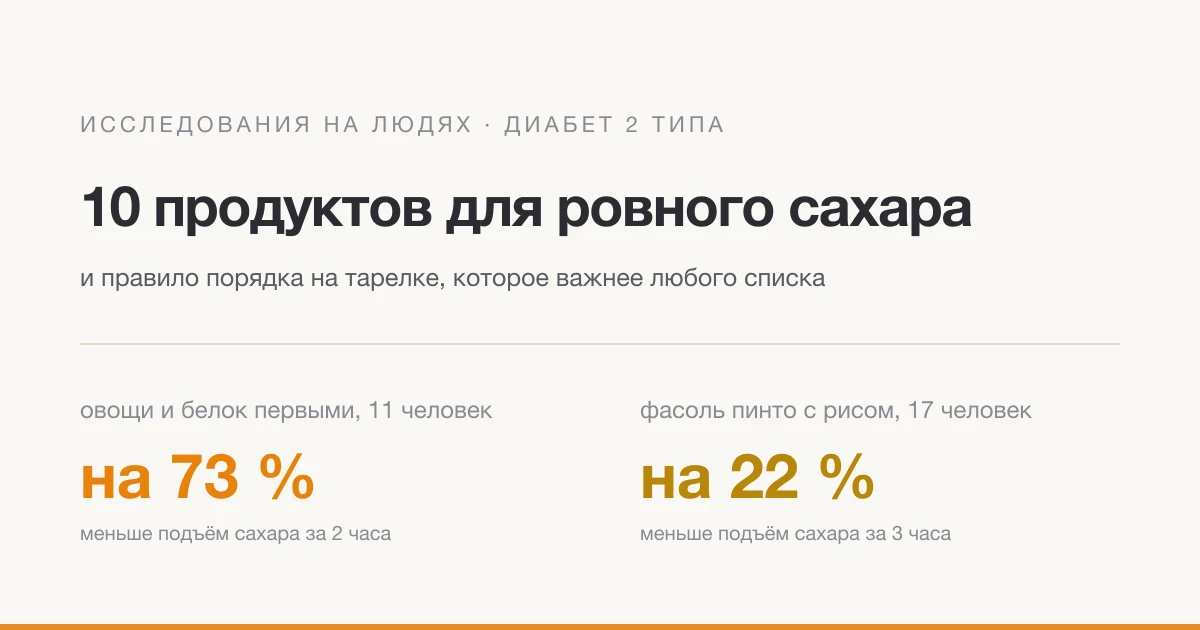
| 1. Beans and lentils | As a side dish; portions with 50 g of carbohydrate in the studies | Glucose rises less after meals | 17 people with type 2 diabetes: with pinto beans the total glucose rise over 3 hours was 22% smaller than from rice alone |
| 2. Vegetables first | At the start of a meal; tomatoes 150 g and broccoli 70 g in the study | Lower glucose peak | 18 healthy young women: peak 5.9 mmol/L (107 mg/dL) instead of 7.1 mmol/L (128 mg/dL) |
| 3. Vinegar | In dressing with food | Lower glucose after meals | Review of trials, 578 people: on average 0.81 mmol/L (14.6 mg/dL) lower |
| 4. Almonds | 20 g 30 minutes before a meal | Lower glucose after meals | 60 people with prediabetes, sensor, 3 days, 20 g before each main meal: total glucose rise after meals 10% smaller than without almonds |
| 5. Eggs | Omelet at breakfast | Smaller daily glucose rise | 23 people with type 2 diabetes, sensor: total rise over 24 hours 32% smaller than with oatmeal at breakfast |
| 6. Avocado | Half a fruit (68 g) in place of part of breakfast carbohydrate | Lower glucose peak | 31 people with excess weight: peak 7.0 mmol/L (126 mg/dL) instead of 8.1 mmol/L (146 mg/dL) |
| 7. Berries | 150 g of puree together with something sweet | Lower glucose peak | 12 healthy people: rise to the peak 1.0 mmol/L (18 mg/dL) smaller than from sugar with equal carbohydrate |
| 8. Extra virgin olive oil | 10 g (about 2 teaspoons) with lunch | Lower glucose after lunch | 25 healthy people: lower at 2 hours than without oil; also lower in 30 people with impaired fasting glucose |
| 9. Fish | At the start of a meal, 15 minutes before carbohydrates | Smaller glucose swings | 12 people with type 2 diabetes: swings almost a third smaller, 1.94 vs 2.77 mmol/L (35 vs 50 mg/dL) |
| 10. Kefir | Instead of a sweet drink; 600 mL of probiotic kefir a day in the trial | An easy swap for sweet drinks | 60 people with type 2 diabetes, 8 weeks: fasting glucose 8.98 → 7.73 mmol/L (162 → 139 mg/dL), in the plain fermented milk group 10.19 → 10.12 mmol/L (183 → 182 mg/dL) |
The main rule: the order on your plate
Vegetables first, then fish, meat or eggs, and the carbohydrate part last. The food stays the same and only the order changes, so there is no need to cross out a favorite dish.
In 11 adults with type 2 diabetes the total glucose rise over 2 hours was 73% smaller than with carbohydrates first (Shukla A P Diabetes Care 2015. PMID 26106234[1]). In 15 people with prediabetes the rise to the peak was more than 40% smaller (Shukla A P Diabetes Obes Metab 2019. PMID 30101510[2]). In 18 healthy young women the total rise over 2 hours was 51% smaller, and with vegetables first glucose hardly depended on whether a person ate fast or slowly (Imai S Nutrients 2023. PMID 36904173[3]).
What each food offers
After meals and in the evening
Walk for 10 minutes after eating. In 41 adults with type 2 diabetes, these walks after each main meal made the glucose rise 12% smaller than one 30-minute walk a day, and 22% smaller after dinner (Reynolds A N Diabetologia 2016. PMID 27747394[16]). And have dinner earlier: in 20 healthy volunteers glucose was higher after dinner at 22:00 than after the same dinner at 18:00 (Gu C J Clin Endocrinol Metab 2020. PMID 32525525[17]).
What you need not fear
Why everyone has their own curve
In the journal Cell, 800 people wore a glucose sensor for a week: across 46,898 meals, identical food produced very different responses in different people (Zeevi D Cell 2015. PMID 26590418[20]). In 1,002 adults in the UK, the composition of the food itself explained the spread in glucose more than the gut microbiome: 15.4% vs 6.0% (Berry S E Nat Med 2020. PMID 32528151[21]). In 30 people without diabetes, identical food gave a different curve on different days (Hengist A Am J Clin Nutr 2025. PMID 39755436[22]). So a single sensor reading is not a verdict, and how your plate is built always matters.
One day
Who should see a doctor first
See a doctor if glucose is repeatedly below 3.0 mmol/L (54 mg/dL) or above 8.9 mmol/L (160 mg/dL). If you do not have diabetes, the same limits apply; with diabetes, targets are individual and set in your doctor's plan, and below 3.0 mmol/L (54 mg/dL) always means seeing a doctor.
Do not change prescribed diabetes treatment on your own. If you change your diet sharply while on treatment, discuss your glucose with your doctor.
Bottom line
Keep at least a few foods from the list at home, start meals with vegetables, leave the carbohydrate part for last and walk for 10 minutes after eating.
References
- Shukla A P Diabetes Care 2015. PMID 26106234
- Shukla A P Diabetes Obes Metab 2019. PMID 30101510
- Imai S Nutrients 2023. PMID 36904173
- Thompson S V Nutr J 2012. PMID 22494488
- Moravek D J Nutr 2018. PMID 29659967
- Mollard R C Appl Physiol Nutr Metab 2011. PMID 21957874
- Shahmohammadi F Food Sci Nutr 2026. PMID 42110393
- Gulati S Eur J Clin Nutr 2023. PMID 36732571
- Chang C R Am J Clin Nutr 2019. PMID 30968140
- Fuller N R Am J Clin Nutr 2015. PMID 25833969
- Park E Nutrients 2018. PMID 30213052
- Törrönen R Br J Nutr 2010. PMID 19930765
- Violi F Nutr Diabetes 2015. PMID 26192450
- Carnevale R Clin Nutr 2017. PMID 27289163
- Kuwata H Diabetologia 2016. PMID 26704625
- Reynolds A N Diabetologia 2016. PMID 27747394
- Gu C J Clin Endocrinol Metab 2020. PMID 32525525
- Atkinson F S Diabetes Care 2008. PMID 18835944
- Liu B BMJ 2024. PMID 39631943
- Zeevi D Cell 2015. PMID 26590418
- Berry S E Nat Med 2020. PMID 32528151
- Hengist A Am J Clin Nutr 2025. PMID 39755436
Key facts
- Vegetables and protein first, carbohydrates last: in 11 adults with type 2 diabetes the total glucose rise over 2 hours was 73% smaller than with carbohydrates first (Shukla A P Diabetes Care 2015. PMID 26106234).
- Pinto beans with rice: in 17 people with type 2 diabetes the total glucose rise over 3 hours was 22% smaller than from the same amount of carbohydrate in rice alone (Thompson S V Nutr J 2012. PMID 22494488).
- Vinegar with food: in a review of trials covering 578 people, glucose after meals was on average 0.81 mmol/L (14.6 mg/dL) lower (Shahmohammadi F Food Sci Nutr 2026. PMID 42110393).
- A 10-minute walk after each main meal: in 41 adults with type 2 diabetes glucose rose 12% less after meals than with one 30-minute walk a day, and 22% less after dinner (Reynolds A N Diabetologia 2016. PMID 27747394).
- See a doctor if glucose is repeatedly below 3.0 mmol/L (54 mg/dL) or above 8.9 mmol/L (160 mg/dL). If you do not have diabetes, the same limits apply; with diabetes, targets are individual and set in your doctor's plan, and below 3.0 mmol/L (54 mg/dL) always means seeing a doctor.