Introduction: a scientist on stress
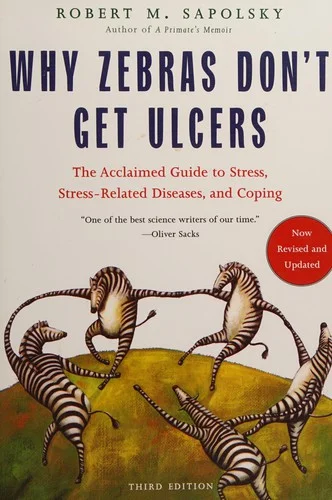
Robert Sapolsky is professor emeritus of biology, neurology and neurosurgery at Stanford University, and one of the most cited neuroscientists in the world. Beyond laboratory studies of glucocorticoid neurotoxicity, Sapolsky spent 30 years studying social stress in a baboon population in Kenya — an anthropologically rare project for its length and depth. His book "Why Zebras Don't Get Ulcers: An Updated Guide to Stress, Stress-Related Diseases, and Coping" (3rd ed., Holt, 2004) is an academically serious yet readable synthesis of the neuroendocrine literature.
This is not "a self-help book". Sapolsky is a scientist, and his book is a textbook on stress with an emphasis on mechanism rather than on "ten breathing techniques". For an endocrinologist this is foundational reading on the biology of the HPA axis and its clinical implications.
🌀
#first_stress_is_for_zebras
The central metaphor is in the title. Zebras do not get ulcers — because they are stressed only at moments of real threat (a lion attack), and the stress response lasts only minutes. Once the threat passes, the zebra's physiological systems return to homeostasis.
Modern humans are exposed to chronic stress through abstract threats: a work deadline, marital conflict, financial anxiety, the news cycle. The stress system activates as it does in a zebra facing a lion — but does not switch off for hours or days. This is an evolutionary mismatch: systems honed for an acute mobilised response are activated chronically in a regime for which they were not designed.
Sapolsky systematises the biological consequences of chronic stress by system:
- Cardiovascular: chronically elevated blood pressure, increased cardiovascular mortality, a pro-atherogenic profile (through HDL suppression, rising ApoB and Lp(a)) - Metabolic: insulin resistance, visceral obesity, dyslipidaemia. Cortisol as the key counter-insular hormone - Immune: a paradoxical biphasic response — acute stress activates immunity, chronic stress suppresses it (particularly the cellular compartment via lymphocytopenia and reduced NK activity). Chronic stress is linked with accelerated thymic atrophy, higher infection risk, and slower wound healing - Reproductive: suppression of GnRH through a CRH mechanism; lower testosterone in men, menstrual disturbance and anovulation in women; reduced fertility - Gastrointestinal: altered motility, permeability and microbiome; links with functional disorders - Nervous: hippocampal atrophy under chronic hypercortisolism, impaired declarative memory; increased amygdalar reactivity; impaired prefrontal control
🌀
#second_whitehall_status_is_biology
The second thesis is social. Sapolsky synthesises data from the Whitehall studies (Marmot M, Lancet 1991, PMID 1674771[1]) — large prospective cohorts of British civil servants begun in 1967. The key observation: when controlled for lifestyle (smoking, diet, physical activity, BMI), rank in the official hierarchy remains an independent predictor of mortality and chronic disease. The lower the rank, the higher the risk of myocardial infarction, stroke, depression and metabolic disease.
This is not explained by income (all participants receive a stable salary). It is not explained by education (most civil servants have comparable education). It is explained by chronic biological stress associated with low control over one's own work, lack of influence on decisions, and a sense of "injustice" and subordination.
Parallel data from Sapolsky's 30-year work with baboons in Kenya: in a stable hierarchy low-ranking individuals have persistently elevated cortisol, increased heart rate, dyslipidaemia and impaired immunity. In an unstable hierarchy (with status conflicts) elevated stress is present in everyone. These data cannot be extrapolated directly to humans, but the basic biological pattern — hierarchical position as a stressor — is observed in primates and in human populations alike.
This is not "a socialist manifesto". It is a neurobiological observation that the social environment is a biological factor inseparable from other determinants of health.
🌀
#third_predictability_and_control_are_modulators
The third thesis is the most practically valuable. Sapolsky presents the classic experiments of Weiss (1971) and later work: at equal stressor intensity, the biological damage differs radically depending on two parameters — predictability and controllability.
The Weiss experiment: two rats receive the same electric shocks. One rat has a button that signals each shock; the other receives the shock without warning. Within weeks only the second rat develops gastric ulcers, immunosuppression and cortisol dysregulation. The stressor is the same; the biological damage differs — because unpredictability multiplies the biological effect.
Similarly with control. Two rats, identical shocks, but one has a lever that stops the shocks; the other receives shocks for as long as the first one decides (yoked control — identical exposure). Only the second rat develops "learned helplessness", sharply elevated cortisol and immunosuppression.
These results have been replicated in humans. Surgeons and pilots show statistically high stress on objective parameters but a low rate of stress-related disease. The explanation: they work in a highly controlled environment with predictable protocols. Call-centre operators and cashiers have lower objective stress intensity but a higher rate of stress-related disease — because they do not control the pace or content of their work.
🌀
#critique
Sapolsky is an exemplary scientist, and the book is well grounded. But there are caveats:
- A 2004 book — over 20 years neuroendocrinology has substantially complicated the HPA-axis model. Current understanding emphasises dynamic balance rather than static "cortisol levels", and stresses rhythm and reactivity more than absolute level. Sapolsky would acknowledge this — but in the book it is presented in simplified form - The concept of "adrenal fatigue" is not criticised as sharply as it deserves from a contemporary perspective. The correct framing is HPA-axis dysregulation, not "exhausted adrenals" - Eustress vs distress — Sapolsky mentions the difference but does not develop it. Acute, time-limited stress (a work challenge, an athletic session) is neuroprotective through hormesis. Chronic, uncontrolled stress is destructive. This distinction is fundamental for clinical advice - The practical part of the book is weaker than the theoretical. Sapolsky is a scientist, and his stress-management recommendations are more general than a clinician's would be
Nonetheless the basic neuroendocrine model of stress in the book remains foundational and has not aged in 20 years.
🌀
#summary
What is strong: the evolutionary and neuroendocrine biology of stress; the synthesis of laboratory and epidemiological data; the concept of social stress (Whitehall, baboons); the predictability/control model as a modulator of stress damage.
What requires caution: some emphases are outdated; the "adrenal fatigue" concept is not criticised enough; the practical section is weaker than the theoretical.
What is critically important: the book is foundational reading for understanding mechanism. It is not a book about managing stress but a textbook on the biology of stress. Specific stress-management interventions are to be sought in other sources (the CBT literature, Kabat-Zinn's MBSR work, the Polyvagal Theory protocols of Stephen Porges).
🌀
#practical_minimum
If the HPA axis is significantly disturbed, refer to a clinician with experience in stress-system dysregulation (a functional endocrinologist, a psychotherapist specialising in stress and trauma).
🌀
#about_the_reviewer
Dr. Vladimir Pereligyn — endocrinologist. Functional medicine with a focus on preventive strategies: metabolic health, thyroid function, hormonal balance, and individualised risk profiling based on extended laboratory diagnostics. Consultations in person and online: universum.earth/consultation. App Store: Teremok (type 2 diabetes, remission).
🌀
Source
▸ Sapolsky RM. Why Zebras Don't Get Ulcers: An Updated Guide to Stress, Stress-Related Diseases, and Coping. 3rd ed. Holt Paperbacks, New York, 2004. ISBN 978-0805073690. 560 pages.
Further reading on the topics of this review: ▸ Marmot MG, Smith GD, Stansfeld S, et al. Health inequalities among British civil servants: the Whitehall II study. Lancet 1991;337(8754):1387-93. PMID 1674771[1] ▸ McEwen BS. Stress, adaptation, and disease. Allostasis and allostatic load. Ann N Y Acad Sci 1998;840:33-44. PMID 9629234[2] ▸ Sapolsky RM. The influence of social hierarchy on primate health. Science 2005;308(5722):648-52. PMID 15860617[3] ▸ Cohen S, Janicki-Deverts D, Miller GE. Psychological stress and disease. JAMA 2007;298(14):1685-7. ▸ Karasek RA. Job demands, job decision latitude, and mental strain: implications for job redesign. Admin Sci Q 1979;24(2):285-308.
🌀
This review reflects the author's clinical interpretation and does not replace consultation with a physician. Before changing therapy, diagnostic protocols or lifestyle, discuss the plan with your treating specialist.
References
- PMID 1674771
- McEwen BS. Stress, adaptation, and disease. Allostasis and allostatic load. Ann N Y Acad Sci 1998;840:33-44. PMID 9629234
- Sapolsky RM. The influence of social hierarchy on primate health. Science 2005;308(5722):648-52. PMID 15860617
Key facts
- The stress response is evolutionarily built for acute physical threats; under chronic abstract stress it never switches off — an evolutionary mismatch.
- Zebras don't get ulcers: their stress lasts minutes and systems return to homeostasis, unlike the chronically activated human.
- Whitehall studies: hierarchy rank independently predicts mortality even after controlling for lifestyle; lower rank, higher disease risk.
- Predictability and control modulate stress damage more than intensity: in Weiss's rats, ulcers appeared only with unpredictable shocks.
- The book is a textbook on the biology of the HPA axis and stress, not a stress-management manual; its practical part is weaker.