Key points
What really matters
What matters less than it seems
What to space apart, and by how many hours
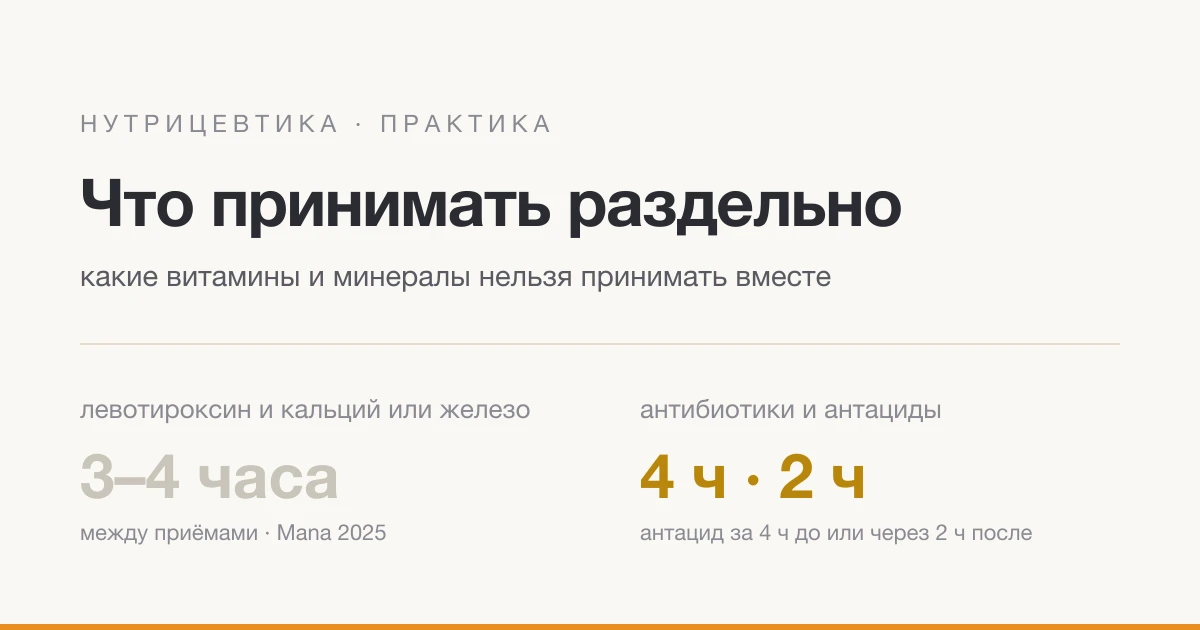
- Levothyroxine and calcium, iron — 3–4 hours (Mana DL Medicina (B Aires) 2025. PMID 41109285[1]); magnesium — separately, the interval has not been studied (Attinger MC Clin Transl Sci 2025. PMID 41221788[8]).
- Tetracyclines, fluoroquinolones and antacids — the antacid 4 hours before or 2 hours after the antibiotic (Ogawa R Drugs 2011. PMID 21942976[2]). For supplements the interval has not been studied — it is carried over from antacids; the exact timing differs for each antibiotic, so check the package leaflet.
- Iron and coffee — coffee an hour before a meal (Morck TA Am J Clin Nutr 1983. PMID 6402915[10]).
- Calcium and iron — with normal iron stores, spacing them apart is, according to the available data, not necessary; data are still scarce (Abioye AI J Nutr 2021. PMID 33758936[4]).
What the studies showed
| What was tested | Who took part | Result |
|---|---|---|
| Calcium and iron, 1998 | 14 volunteers; 24 people for half a year | Absorption over a day 15.8 → 4.7%; after half a year haemoglobin and ferritin did not change |
| Calcium and iron, meta-analysis, 2021 | Randomised and crossover studies | Absorption 5.6 percentage points lower; haemoglobin did not fall, but the more calcium, the lower the ferritin |
| Vitamin C with iron, 2020 | 440 adults with iron deficiency anaemia | Rise in haemoglobin comparable: difference within 10 g/L (1 g/dL) |
| Coffee and tea with a meal, 1983 | People with normal iron levels | Iron absorption −39% and −64% |
| Levothyroxine and magnesium, 2025 | 15 healthy volunteers | Thyroxine absorption −12% (significant) and −7% (not significant) |
| High-dose zinc, 2026 | 37 reported cases | Copper low in all |
| Vitamin K and warfarin, 2016 | 11 studies | Data conflicting |
| Vitamin D3 with fat, 2015 | 50 older people | Peak blood level 32% higher |
Not everything is equally proven: that taking calcium and iron separately improves treatment results has not been shown (Abioye AI J Nutr 2021. PMID 33758936[4]). The handbook advises taking calcium and manganese on different days (Burgerstein, Handbuch Nährstoffe 2015, p. 117–118): in 6 adults, calcium almost completely blocked the entry of manganese into the blood (Freeland-Graves JH J Am Coll Nutr 1991. PMID 2010579[11]), but the benefit of taking them on different days has not been studied. The handbook’s warning that high doses of vitamin C weaken anticoagulants (Burgerstein, Handbuch Nährstoffe 2015, p. 91) was not checked in this set of sources.
Who should be more careful
- People taking levothyroxine: if you start or stop calcium, iron or magnesium, tell your endocrinologist.
- People being treated with tetracyclines or fluoroquinolones: check the interval with minerals with your doctor.
- People taking more than 25 mg of zinc a day for longer than 6 weeks: discuss copper monitoring with your doctor; the review has no data for doses of 25–50 mg.
- People taking warfarin: do not start or stop vitamin K supplements without your doctor.
Bottom line
Most vitamins and minerals can be taken together. A few pairs matter: levothyroxine and two groups of antibiotics with minerals, high doses of zinc with copper, warfarin with sudden changes in vitamin K. You can put together a regimen that suits your medicines at a consultation.
This material is for information only and does not replace a doctor’s consultation. Do not change how you take medicines and supplements without agreeing it with your doctor.
References
- B Aires) 2025. PMID 41109285
- Ogawa R Drugs 2011. PMID 21942976
- Minihane AM Am J Clin Nutr 1998. PMID 9665102
- Abioye AI J Nutr 2021. PMID 33758936
- Li N JAMA Netw Open 2020. PMID 33136134
- Dawson-Hughes B J Acad Nutr Diet 2015. PMID 25441954
- Baltimore) 2016. PMID 26962786
- Attinger MC Clin Transl Sci 2025. PMID 41221788
- Dutta A Biol Trace Elem Res 2026. PMID 42087025
- Morck TA Am J Clin Nutr 1983. PMID 6402915
- Freeland-Graves JH J Am Coll Nutr 1991. PMID 2010579
Key facts
- In short experiments, calcium lowered iron absorption by an average of 5.6 percentage points; haemoglobin did not fall, but the more calcium, the lower the ferritin (Abioye AI, J Nutr 2021).
- In 440 adults with iron deficiency anaemia (97% women), iron without vitamin C raised haemoglobin over 2 weeks comparably: 18.4 and 20.0 g/L (1.84 and 2.00 g/dL), the difference fell within the preset margin of 10 g/L (1 g/dL) (Li N, JAMA Netw Open 2020).
- Levothyroxine is advised to be spaced 3–4 hours apart from calcium and iron salts (Mana DL, Medicina (B Aires) 2025).
- An antacid is advised to be taken 4 hours before tetracycline and fluoroquinolone antibiotics or 2 hours after (Ogawa R, Drugs 2011).
- On warfarin, restricting vitamin K in food apparently does not improve treatment; a stable diet may matter more (Violi F, Medicine (Baltimore) 2016).