Key points
What carnitine does
Carnitine carries fatty acids into the mitochondria — the cell’s “power stations”, where fat is burned to produce energy. The body holds 20–25 g of carnitine, and more than 95% of it is in the heart and skeletal muscles (Burgerstein, Handbuch Nährstoffe 2015, p. 201). Its synthesis also needs vitamin C — see the article Vitamin C: does it help with colds and how much to take.
Who may be short of it
Does it help weight loss?
Sport and endurance
Does it help with fatigue?
In cancer patients with fatigue, 2 g of L-carnitine a day for 4 weeks did not help more than placebo: in a study of 376 patients, fatigue decreased in both groups, with no significant difference between them. There was no significant improvement even in those who had a carnitine deficiency at baseline (Cruciani RA J Clin Oncol 2012. PMID 22987089[7]).
Trimethylamine N-oxide (TMAO): what the debate is about
Some of the carnitine from food and supplements is processed by gut bacteria: this produces trimethylamine, and from it trimethylamine N-oxide (TMAO). In people who eat meat, more TMAO formed after taking L-carnitine than in vegans and vegetarians, and this depended on gut bacteria. In 2595 patients undergoing cardiac evaluation, high blood carnitine was linked to the risk of cardiovascular disease and events, but only when TMAO was also high (Koeth RA Nat Med 2013. PMID 23563705[8]). This is an association, not a proven cause.
The supplement does raise TMAO: in 11 older women (9 received placebo), 1.5 g of L-carnitine L-tartrate a day for 24 weeks raised blood TMAO 10-fold, but markers of inflammation, atherosclerosis and oxidative stress, as well as blood lipids, did not change significantly (Samulak JJ Ann Nutr Metab 2019. PMID 30485835[9]; Olek RA Oxid Med Cell Longev 2019. PMID 31636806[10]). In people after acute myocardial infarction, in a meta-analysis of 13 controlled trials (3629 people), L-carnitine was associated with a 27% reduction in all-cause mortality and a 65% reduction in ventricular arrhythmias, without a reduction in heart failure or repeat infarctions (DiNicolantonio JJ Mayo Clin Proc 2013. PMID 23597877[11]).
How it is taken
In the meta-analysis, weight loss was greatest with 2000 mg of L-carnitine a day (Talenezhad N Clin Nutr ESPEN 2020. PMID 32359762[2]). The handbook gives the author’s own dosage (1–3.5 g a day, in divided doses after meals) (Burgerstein, Handbuch Nährstoffe 2015, p. 202); current guidelines are more cautious.
The handbook recommends only pure L-carnitine: the DL form contains D-carnitine, which interferes with the action of the L form and can cause muscle weakness. Up to 4 g a day, the handbook describes no side effects other than diarrhea that passes quickly (it is more common on an empty stomach) (Burgerstein, Handbuch Nährstoffe 2015, p. 202, 204). Restlessness occurs occasionally, and a fishy odor of the breath, sweat and urine has been described (LactMed, NICHD 2024. PMID 30000924[12]).
What the studies showed
| What was tested | Who took part | Result |
|---|---|---|
| Weight, meta-analysis of 9 studies, 2016 | 911 adults | −1.33 kg vs control; the benefit shrank over time |
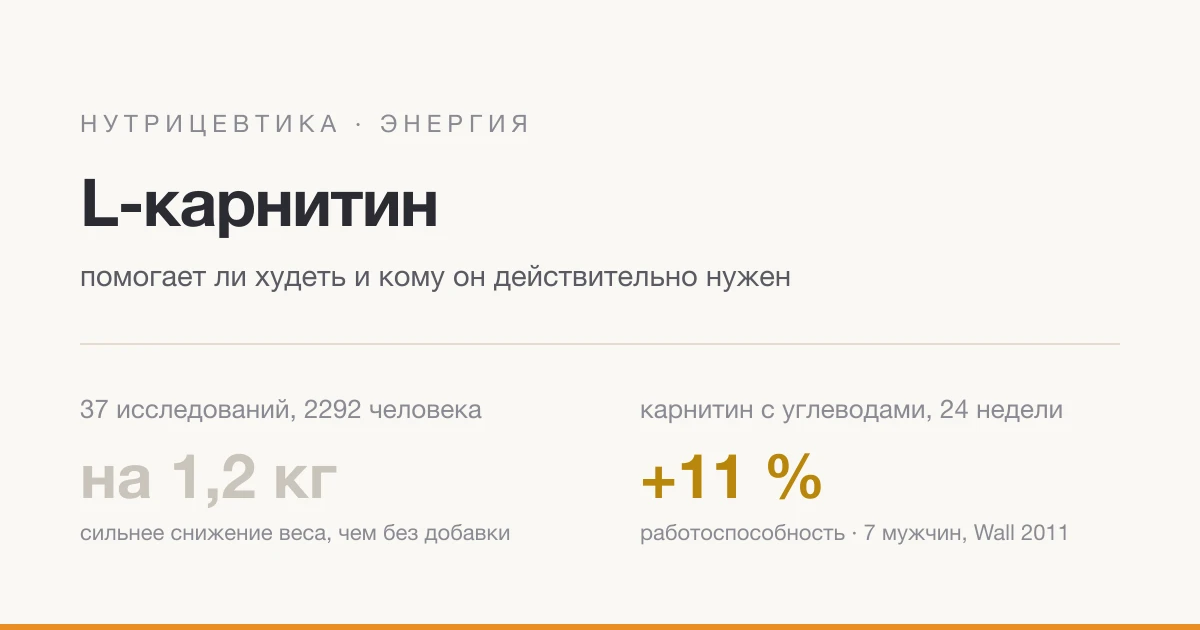
| Weight, meta-analysis of 37 studies, 2020 | 2292 people | −1.21 kg, fat mass −2.08 kg; in high-quality studies only the weight reduction was confirmed; waist and body fat percentage did not change significantly |
| Muscle and exercise, 24 weeks, 2011 | 14 healthy men: 7 on carnitine with carbohydrate, 7 on carbohydrate only | Muscle carnitine +21%, work capacity +11% from baseline; no change in those on carbohydrate only |
| Vegetarians, 2 g a day for 12 weeks, 2016 | 16 vegetarians and 8 meat eaters | Blood carnitine +31%, muscle +13%; exercise capacity did not change significantly |
| Fatigue in cancer, 2 g a day for 4 weeks, 2012 | 376 patients | No better than placebo |
| TMAO, 1.5 g a day for 24 weeks, 2019 | 11 older women, 9 on placebo | TMAO ×10; inflammation, oxidative stress and lipids did not change significantly |
Not everything was confirmed: in cancer, carnitine did not reduce fatigue more than placebo, and in vegetarians maximal exercise capacity did not change significantly (Cruciani RA J Clin Oncol 2012. PMID 22987089[7]; Novakova K Eur J Nutr 2016. PMID 25612929[5]).
Who should be more careful
- In kidney disease and on dialysis, carnitine is prescribed by a nephrologist: on dialysis it is given intravenously, and how well such patients absorb carnitine taken by mouth is unknown (Evans A Am J Kidney Dis 2003. PMID 12751050[1]).
- If you or your child take valproic acid, the question of carnitine is decided by a neurologist.
- If you have heart or vascular disease, discuss long-term use without a medical reason with a cardiologist: in healthy people the supplement’s effect on the heart has been studied for no longer than 24 weeks (Samulak JJ Ann Nutr Metab 2019. PMID 30485835[9]).
- While breastfeeding, L-carnitine is best taken only when prescribed by a doctor (LactMed, NICHD 2024. PMID 30000924[12]).
Bottom line
L-carnitine is truly needed by those who lack it — above all, some people on long-term hemodialysis. For weight loss there is an effect, but a modest one: 1.2–1.3 kg more than without the supplement, and it shrinks over time. A gain in endurance has been shown in one small study, and in cancer carnitine did not reduce fatigue more than placebo. You can find out whether you personally need it at a consultation.
This material is for information only and does not replace a consultation with a doctor. The dose and form of L-carnitine are chosen by a doctor.
References
- Evans A Am J Kidney Dis 2003. PMID 12751050
- Talenezhad N Clin Nutr ESPEN 2020. PMID 32359762
- Wall BT J Physiol 2011. PMID 21224234
- Raskind JY Ann Pharmacother 2000. PMID 10852092
- Novakova K Eur J Nutr 2016. PMID 25612929
- Pooyandjoo M Obes Rev 2016. PMID 27335245
- Cruciani RA J Clin Oncol 2012. PMID 22987089
- Koeth RA Nat Med 2013. PMID 23563705
- Samulak JJ Ann Nutr Metab 2019. PMID 30485835
- Olek RA Oxid Med Cell Longev 2019. PMID 31636806
- DiNicolantonio JJ Mayo Clin Proc 2013. PMID 23597877
- NICHD 2024. PMID 30000924
Key facts
- Carnitine carries fatty acids into the mitochondria; the body holds 20–25 g of it, more than 95% in the heart and skeletal muscles (Burgerstein, Handbuch Nährstoffe 2015, p. 201).
- With many years of hemodialysis, carnitine levels in the blood and tissues may fall; for such a deficiency, intravenous L-carnitine is approved (Evans A, Am J Kidney Dis 2003).
- In a meta-analysis of 37 randomized trials (2292 people), L-carnitine lowered weight on average by 1.21 kg more than control and fat mass by 2.08 kg, but in high-quality studies only the weight reduction was confirmed (Talenezhad N, Clin Nutr ESPEN 2020).
- In 7 men, 2 g of L-carnitine L-tartrate with 80 g of carbohydrate twice a day for 24 weeks raised muscle carnitine by 21% and work capacity by 11% from baseline; in 7 who took carbohydrate only, there was no change (Wall BT, J Physiol 2011).
- In 11 older women (9 received placebo), 1.5 g of L-carnitine L-tartrate a day for 24 weeks raised blood trimethylamine N-oxide (TMAO) 10-fold, but markers of inflammation, atherosclerosis and oxidative stress did not change significantly (Samulak JJ, Ann Nutr Metab 2019; Olek RA, Oxid Med Cell Longev 2019).