Introduction: a journalist as cultural diagnostician
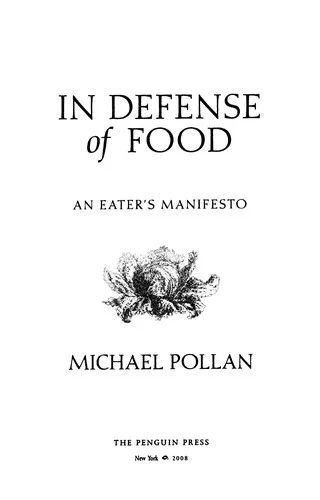
Michael Pollan is a journalist, a professor at New York University and UC Berkeley, and the author of "The Omnivore's Dilemma" (2006), "In Defense of Food: An Eater's Manifesto" (Penguin Press, 2008) and "Cooked" (2013). "In Defense of Food" is the most concise and practically important of them. The book opens with a seven-word epigraph: "Eat food. Not too much. Mostly plants." — and goes on to argue why this seven-word rule is harder than it looks.
Pollan is not a physician or a nutrition scientist. He is a food anthropologist and a cultural analyst. That is both his weakness and his strength. The weakness is that some claims rest on epidemiological observation without direct evidence. The strength is that he treats food as a cultural and social phenomenon that the reductionist biomedical model misses. For an endocrinologist working with metabolic disease, that frame is critically valuable.
🌀
#first_nutritionism_is_a_trap
The central concept of the book is the critique of nutritionism (Pollan's term, following Gyorgy Scrinis). Nutritionism is the ideology that food is defined by the sum of its nutrients: proteins, fats, carbohydrates, vitamins, minerals, phytochemicals. At first glance this is a sensible reduction. In practice it is a methodological failure that has driven a series of large-scale epidemiological errors:
- The anti-fat era (1980s) — the hypothesis that fats cause cardiovascular disease led to a mass substitution of saturated fats with refined carbohydrates. Result: rising obesity and diabetes, not reduced CVD. Contemporary meta-analyses (Siri-Tarino PW et al., Am J Clin Nutr 2010, PMID 20071648[1]) have not confirmed the original anti-fat hypothesis - Fortification of foods (adding vitamins, minerals, omega-3) — the attempt to "fix" refined products by artificial addition of nutrients. Failed to show clinical benefit for most health outcomes - Low-calorie or "low-something" substitutes — based on isolating a "bad" nutrient. The paradox: low-fat dairy with added sugar is clinically worse than full-fat dairy without additives - Isolation of "beneficial" nutrients (beta-carotene, vitamin E, selenium) and their administration as supplements — many RCTs showed no benefit or even harm, while the same nutrients in foods are associated with benefit
The biological logic of the failure of nutritionism: food is not a sum of components but a matrix (food matrix) with emergent properties. Beta-carotene isolated from a carrot is biochemically the same but clinically behaves differently from beta-carotene in the carrot matrix with its fibre, other carotenoids, minerals and phytochemicals. Lutein and zeaxanthin from egg yolk are more bioavailable than from spinach, because the lecithin matrix of the yolk improves absorption. Calcium from dairy is absorbed better than calcium from tablets, partly because of the dairy matrix. These emergent effects cannot be reproduced by isolated supplementation.
🌀
#second_western_diet_syndrome
The second key thesis is Western diet syndrome as a universal pattern. Anthropological data show that when peoples historically eating traditional diets (Okinawa, Inuit, Maasai, Tarahumara, the Mediterranean) shift to an industrialised Western diet, they develop the same diseases: obesity, metabolic syndrome, type 2 diabetes, CVD, rising oncology and neurodegeneration.
Crucially, these original traditional diets differed radically in macronutrient profile. The Inuit ate almost entirely animal food with very few carbohydrates. The Okinawan diet was about 80% carbohydrates from sweet potato. The Maasai lived on milk, blood and meat. The Mediterranean diet is balanced with abundant olive oil. But all of these shared common characteristics:
- Minimally processed foods - High nutrient density - No added sugar or refined carbohydrates - No industrial vegetable oils (soybean, corn, cottonseed) - High continuous physical activity - A social organisation of meals
What all these populations have in common after industrialisation is a shift to the Western pattern and the universal emergence of the same diseases. This is a strong epidemiological argument that the problem is not a single macronutrient but a structural change in the food environment.
🌀
#third_seven_rules_of_recognition
The third part of the book is practical. Pollan formulates seven simple rules for recognising "real food":
1. "Do not eat anything your great-grandmother would not recognise as food" — Pop-Tarts, Go-Gurt, Lunchables — modern products that did not exist 50 years ago. Their biological impact on humans is evolutionarily untested 2. "Avoid foods with ingredients you cannot pronounce" — long lists of chemical additives signal industrial processing 3. "Avoid foods with more than five ingredients" — a proxy for processing 4. "Avoid foods containing high-fructose corn syrup" — a marker of ultra-processing and metabolic load 5. "Avoid foods that advertise health claims on the package" — real food does not need health claims 6. "Shop on the perimeter of the supermarket" — fresh vegetables, fruit, meat, fish and dairy usually sit on the perimeter; packaged goods sit in the centre 7. "Do not eat anything that would not rot" — real food biologically decomposes. Products "that keep for years" are structurally altered such that even bacteria and fungi no longer recognise them
These rules do not have the status of scientific recommendations. They are heuristics — simple decision rules under information overload. Their strength is that they do not require the patient to become a nutrition scientist. A single supermarket visit with these seven rules in mind eliminates most poor choices without calorie counting or macronutrient tracking.
🌀
#critique
Pollan is a journalist, and his book is more cultural analysis than clinical guideline:
- Not all "whole foods" are equally healthy. Whole grains are better than refined, but not for everyone — a coeliac patient gains nothing. "Whole" food does not mean "safe for everyone" - Romanticisation of traditional diets. Pollan at times idealises pre-industrial diets. In practice these diets coexisted with high infectious mortality, malabsorption, micronutrient deficiencies and famine. The modern Western diet is a problem of excess, but traditional diets were often a problem of deficiency - A 2008 book — some emphases have aged. His caution about saturated fats now looks overdone; contemporary meta-analyses show no convincing CVD-risk difference between mono-unsaturated and saturated fats from whole sources - "Mostly plants" is a generic recommendation, but clinically requires individualisation. For a type 2 diabetes patient losing weight and improving HbA1c on a low-carbohydrate diet with significant high-quality meat and fish, "mostly plants" may be less optimal than a balanced mixed approach
Despite this, Pollan's basic principles — the critique of nutritionism, the concept of the food matrix, Western diet syndrome — remain clinically relevant and have been corroborated in the 17 years since.
🌀
#summary
What is strong: the critique of nutritionism as ideology; the concept of the food matrix with emergent properties; Western diet syndrome as a universal pattern; the seven rules as an operational tool.
What requires caution: romanticisation of traditional diets without their deficits; generic recommendations without individualisation; outdated emphases on fats.
What is critically important: the book is for a patient who wants to understand the general principles of healthy eating without a master's degree in nutrition science. It is a starting point, not a final guide. A specific nutritional strategy requires individualisation by metabolic status, genetics, gut, lifestyle and preferences.
🌀
#practical_minimum
Pollan's ideas in daily practice:
Pollan's seven rules for shopping and eating — as above.
🌀
#about_the_reviewer
Dr. Vladimir Pereligyn — endocrinologist. Functional medicine with a focus on preventive strategies: metabolic health, thyroid function, hormonal balance, and individualised risk profiling based on extended laboratory diagnostics. Consultations in person and online: universum.earth/consultation. App Store: Teremok (type 2 diabetes, remission).
🌀
Source
▸ Pollan M. In Defense of Food: An Eater's Manifesto. Penguin Press, New York, 2008. ISBN 978-1594201455. 244 pages.
Further reading on the topics of this review: ▸ Siri-Tarino PW, Sun Q, Hu FB, Krauss RM. Meta-analysis of prospective cohort studies evaluating the association of saturated fat with cardiovascular disease. Am J Clin Nutr 2010;91(3):535-46. PMID 20071648[1] ▸ Cordain L, Eaton SB, Sebastian A, et al. Origins and evolution of the Western diet: health implications for the 21st century. Am J Clin Nutr 2005;81(2):341-54. PMID 15699220[2] ▸ Aune D, Giovannucci E, Boffetta P, et al. Fruit and vegetable intake and the risk of cardiovascular disease, total cancer and all-cause mortality. Int J Epidemiol 2017;46(3):1029-1056. PMID 28338764[3] ▸ Monteiro CA, Cannon G, Levy RB, et al. Ultra-processed foods: what they are and how to identify them. Public Health Nutr 2019;22(5):936-941. PMID 30744710[4] ▸ Scrinis G. On the ideology of nutritionism. Gastronomica 2008;8(1):39-48.
🌀
This review reflects the author's clinical interpretation and does not replace consultation with a physician. Before changing therapy, diagnostic protocols or lifestyle, discuss the plan with your treating specialist.
References
- PMID 20071648
- Cordain L, Eaton SB, Sebastian A, et al. Origins and evolution of the Western diet: health implications for the 21st century. Am J Clin Nutr 2005;81(2):341-54. PMID 15699220
- Aune D, Giovannucci E, Boffetta P, et al. Fruit and vegetable intake and the risk of cardiovascular disease, total cancer and all-cause mortality. Int J Epidemiol 2017;46(3):1029-1056. PMID 28338764
- Monteiro CA, Cannon G, Levy RB, et al. Ultra-processed foods: what they are and how to identify them. Public Health Nutr 2019;22(5):936-941. PMID 30744710
Key facts
- Nutritionism — reducing food to the sum of isolated nutrients — is a methodological failure.
- Food is not a sum of components but a matrix with emergent properties, not reproducible by supplements.
- Western diet syndrome is the common denominator of chronic disease, regardless of the original diet.
- Successful traditional diets share whole foods, minimal added sugar and no industrial oils.
- Seven simple heuristic rules help recognise 'real food' without counting calories or nutrients.