In plain words: what is linked with a long life
Long and healthy
A long life is built from ordinary habits.
- five habits studied in hundreds of thousands of people
- you can start with one
- each is available at home, no special conditions
Steps every day
The more you walk, the lower the risk, up to a sensible level.
- after 60 fewer steps are enough than before 60
- ten minutes on foot is already a good start
- walking together combines two habits
Close people
Strong relationships are linked with a long life.
- living contact matters, not just sharing a flat
- a friend, a family dinner, a call to your parents
- contact can be combined with a walk
Strong hands
Grip strength is a simple marker of overall muscle fitness.
- it is linked with a long life
- muscles need load: squats, push-ups, a band
- you can start with light exercises at home
Mediterranean plate
Vegetables, fish, olive oil and legumes.
- the closer to this eating, the better the picture
- you do not need to live by the sea: ordinary foods work
- you can change one dish at a time
Sleep of about seven hours
Sleep that is too short or too long is linked with higher risk.
- the same wake-up hour
- a dark cool bedroom
- less screen before bed
Where to start
One habit at a time.
- week one: add walking
- then strength at home, one Mediterranean meal and tidy sleep
- missed a day? continue with the next
When to see a doctor
See a doctor first if you have:
- heart disease, a stent or high blood pressure
- chest pain or breathlessness when walking
- you have been inactive and plan a sharp start
Important. Important: prescribed treatment continues; habits complement it.
Key points
A long life is built from ordinary habits, and five of them have been studied in hundreds of thousands of people. More steps a day are associated with a lower risk of death, up to a limit that depends on age: at 10,901 steps the risk is 53% lower than at 3,553. Strong relationships with close people are associated with a 50% higher likelihood of survival over follow-up. Strong hands, Mediterranean-style eating and steady sleep are also linked with a long life. All five are available tonight, and you can start with one.
| Habit | How much | Why it helps | What studies showed |
|---|---|---|---|
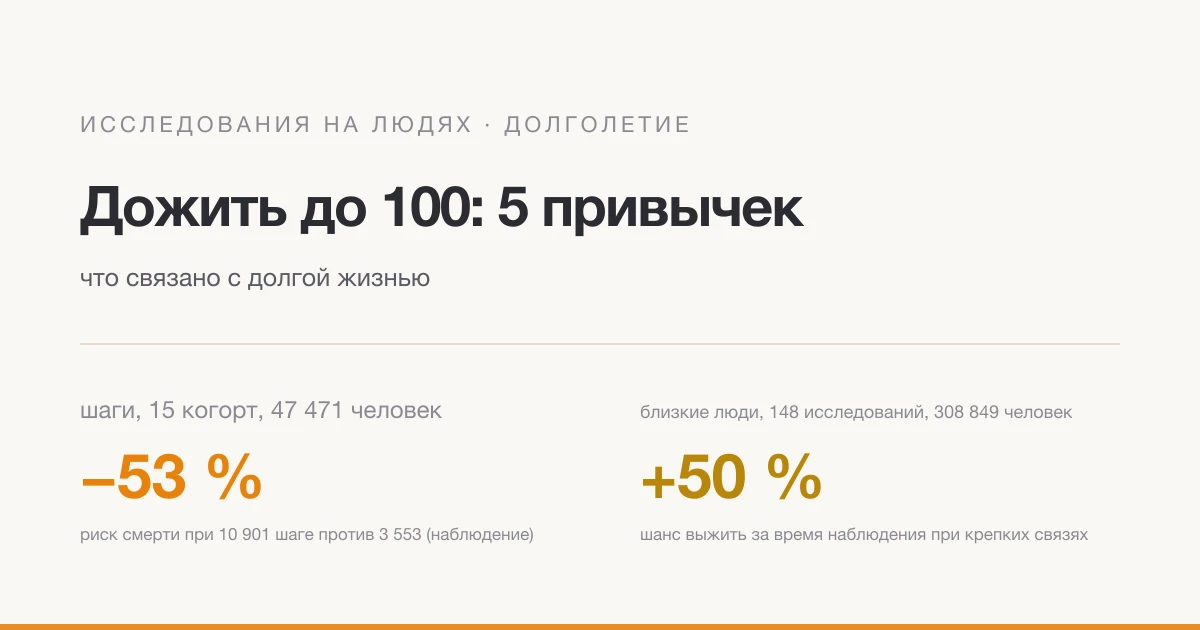
| Steps | 6,000-8,000 after 60, 8,000-10,000 under 60 | Lower risk of death from any cause | 15 cohorts, 47,471 people, 7.1 years: 40%, 45% and 53% lower at 5,801, 7,842 and 10,901 steps vs 3,553 |
| Close people | Strong social relationships | Higher likelihood of survival over follow-up | 148 studies, 308,849 people: 50% higher (OR 1.50) |
| Muscle strength | Every 5 kg of grip strength | Lower risk of death | 139,691 people, 17 countries: every 5 kg lower strength meant a 16% higher risk of death |
| Mediterranean-style eating | 2-point higher adherence | Lower risk of death | 8 cohorts, 514,816 people: 9% lower (RR 0.91) |
| Sleep | About 7-8 hours | Short and long sleep are linked with higher risk | 16 studies, 1,382,999 people: short sleep 12% higher, long 30% higher |
1. Steps: the easiest start
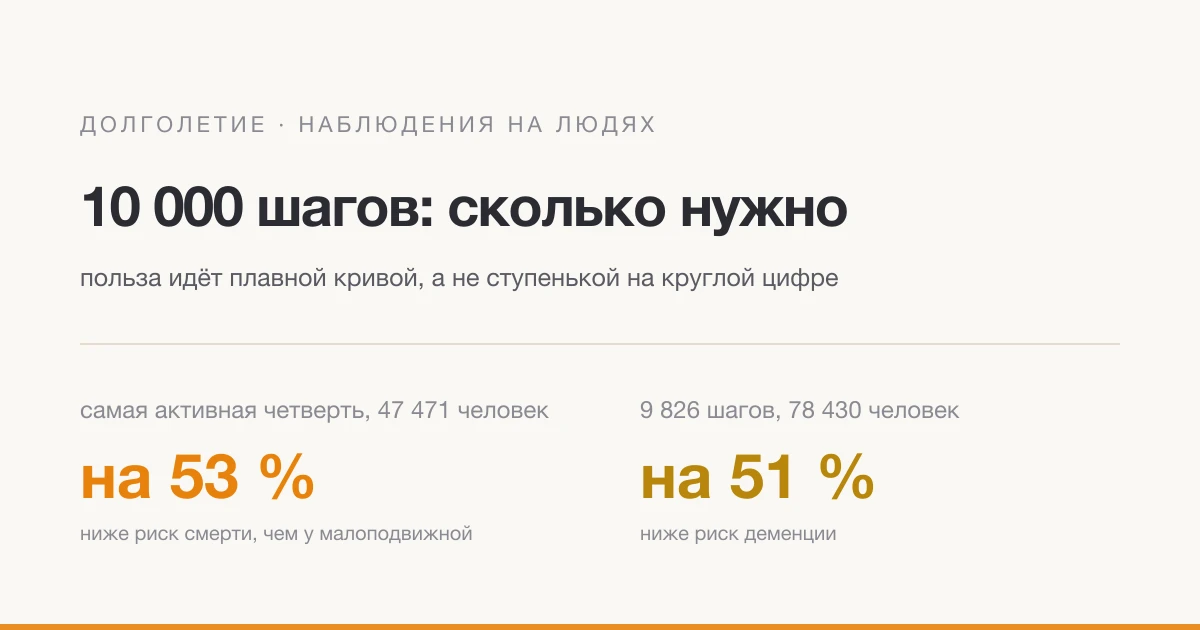
The easiest thing you can start today is to walk. In a pooled analysis of 15 cohorts, 47,471 adults took part and 3,013 deaths occurred over 7.1 years. People were divided into four groups by steps; the medians were 3,553, 5,801, 7,842 and 10,901 steps a day. Compared with the least active group, the risk of death from any cause was 40%, 45% and 53% lower (HR 0.60, 0.55 and 0.47) (Paluch AE Lancet Public Health 2022. PMID 35247352[1]).
An important nuance: the aim is not "as many as possible" but a level that suits your age. In people over 60 the risk fell up to 6,000-8,000 steps a day, in younger people up to 8,000-10,000. So a round ten thousand is not mandatory: after sixty, six to eight thousand is already the working zone. In an ordinary day that is ten minutes on foot to work or the shop, a phone call on the move, stairs instead of the lift, an evening loop around the yard. This is an observation: it shows an association and does not guarantee a result for everyone.
2. Close people around you
Second place goes to the people near you. A review of 148 studies with 308,849 participants showed a 50% higher likelihood of survival over follow-up with stronger social relationships (OR 1.50; 95% CI 1.42-1.59) (Holt-Lunstad J PLoS Med 2010. PMID 20668659[2]). The result held across age, in men and women, at different starting health and different lengths of follow-up.
The association was strongest not for the formal picture but for real involvement in other people's lives: for complex measures of social integration the OR was 1.91 (95% CI 1.63-2.23), while for the simple marker of living alone or with others it was 1.19 (0.99-1.44). Put simply, living contact matters: a friend you meet, a family dinner, a call to your parents, a hobby group, a walk with a neighbour. The good news is that you can start this habit today and combine it with the first one: walk together.
3. Muscle strength
Third place goes to the strength of your muscles. The PURE study followed 139,691 people in 17 countries, median follow-up 4.0 years, during which 3,379 people died. Grip strength was measured with a dynamometer. For every 5 kg lower grip strength the risk of death from any cause was 16% higher (HR 1.16; 95% CI 1.13-1.20) and the risk of cardiovascular death 17% higher (Leong DP Lancet 2015. PMID 25982160[3]).
An interesting detail: grip strength predicted death from any cause and cardiovascular death better than systolic blood pressure. It is a simple marker of overall muscle fitness and is quick and inexpensive to measure. The study was observational: it did not test whether raising strength lowers mortality, so this is an association, not a promise. The practical meaning is simple: muscles need load. Sit-to-stand squats from a chair, wall or floor push-ups, a resistance band, dumbbells, carrying bags, a pull-up bar in the park: any work after which your muscles feel the effort will do.
4. Mediterranean-style eating
Fourth place goes to the Mediterranean eating pattern: vegetables, fish, olive oil and legumes. In a meta-analysis of prospective cohorts, eating closer to this pattern was associated with a lower risk of death. The all-cause mortality analysis included 8 cohorts, 514,816 people and 33,576 deaths; a 2-point higher adherence score was associated with a 9% lower risk of death (RR 0.91; 95% CI 0.89-0.94) (Sofi F BMJ 2008. PMID 18786971[4]).
In the same meta-analysis higher adherence was also associated with 9% lower cardiovascular mortality (RR 0.91; 0.87-0.95). On the plate it looks like this: stewed vegetables with fish and a spoon of olive oil for lunch, lentil soup or a chickpea salad for dinner. You do not have to move to the sea: local vegetables, fish from the nearest shop and tinned legumes will do. Adherence in the studies was scored in points and the benefit was counted per 2 points, so the habit can be built gradually, one dish at a time.
5. Sleep of about seven hours
Fifth place goes to sleep. A meta-analysis of 16 prospective studies (27 independent cohort samples) pooled 1,382,999 participants and 112,566 deaths with follow-up from 4 to 25 years. Short sleep was associated with a 12% higher risk of death (RR 1.12; 95% CI 1.06-1.18), long sleep with a 30% higher risk (RR 1.30; 1.22-1.38) (Cappuccio FP Sleep 2010. PMID 20469800[5]). Sleep duration was assessed by questionnaire.
A good target for most people is about seven to eight hours. Sleep becomes steadier with simple things: the same wake-up time even at weekends, a dark cool bedroom, less screen time before bed, an earlier dinner. If you regularly sleep far more than usual and still feel wrecked in the morning, it is a reason to discuss sleep with a doctor. Good sleep also helps the other habits: after it, it is easier to walk, train and socialise.
How to start: one habit at a time
Do not try to introduce all five habits on Monday. Choose one and tie it to something already in your day. Week one: add ten minutes of walking to your usual route, preferably with someone, so that steps and close people work together. Week two: home strength work several times a week. Week three: replace one meal with a Mediterranean one, with vegetables, fish or legumes and a spoon of olive oil. Week four: put sleep in order, starting with the same wake-up hour. In a month you have five habits, each resting on the previous one. If you miss a day, just continue with the next.
Who should see a doctor first
Discuss exercise and diet changes with a doctor first if you have heart disease or a stent, high blood pressure or diabetes on treatment, chest pain or breathlessness when walking, dizziness, joint pain that makes moving difficult, or if you have been inactive for a long time and plan a sharp start. If you snore with pauses in breathing, or sleep a lot and do not feel rested, tell your doctor: sleep sometimes needs a separate assessment. Prescribed treatment continues; habits complement it.
Bottom line
The road to a long life starts not with heroic feats but with five ordinary habits: walk every day, keep close people near, keep your muscles working, eat Mediterranean-style and sleep about seven to eight hours. All five are associated with lower risk of death in large human studies, so any step you take has something to give. These are observations of large groups: they show an association of a habit with a long life but do not guarantee a lifespan for an individual. It is best to build your plan with a doctor, based on your tests and condition.
References
- Paluch AE Lancet Public Health 2022. PMID 35247352
- Holt-Lunstad J PLoS Med 2010. PMID 20668659
- Leong DP Lancet 2015. PMID 25982160
- Sofi F BMJ 2008. PMID 18786971
- Cappuccio FP Sleep 2010. PMID 20469800
Key facts
- Steps: at 10,901 steps a day (median of the top quarter) the risk of death from any cause was 53% lower than at 3,553 steps (HR 0.47; 15 cohorts, 47,471 adults, 7.1 years; observational); after age 60 the benefit rose up to 6,000-8,000 steps, under 60 up to 8,000-10,000 (Paluch AE Lancet Public Health 2022. PMID 35247352).
- Close people: with stronger social relationships the likelihood of survival over follow-up was 50% higher (OR 1.50; 95% CI 1.42-1.59; 148 studies, 308,849 people; observational) (Holt-Lunstad J PLoS Med 2010. PMID 20668659).
- Muscle strength: for every 5 kg lower grip strength the risk of death from any cause was 16% higher (HR 1.16; 95% CI 1.13-1.20; 139,691 people in 17 countries, median follow-up 4.0 years); grip strength predicted death better than systolic blood pressure (Leong DP Lancet 2015. PMID 25982160).
- Mediterranean-style eating: a 2-point higher adherence score was associated with a 9% lower risk of death (RR 0.91; 95% CI 0.89-0.94; 8 cohorts, 514,816 people, 33,576 deaths; observational) (Sofi F BMJ 2008. PMID 18786971).
- Sleep: short sleep was associated with a 12% higher risk of death (RR 1.12; 1.06-1.18), long sleep with a 30% higher risk (RR 1.30; 1.22-1.38); 16 studies, 1,382,999 people, 112,566 deaths (Cappuccio FP Sleep 2010. PMID 20469800).