Introduction: an endocrinologist on the neurochemistry of happiness
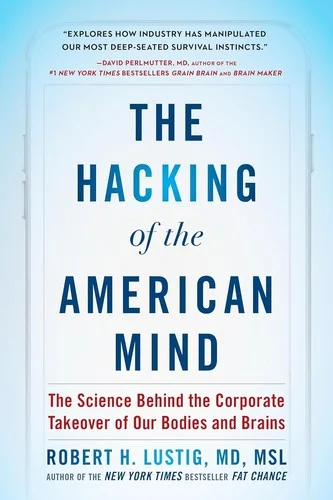
Robert Lustig is professor emeritus of paediatrics and a member of the Institute for Health Policy Studies at UCSF, an endocrinologist with a focus on childhood obesity. His lecture "Sugar: The Bitter Truth" (2009, more than 26 million YouTube views) set the tone of the modern anti-sugar campaign. The book "The Hacking of the American Mind: The Science Behind the Corporate Takeover of Our Bodies and Brains" (Avery, 2017) extends this work from sugar as a metabolic insult to systemic neurochemical dysregulation through sugar, media, devices and social isolation.
The book matters to an endocrinologist because it formulates a systemic neuroendocrine view of the epidemic of depression, obesity and metabolic disease. Lustig is not a neuroscientist, and his model is at times simplified for a lay audience. But the clinical logic — that metabolic health and psychoemotional health are linked through concrete neurochemical cascades — is critically important for contemporary medicine.
🌀
#first_pleasure_is_not_happiness
The central idea is the neurochemical distinction between pleasure and happiness.
Pleasure is a short-lived hedonic signal mediated by the mesolimbic dopamine system (ventral tegmental area → nucleus accumbens). The biological function is motivation to repeat behaviours linked with survival (food, reproduction, social interaction). The dopamine signal is acute, phasic and brief.
Happiness is a sustained state of well-being mediated primarily by the serotonergic system (raphe nuclei → prefrontal cortex and limbic regions). The biological function is the maintenance of affective homeostasis, regulation of mood, impulse control and social functioning. The serotonin signal is tonic, sustained and regulatory.
Lustig formulates the key observation: these two systems are regulated in opposite ways. Chronic over-stimulation of the dopamine system (through sugar, nicotine, opioids, gambling mechanics, cocaine, supernormal stimuli) leads to down-regulation of striatal D2 receptors (Volkow ND et al., NeuroImage 2008). This is the basis of tolerance and addiction. In parallel cortisol rises under chronic stimulation and serotonin falls (chronic hypercortisolism suppresses tryptophan hydroxylase, the key enzyme of serotonin synthesis).
Biologically this is a transition from a reward system to a system of addiction and depression. Clinically, this is a patient who eats more but derives less satisfaction, spends more hours on social media but feels more isolated.
🌀
#second_supernormal_stimuli_industrial_exploitation
The second thesis is industrial. Lustig argues that modern food, media and technology industries have deliberately created products that exploit the dopamine system. The concept of supernormal stimuli (Nikolaas Tinbergen, 1953) describes artificial stimuli that "deceive" evolved reward systems: they activate the same neural pathways as natural stimuli, but with greater intensity.
Examples: - Ultra-processed food — a combination of sugar, fat, salt and texture not achievable in nature. Activates the hedonic hot spots of the nucleus accumbens more intensely than natural food. In parallel, the absence of fibre and the natural nutrient matrix means rapid absorption and sharp insulin peaks - Social media — variable-ratio reinforcement (the same mechanism as in slot machines) through likes and notifications. The strongest of all schedules of conditioning in the Skinnerian paradigm - The news cycle — outrage- and fear-based attention engineering to retain user attention - Streaming platforms — autoplay and algorithmic personalisation for endless consumption
Lustig documents the clinical consequences through epidemiological data: the rise of paediatric obesity, metabolic syndrome, type 2 diabetes in adolescents, depression in young women (especially since the spread of smartphones and Instagram). This is not "random correlation" — there is a neurochemical and behavioural model of causation (Twenge JM et al., Clin Psychol Sci 2018).
An important nuance: Lustig does not claim that social media or ultra-processed food "cause depression in every individual". He claims that these factors are potent risk modifiers in a population with genetic, metabolic and psychosocial predisposition.
🌀
#third_four_c_recovery
The third part of the book is practical. Lustig formulates the four C's as a strategy for restoring dopamine/serotonin balance:
The four C's are not "a therapeutic prescription" but a list of domains of life that require reinvestment in a patient with metabolic or psychoemotional dysfunction.
🌀
#critique
Lustig is a powerful communicator and a passionate advocate. His passion sometimes shades into categoricism:
- The model dopamine = "bad", serotonin = "good" is a simplification. Dopamine is essential for motivation, learning and motor control. Depression associated with dopaminergic hypofunction (for example in parkinsonism) is not cured by "renouncing pleasure" - The claim that "sugar is a drug" is biologically close (shared neural substrates) but not clinically equivalent. Sugar dependence is a food addiction, not a chemical addiction in the strict sense - The categorical anti-industrial position is defensible but at times loses nuance. Not all ultra-processed food is equally harmful; not all social media are equally toxic - The book is more social commentary than clinical protocol — that is simultaneously its strength and its weakness
At the same time Lustig's biological models (dopamine/serotonin neurochemistry, the metabolic nature of depression, the sugar–insulin–mood link) are sound and supported by research.
🌀
#summary
What is strong: the neurochemical distinction between pleasure and happiness as a practical clinical frame; the link between metabolic and psychoemotional health; the concept of supernormal stimuli and industrial exploitation of reward systems; the operational four C's for recovery.
What requires caution: the simplified binary model of dopamine and serotonin; categorical rhetoric; a blending of biological and sociocultural arguments.
What is critically important: the book is for a patient or clinician who wants to understand the systemic roots of the depression and metabolic-disease epidemics. It is not a textbook for the treatment of clinical depression — for which the first line remains standard (CBT, pharmacotherapy when indicated). But as a supplementary analysis of lifestyle and environment it is critically valuable.
🌀
#practical_minimum
| Domain | Target |
|---|---|
| Added sugar | < 25 g/day (ideal < 15) |
| Social media | ≤ 30 min/day |
| Connect | 5+ h/week |
| Cook | 5+ dinners/week |
🌀
#about_the_reviewer
Dr. Vladimir Pereligyn — endocrinologist. Functional medicine with a focus on preventive strategies: metabolic health, thyroid function, hormonal balance, and individualised risk profiling based on extended laboratory diagnostics. Consultations in person and online: universum.earth/consultation. App Store: Teremok (type 2 diabetes, remission).
🌀
Source
▸ Lustig RH. The Hacking of the American Mind: The Science Behind the Corporate Takeover of Our Bodies and Brains. Avery, New York, 2017. ISBN 978-1101982945. 352 pages.
Further reading on the topics of this review: ▸ Volkow ND, Wang GJ, Telang F, et al. Low dopamine striatal D2 receptors are associated with prefrontal metabolism in obese subjects. NeuroImage 2008;42(4):1537-43. ▸ Twenge JM, Joiner TE, Rogers ML, Martin GN. Increases in Depressive Symptoms, Suicide-Related Outcomes, and Suicide Rates Among U.S. Adolescents After 2010 and Links to Increased New Media Screen Time. Clin Psychol Sci 2018;6(1):3-17. ▸ Lustig RH. Fructose: it's "alcohol without the buzz". Adv Nutr 2013;4(2):226-35. PMID 23493539[1] ▸ Avena NM, Rada P, Hoebel BG. Evidence for sugar addiction: behavioral and neurochemical effects of intermittent, excessive sugar intake. Neurosci Biobehav Rev 2008;32(1):20-39. PMID 17617461[2] ▸ Berridge KC, Robinson TE. Liking, wanting, and the incentive-sensitization theory of addiction. Am Psychol 2016;71(8):670-679. PMID 27977239[3]
🌀
This review reflects the author's clinical interpretation and does not replace consultation with a physician. Before changing therapy, diagnostic protocols or lifestyle, discuss the plan with your treating specialist.
References
- Lustig RH. Fructose: it's "alcohol without the buzz". Adv Nutr 2013;4(2):226-35. PMID 23493539
- Avena NM, Rada P, Hoebel BG. Evidence for sugar addiction: behavioral and neurochemical effects of intermittent, excessive sugar intake. Neurosci Biobehav Rev 2008;32(1):20-39. PMID 17617461
- Berridge KC, Robinson TE. Liking, wanting, and the incentive-sensitization theory of addiction. Am Psychol 2016;71(8):670-679. PMID 27977239
Key facts
- Pleasure (dopamine) and happiness (serotonin) are distinct neurochemical systems regulated in opposite ways.
- Chronic over-stimulation of dopamine down-regulates striatal D2 receptors — the basis of tolerance and addiction.
- Industry engineered supernormal stimuli (ultra-processed food, social media) that exploit the reward system.
- Metabolic and psychoemotional health are parts of one system; the sugar-insulin-mood link.
- Restoring the dopamine/serotonin balance runs through the four C's: Connect, Contribute, Cope, Cook.