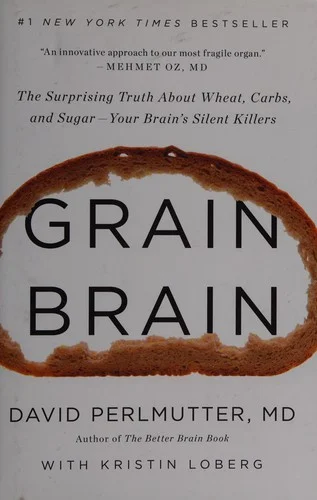
Introduction: "Grain Brain" — a contested book with serious ideas
David Perlmutter is a practising neurologist in Naples (Florida) and a Fellow of the American College of Nutrition. His book "Grain Brain: The Surprising Truth about Wheat, Carbs, and Sugar — Your Brain's Silent Killers" (Little, Brown, 2013) was a #1 New York Times bestseller that brought the concept of brain metabolic health to a mass audience.
It is probably the most polarising book in this list. Perlmutter made bold claims, some of which have a robust evidence base and some of which are seriously overstated. I review the book not as "true or false" but as a spectrum of clinically relevant ideas to which a differentiated response is required: what to take into practice, what to ignore, and what to apply with caution.
🌀
#first_alzheimer_is_type_3_diabetes
The strongest thesis of the book: Alzheimer's disease is in large part a metabolic disease of the brain associated with insulin resistance. The "type 3 diabetes" concept, proposed by Suzanne de la Monte (Brown University, J Diabetes Sci Technol 2008), describes how the Alzheimer's brain demonstrates the characteristic features of insulin resistance: reduced expression of insulin receptors in the hippocampus, impaired signalling, dysfunctional glucose metabolism (visible on FDG-PET 10–15 years before clinical symptoms).
The evidence base for the metabolic nature of Alzheimer's is extensive: - Systematic review by Pearson-Stuttard J et al., Lancet Diabetes Endocrinol 2015 — type 2 diabetes increases the risk of dementia by 50–100% - Crane PK et al., NEJM 2013, PMID 23924004[1] — blood glucose level (even in the subdiabetic range) correlates directly with dementia risk in a prospective cohort - Talbot K et al., J Clin Invest 2012 — brain insulin resistance is confirmed in postmortem tissue from Alzheimer's patients - APOE4 carriers carry a heightened predisposition to Alzheimer's, and this association is modified by metabolic factors (diabetes, obesity)
The relationship is bidirectional and mechanistically logical. Insulin resistance reduces glucose uptake by neurons (the brain accounts for 20% of whole-body glucose metabolism). Neurons enter an energy deficit. In parallel β-amyloid is a by-product of impaired APP processing under conditions of hyperglycaemia and oxidative stress. Chronic energy deficit plus β-amyloid accumulation gives clinical disease 15–30 years later.
🌀
#second_gluten_is_not_only_about_coeliac
The second central thesis is the most contested. Perlmutter argues that gluten has a neuroinflammatory effect even in patients without coeliac disease. This claim requires careful unpacking.
What is established: - Coeliac disease (1% of the population) is a clinically reliable autoimmune disease with robust serological diagnosis (anti-tTG, anti-EMA, anti-DGP) and endoscopic confirmation. Treatment is lifelong gluten exclusion. This is mainstream medicine - Non-coeliac gluten sensitivity (NCGS, about 6% of the population) is a clinically observable phenomenon in which symptomatic patients without serological or endoscopic features of coeliac disease improve on a gluten-free diet and relapse on challenge (Volta U et al., BMC Med 2014). The mechanism is debated: possibly a FODMAP reaction rather than gluten itself - Zonulin-mediated increases in intestinal permeability in susceptible individuals under a gluten load (Fasano A, Physiol Rev 2011, PMID 21248165[2]) — a defensible biological model
What is not established in the form claimed in the book: - The claim that gluten raises the risk of Alzheimer's disease across the whole population — there is no data to support such a broad conclusion. Direct studies (Kasarda DD, J Agric Food Chem 2013) show that modern wheat does not differ in gluten content from older cultivars - A categorical universal exclusion of gluten for everyone is an unjustified restriction for most people
🌀
#third_ketones_alternative_fuel
The third idea is the ketogenic diet as a neuroprotective regime. The logic: when glucose utilisation is impaired (pre-diabetes, early neurodegeneration), the brain does not receive enough energy. Ketone bodies (β-hydroxybutyrate, acetoacetate) are an alternative energy substrate independent of insulin signalling.
Evidence base: - Cunnane SC et al., Ageing Res Rev 2020 — the brain in early Alzheimer's shows a deficit of glucose metabolism with preserved utilisation of ketone bodies (on β-hydroxybutyrate-tracer PET) - Small RCTs of MCT oil and ketogenic diet in patients with mild cognitive impairment show short-term improvement in cognitive measures (Henderson ST et al., Nutr Metab 2009, PMID 19664276[3]) - The ketogenic diet has been a standard therapy for refractory paediatric epilepsy since the 1920s, with reliable efficacy and predictable tolerability
However, the ketogenic diet has significant limitations: - Not suitable in hypothyroidism (low carbohydrate intake reduces T4-to-T3 conversion) - Risk of menstrual disturbance in women of reproductive age - Contraindicated in adrenal disease, glycogen storage disease, carnitine deficiency, and biliary disease - Long-term safety data in healthy adults are limited; there are signals of dyslipidaemia (rising ApoB in some patients), renal function disturbance and microbiome shifts
🌀
#critique
Perlmutter is one of the most criticised authors in our list, and the criticism is often justified:
- Categorical anti-gluten positions for the entire population are not supported by evidence. Most people without coeliac disease or NCGS tolerate gluten normally - The book cites studies selectively, choosing supporting data and ignoring contradictions - The categorical equation of carbohydrates with "brain poison" ignores millennia of successful grain consumption by Mediterranean, Okinawan and traditional Asian populations with low rates of neurodegeneration - The recommendation that everyone adopt a ketogenic diet as prevention is not supported by long-term safety or efficacy data in a healthy population
At the same time the principal biological concepts — the link between metabolic health and the brain, the metabolic nature of Alzheimer's, gut-brain neuroactivity — are sound and merit serious attention. The issue is delivery and overinterpretation.
🌀
#summary
What is strong: the metabolic nature of Alzheimer's as type 3 diabetes; the link between HbA1c and neurodegeneration risk; the role of ketone utilisation in brain energetics; the idea that neurodegeneration is a process beginning decades before clinical signs and modifiable by metabolic means.
What requires critical caution: categorical anti-gluten rhetoric; broad recommendation of the ketogenic diet for all; a style in which hypothesis is presented as fact.
What is critically important: the book is for a healthy person who wants to understand the metabolic roots of neurodegeneration and optimise their diet. It is not a textbook for the treatment of established dementia — for which the standard remains in neurology. And it is not grounds for self-exclusion of gluten without diagnosis — for a significant fraction of patients this creates nutritional risks without clinical benefit.
🌀
#practical_minimum
What can be taken from Perlmutter's ideas in clinical practice:
| Marker | Target |
|---|---|
| HbA1c | < 5.4% |
| HOMA-IR | < 1.5 |
| ApoB | < 80 mg/dL |
| Omega-3 index | > 8% |
| 25(OH)D | 40–60 ng/mL |
🌀
#about_the_reviewer
Dr. Vladimir Pereligyn — endocrinologist. Functional medicine with a focus on preventive strategies: metabolic health, thyroid function, hormonal balance, and individualised risk profiling based on extended laboratory diagnostics. Consultations in person and online: universum.earth/consultation. App Store: Teremok (type 2 diabetes, remission).
🌀
Source
▸ Perlmutter D, Loberg K. Grain Brain: The Surprising Truth about Wheat, Carbs, and Sugar — Your Brain's Silent Killers. Little, Brown and Company, New York, 2013. ISBN 978-0316234801. 336 pages.
Further reading on the topics of this review: ▸ de la Monte SM, Wands JR. Alzheimer's disease is type 3 diabetes-evidence reviewed. J Diabetes Sci Technol 2008;2(6):1101-13. ▸ Crane PK, Walker R, Hubbard RA, et al. Glucose levels and risk of dementia. N Engl J Med 2013;369(6):540-8. PMID 23924004[1] ▸ Talbot K, Wang HY, Kazi H, et al. Demonstrated brain insulin resistance in Alzheimer's disease patients is associated with IGF-1 resistance, IRS-1 dysregulation, and cognitive decline. J Clin Invest 2012;122(4):1316-38. ▸ Volta U, Bardella MT, Calabrò A, et al. An Italian prospective multicenter survey on patients suspected of having non-celiac gluten sensitivity. BMC Med 2014;12:85. ▸ Cunnane SC, Trushina E, Morland C, et al. Brain energy rescue: an emerging therapeutic concept for neurodegenerative disorders of ageing. Nat Rev Drug Discov 2020;19(9):609-633. PMID 32709961[4]
🌀
This review reflects the author's clinical interpretation and does not replace consultation with a physician. Before changing therapy, diagnostic protocols or lifestyle, discuss the plan with your treating specialist.
References
- Crane PK, Walker R, Hubbard RA, et al. Glucose levels and risk of dementia. N Engl J Med 2013;369(6):540-8. PMID 23924004
- PMID 21248165
- PMID 19664276
- Cunnane SC, Trushina E, Morland C, et al. Brain energy rescue: an emerging therapeutic concept for neurodegenerative disorders of ageing. Nat Rev Drug Discov 2020;19(9):609-633. PMID 32709961
Key facts
- Alzheimer's disease is in large part a metabolic disease of the brain associated with insulin resistance ('type 3 diabetes').
- Hyperglycaemia is a modifiable risk factor for neurodegeneration; type 2 diabetes raises dementia risk.
- Gluten may be a neuroinflammatory trigger in some patients, but universal exclusion for everyone is unjustified.
- Ketone bodies are an alternative brain energy substrate under impaired glucose utilisation, independent of insulin.
- Categorical anti-gluten rhetoric and a ketogenic diet 'for all' are exaggerations without an evidence base.