a new cholesterol pill in pictures and a few words
What it is
Enlicitide is the first cholesterol pill of a new type. It was approved in the US in July 2026.
- Until now, such drugs came only as injections
- Taken once a day
- Prescribed by a doctor
Which cholesterol it lowers
It lowers "bad" cholesterol, which doctors call LDL cholesterol.
- Its level is shown by a blood lipid test
- Lowering this cholesterol is the goal of treatment
How it works
The liver removes cholesterol from the blood with special "traps". A protein helps destroy these traps. The pill blocks it, so more traps remain.
- More traps in the liver
- More cholesterol leaves the blood
Who it is prescribed for
Adults with high "bad" cholesterol, including inherited high cholesterol.
- Studied in people already taking cholesterol drugs who still need to lower it further
- Also studied in people with inherited high cholesterol
How to take it
One tablet in the morning, on an empty stomach, with water. No food for half an hour afterwards.
- Wash it down with water; black coffee or unsweetened tea are allowed
- Swallow it whole
- Food no sooner than 30 minutes later
Important. Important: a missed tablet is taken as soon as possible, but never two in one day.
What about diet and exercise
The pill is added to diet and exercise, not a replacement for them.
- Drugs already prescribed are not stopped on your own
- The regimen is chosen by the doctor
How it is tolerated
In large studies the pill was well tolerated. In people with inherited cholesterol, loose stools and dizziness were more common than on the dummy pill.
- Unpleasant effects were about as frequent as on the dummy pill
- Tell your doctor about any unpleasant sensations
What we do not know yet
The pill lowers the level of bad cholesterol well. Whether it will reduce the number of heart attacks and strokes is still being studied.
- A large study is under way
- The answer will come later
Important. Important: the prescription and regimen are determined by the doctor based on tests. Pregnant women and those planning pregnancy should tell their doctor.
In one sentence
The first cholesterol pill of a new type: lowers "bad" cholesterol, taken once a day on an empty stomach, prescribed by a doctor.
Key points
Enlicitide (brand name Lipfendra) is the first tablet in the class of PCSK9 inhibitors (proprotein convertase subtilisin/kexin type 9): the US Food and Drug Administration (FDA) approved it in July 2026, while earlier drugs of this class were given by injection. It is taken once daily, and in large studies it markedly lowered LDL cholesterol (low-density lipoprotein, "bad" cholesterol).
| What was studied | What it does | What human studies showed |
|---|---|---|
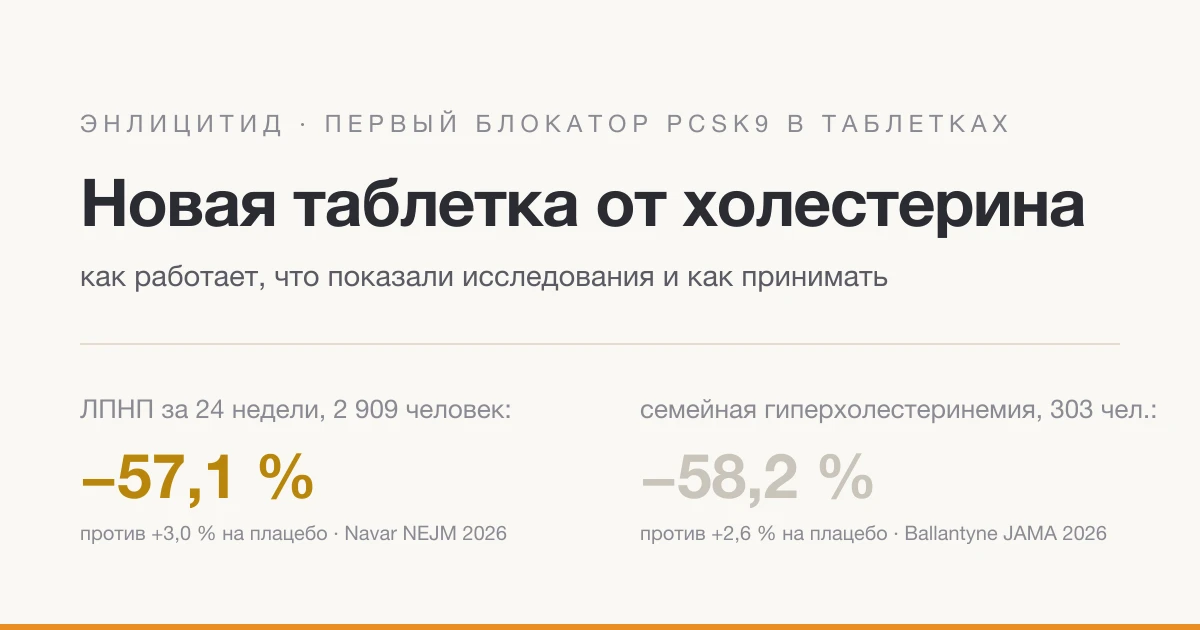
| Enlicitide 20 mg once daily, CORALreef Lipids | Lowers LDL cholesterol | 2,909 participants, 24 weeks: −57.1 % from baseline vs +3.0 % on placebo, a difference of 55.8 percentage points (Navar AM N Engl J Med 2026. PMID 41879224[1]) |
| Heterozygous familial hypercholesterolemia, CORALreef HeFH | The same in inherited high cholesterol | 303 people, 24 weeks: −58.2 % vs +2.6 % on placebo, a difference of 59.4 percentage points (Ballantyne CM JAMA 2026. PMID 41206969[2]) |
| Risk analysis, 843 people without prior events | Lowers LDL cholesterol similarly at low and high risk | 57–63 percentage points more than on placebo in four risk groups; on the drug, levels below 1.8 mmol/L (70 mg/dL) were reached more often than on placebo (American Heart Association, AHA, 2026 congress abstracts; Navar AM) |
| Continued treatment, 2,774 people | The effect persists for up to 2 years (per the authors) | −57.5 % from the pre-treatment level at week 8 of the extension; lipoprotein(a), Lp(a), median −27.5 % (AHA 2026 abstracts, Ballantyne C) |
| Comparison with other pills, 301 people on statins | Stronger than ezetimibe and bempedoic acid | Over 56 days LDL cholesterol −64.6 % (enlicitide) vs −6.3 % (bempedoic acid), −27.8 % (ezetimibe) and −36.5 % (their combination) (Catapano AL J Am Coll Cardiol 2026. PMID 42017875[3]) |
Why a pill is needed
Statins remain the foundation of treatment; if the effect is insufficient, ezetimibe or injectable PCSK9 inhibitors are added. Their use was limited by concerns about injections, cost, availability and "therapeutic inertia", when treatment is not intensified in time (Sun Y Drug Discov Ther 2026. PMID 42604807[4]). A tablet removes the barrier of the injection, although it must be taken under special rules. In CORALreef Lipids it was added to ongoing treatment: 97 % of participants were taking statins (FDA prescribing information, 7/2026).
How it works
The liver removes LDL cholesterol from the blood with receptors on the surface of its cells. The PCSK9 protein binds to these receptors and promotes their breakdown. Enlicitide is a macrocyclic (ring-shaped) peptide: it prevents PCSK9 from binding to the receptor, more receptors remain, and they remove more LDL cholesterol from the blood (Sun Y Drug Discov Ther 2026. PMID 42604807[4]).
The peptide is poorly absorbed when taken by mouth: even with sodium caprate, a substance added to the tablet to aid absorption, about 1 % of the dose reaches the blood. This is why the rules for taking it matter (FDA prescribing information, 7/2026).
What the studies showed
- Large study, 52 weeks. CORALreef Lipids enrolled 2,909 adults with a prior atherosclerotic cardiovascular disease (ASCVD) event or at increased risk of a first one; 2,904 received the drug or placebo. At 24 weeks LDL cholesterol on the drug fell by 57.1 % from baseline and rose by 3.0 % on placebo; the advantage of the drug persisted at week 52 (Navar AM N Engl J Med 2026. PMID 41879224[1]).
- What this means in numbers. With a mean baseline LDL cholesterol of 2.5 mmol/L (96 mg/dL), a 57 % reduction brings it down to about 1.1 mmol/L (41 mg/dL); on placebo it stays at about 2.6 mmol/L (99 mg/dL) (rough conversion from the means in Navar AM N Engl J Med 2026. PMID 41879224[1]).
- Heterozygous familial hypercholesterolemia. In CORALreef HeFH (heterozygous familial hypercholesterolemia, HeFH; 303 people; baseline LDL cholesterol 3.1 mmol/L (119 mg/dL), all taking statins) the difference from placebo was 59.4 percentage points at week 24 and 61.5 at week 52. Lipoprotein(a) fell by a median of 24.7 % over 24 weeks, and by 1.6 % on placebo (Ballantyne CM JAMA 2026. PMID 41206969[2]).
- Dose selection. In phase 2b (380 people) the LDL cholesterol reduction grew with the dose: over 8 weeks the difference from placebo ranged from 41.2 (6 mg) to 60.9 percentage points (30 mg) (Ballantyne CM J Am Coll Cardiol 2023. PMID 36889610[5]). The 20 mg dose gives almost the maximum reduction (FDA prescribing information, 7/2026).
- At different levels of risk. In 843 CORALreef Lipids participants without prior ASCVD events, LDL cholesterol fell by 57–63 percentage points more than on placebo in all four groups of 10-year risk by the PREVENT score (AHA 2026 abstracts, Navar AM).
- Two years. In the open-label extension (2,774 people from three CORALreef studies), the LDL cholesterol reduction, according to the authors, persisted up to week 104 (AHA 2026 abstracts, Ballantyne C).
- Tolerability. In both main studies, adverse events and discontinuations because of them occurred about as often as on placebo (Navar AM N Engl J Med 2026. PMID 41879224[1]; FDA prescribing information, 7/2026). In heterozygous familial hypercholesterolemia, diarrhea (7 % vs 2 % on placebo) and dizziness (9 % vs 4 %) were more common (FDA prescribing information, 7/2026). In the extension, 1.6 % of participants stopped because of adverse events (AHA 2026 abstracts, Ballantyne C).
Who this pill is for
Per the FDA prescribing information, enlicitide is indicated for adults with elevated cholesterol, including familial hypercholesterolemia, to lower LDL cholesterol in addition to diet and physical activity. The studies enrolled people who needed to lower LDL cholesterol further despite statins: after a prior ASCVD event, at a level of 1.4 mmol/L (55 mg/dL) or higher; at risk of a first event, at 1.8 mmol/L (70 mg/dL) or higher (Navar AM N Engl J Med 2026. PMID 41879224[1]; FDA prescribing information, 7/2026). Which level is the target for you is determined by your doctor.
What to do: how it is taken
The tablet is prescribed by a doctor, based on the lipid profile and overall cardiovascular risk. It supplements diet and physical activity and does not replace them. Per the FDA prescribing information:
- one 20 mg tablet once daily, in the morning on an empty stomach, with water (black coffee or unsweetened tea are allowed);
- swallow whole, do not break or chew;
- for at least 30 minutes after the dose, do not eat or drink anything except water, black coffee and unsweetened tea;
- take a missed dose as soon as possible, at least 30 minutes before the next meal; do not take two doses in one day;
- it can be combined with other drugs: no significant drug interactions were observed.
Taking it 30 minutes after a meal lowers the amount of drug in the blood by about half (by 48–50 %), so morning dosing on an empty stomach is part of the regimen. The LDL cholesterol reduction can be assessed as early as 4 weeks (FDA prescribing information, 7/2026).
Who should see a doctor first
Everyone: the regimen is chosen by the doctor based on a blood lipid test. Pregnant women and those planning pregnancy must tell their doctor: per the prescribing information, if pregnancy is detected the drug is stopped unless the benefit outweighs the possible risk to the fetus. Efficacy and safety in children have not been established. Statins and other prescribed drugs should not be stopped on your own.
Summary
Enlicitide is the first cholesterol pill with a PCSK9 inhibitor mechanism: in studies LDL cholesterol fell by 56–59 percentage points more than on placebo, and the drug was well tolerated. The goal of treatment is to lower LDL cholesterol; the effect on heart attacks and strokes is being studied. Whether the pill is right for you is decided by your doctor based on your tests. You can go over your lipid profile results at a consultation.
References
- Navar AM N Engl J Med 2026. PMID 41879224
- Ballantyne CM JAMA 2026. PMID 41206969
- Catapano AL J Am Coll Cardiol 2026. PMID 42017875
- Sun Y Drug Discov Ther 2026. PMID 42604807
- Ballantyne CM J Am Coll Cardiol 2023. PMID 36889610
Key facts
- Enlicitide was approved by the FDA in July 2026 as the first PCSK9 inhibitor in tablet form; the approved drugs of this class before it were given by injection (Sun Y Drug Discov Ther 2026. PMID 42604807).
- CORALreef Lipids (2,909 participants, 24 weeks): LDL cholesterol ("bad" cholesterol) fell by 57.1 % from baseline and rose by 3.0 % on placebo, a difference of 55.8 percentage points (Navar AM N Engl J Med 2026. PMID 41879224).
- Heterozygous familial hypercholesterolemia, 303 people, 24 weeks: LDL cholesterol −58.2 % vs +2.6 % on placebo, a difference of 59.4 percentage points; lipoprotein(a) median −24.7 % vs −1.6 % (Ballantyne CM JAMA 2026. PMID 41206969).
- In 843 participants without prior cardiovascular events, LDL cholesterol fell by 57–63 percentage points more than on placebo at any 10-year PREVENT risk; on the drug, levels below 1.8 mmol/L (70 mg/dL) were reached more often than on placebo (AHA 2026 abstracts, Navar AM).
- The dose is 20 mg once daily in the morning on an empty stomach with water, with no food for 30 minutes (FDA prescribing information, 7/2026); whether the drug reduces heart attacks and strokes is being studied in CORALreef Outcomes (Sun Y Drug Discov Ther 2026. PMID 42604807).