in pictures and a few words
What it is and why
Azilsartan (Edarbi) is a tablet for high blood pressure from the sartan group. Adults with hypertension use it.
- One tablet a day
- The plan is set by a doctor
Where the pressure comes from
The hormone angiotensin II narrows blood vessels and keeps salt and water in the body. A narrower vessel means higher pressure.
- The drug blocks this hormone
- Vessels stay open
How it works
Azilsartan locks the AT1 "door" through which angiotensin II squeezes vessels. With nothing to squeeze them, blood pressure falls.
- It becomes active in the gut
- Food does not change its effect
Minus 14 mm Hg
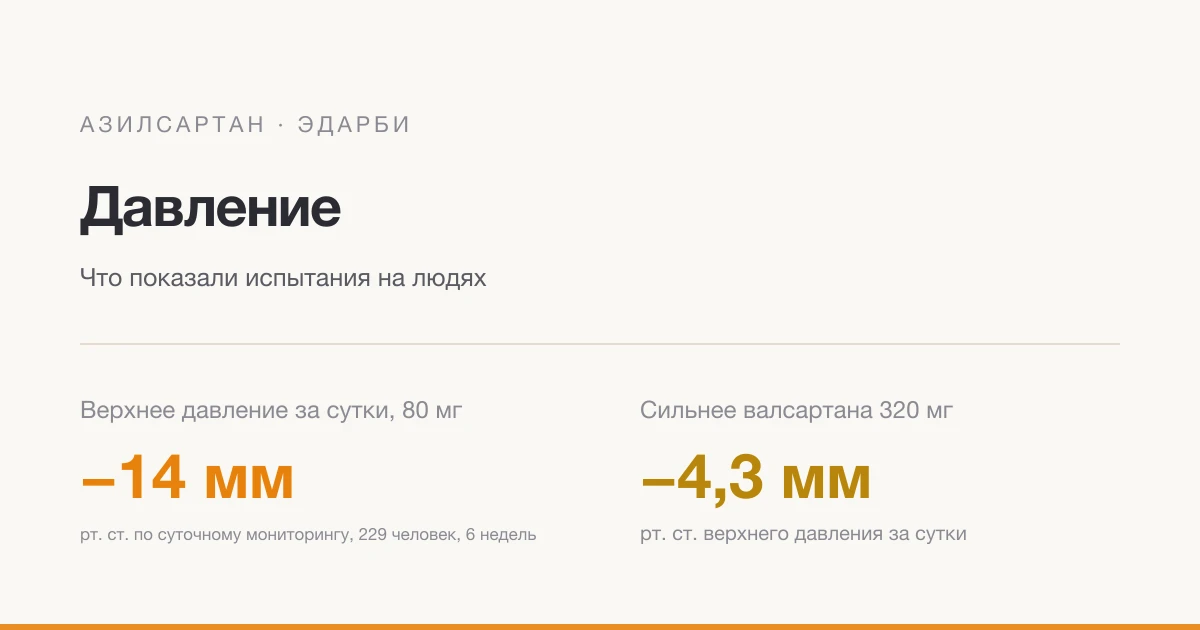
In a study of 1,291 people over 6 weeks, the 80 mg dose lowered 24-hour top blood pressure by 14.3 mm Hg more than a dummy pill.
- 229 people on the drug, 134 on a dummy pill
- More than valsartan and olmesartan
Lasts 24 hours
One tablet keeps blood pressure lower all 24 hours. The effect is nearly full at 2 weeks and full by 4 weeks.
- Side effects like on a dummy pill
- Works in long-term use too
How to take it
Usually 40 mg once a day, 80 mg if needed. At 75 and over, or with fluid loss, a doctor may start with 20 mg.
- Before or after food — no difference
- Only a doctor changes the dose
What can happen
Common: dizziness, diarrhoea. Uncommon: low blood pressure, nausea, rash, tiredness, swollen legs.
- Potassium and kidneys are checked by a blood test
- NSAID painkillers weaken the effect
Important. Important: with swelling of the face, lips or tongue — see a doctor at once.
Who should see a doctor first
Do not take azilsartan without a doctor if you have:
- pregnancy or plans for it, breastfeeding
- kidney disease, heart failure
- potassium, lithium or aliskiren use
Important. Important: high pressure with chest pain, a weak arm or trouble speaking — call an ambulance.
In one sentence
The tablet relaxes blood vessels, so blood pressure stays lower all day.
- 40 mg once a day, 80 mg if needed
- Full effect by 4 weeks
- Decision made with a doctor
Key points
| Substance | How much | What it helps with | What the studies showed |
|---|---|---|---|
| Azilsartan medoxomil (Edarbi 20, 40, 80 mg) | 40 mg once a day, 80 mg if needed; a doctor may start with 20 mg | lowers blood pressure in essential hypertension in adults, the effect lasts 24 hours | 1,291 people, 6 weeks, ambulatory monitoring: mean 24-hour systolic pressure 14.3 mm Hg lower than on placebo (229 and 134 people); valsartan 320 mg — 10.0, olmesartan 40 mg — 11.7 |
How it works
Angiotensin II is the main hormone that raises blood pressure. It narrows blood vessels, makes the adrenal glands release aldosterone and makes the kidneys hold on to sodium (Edarbi, EMA product information, section 5.1).
Azilsartan medoxomil is a prodrug. In the gut it is quickly converted to active azilsartan, which blocks the AT1 receptor. Angiotensin II has nothing to act on: the vessels relax and blood pressure falls. This is the sartan class, or angiotensin II receptor blockers (section 5.1).
Blood levels peak 1.5–3 hours after a dose, the half-life is about 11 hours and a steady level is reached in 5 days. Food does not affect absorption (section 5.2).
What the studies showed
| Study | Who took part | Comparison | Result |
|---|---|---|---|
| White 2011, double-blind randomised trial, 5 groups, 6 weeks, ambulatory blood pressure monitoring (PMID 21282560[1]; NCT00696436) | 1,291 adults with stage 1–2 hypertension, mean age 56, 54% men, baseline mean 24-hour systolic pressure 145 mm Hg | azilsartan 40 and 80 mg, valsartan 320 mg, olmesartan 40 mg, placebo | mean 24-hour systolic pressure lower than on placebo: azilsartan 80 mg by 14.3, valsartan by 10.0, olmesartan by 11.7 mm Hg; in the clinic both azilsartan doses lowered pressure more than the other sartans; tolerability like placebo |
The White 2011 trial
1,291 adults were randomly split into 5 groups. For the first 2 weeks everyone took half the dose, which was then doubled: azilsartan 20 → 40 mg or 40 → 80 mg, valsartan 160 → 320 mg, olmesartan 20 → 40 mg. The main goal was the change in mean 24-hour systolic pressure on ambulatory monitoring at 6 weeks (White WB Hypertension 2011. PMID 21282560[1]; NCT00696436).
- Azilsartan 80 mg: 24-hour systolic pressure 14.3 mm Hg and diastolic 9.4 mm Hg lower than on placebo (229 and 134 people).
- Versus valsartan 320 mg: a 4.3 mm Hg difference in favour of azilsartan 80 mg, p < 0.001 (229 and 234 people).
- Versus olmesartan 40 mg: a 2.5 mm Hg difference in favour of azilsartan 80 mg, p = 0.009 (229 and 254 people). Azilsartan 40 mg was no worse than olmesartan 40 mg: a 1.4 mm Hg difference (237 and 254 people).
- In the clinic: both azilsartan doses lowered systolic pressure more than valsartan and olmesartan; azilsartan 80 mg by 14.9 mm Hg more than placebo (270 and 148 people).
- Tolerability: similar for placebo and all four active groups.
Indications
According to the EMA label (section 4.1), Edarbi is used in adults for:
- essential (primary) hypertension — raised blood pressure without another disease that causes it.
How it is used
- Dose: 40 mg once a day. If blood pressure does not reach the target, the dose is raised to the maximum of 80 mg once a day (Edarbi, EMA product information, section 4.2).
- When a doctor may start with 20 mg: at age 75 and over if there is a risk of a sharp fall in blood pressure; in fluid or salt loss (vomiting, diarrhoea, high doses of diuretics); in mild to moderate liver disease.
- How to take it: by mouth, once a day, with or without food.
- When to expect the effect: nearly full at 2 weeks, full by 4 weeks.
- If one medicine is not enough: it is combined with diuretics (chlortalidone, hydrochlorothiazide) or calcium channel blockers; a doctor sets the plan.
Safety
- Common (1–10 in 100): dizziness, diarrhoea, raised blood CPK (Edarbi, EMA product information, section 4.8).
- Uncommon: low blood pressure, nausea, rash, itching, muscle spasms, tiredness, swollen legs, raised creatinine and uric acid. Rare: angioedema.
- Potassium may rise when combined with potassium supplements, potassium-sparing diuretics, potassium salt substitutes or heparin; anti-inflammatory painkillers (NSAIDs) weaken the effect and strain the kidneys — a doctor checks potassium and kidney function (sections 4.4 and 4.5).
- It has little effect on driving, but dizziness and tiredness occasionally occur (section 4.7).
Important
If blood pressure rises sharply with chest pain, shortness of breath, a severe headache, trouble speaking or a weak arm, call an ambulance rather than taking a new tablet.
According to the EMA label (section 4.3), azilsartan is not used:
- in allergy to the medicine;
- in the second and third trimesters of pregnancy;
- together with aliskiren in diabetes or a glomerular filtration rate below 60 mL/min/1.73 m².
Discuss it with a doctor in these cases too:
- planning a pregnancy and the first trimester: sartans are not started, and are stopped when pregnancy occurs; not recommended while breastfeeding (sections 4.4 and 4.6);
- severe kidney disease, dialysis, a recent kidney transplant, narrowed kidney arteries;
- heart failure, narrowing of the aortic or mitral valve, hypertrophic obstructive cardiomyopathy;
- severe liver disease: the medicine is not recommended;
- primary hyperaldosteronism: sartans usually do not help;
- vomiting, diarrhoea, high doses of diuretics;
- taking potassium supplements, potassium-sparing diuretics, ACE inhibitors, aliskiren or lithium;
- children and adolescents under 18: the medicine is not indicated (section 4.2).
Summary
Azilsartan is a sartan for adults with high blood pressure, one tablet a day. In a trial of 1,291 people over 6 weeks, the 80 mg dose lowered mean 24-hour systolic pressure by 14.3 mm Hg more than placebo (229 and 134 people) and more than valsartan 320 mg and olmesartan 40 mg, with tolerability like placebo. 40 mg a day, 80 mg if needed, and the decision made with a doctor, especially in pregnancy and kidney disease.
References
- White WB Hypertension 2011. PMID 21282560
Key facts
- Azilsartan medoxomil is an angiotensin II receptor blocker (a sartan). In the gut it is quickly converted to active azilsartan, which stops angiotensin II from narrowing blood vessels (Edarbi, EMA product information, section 5.1).
- The EMA indication is essential hypertension in adults (section 4.1).
- In a double-blind trial of 1,291 adults over 6 weeks, azilsartan 80 mg lowered mean 24-hour systolic pressure by 14.3 mm Hg more than placebo (229 and 134 people); valsartan 320 mg by 10.0 and olmesartan 40 mg by 11.7 mm Hg (White WB Hypertension 2011. PMID 21282560).
- Tolerability in all groups of this trial was similar to placebo (PMID 21282560).
- The usual dose is 40 mg once a day, 80 mg if needed; a doctor may start with 20 mg at age 75 and over and in fluid loss (section 4.2).